Loading...
Loading...
The civilian and federal jobs that hire Navy Navy Musicians — with real salaries and the resume that gets callbacks.
Every MU has more options than a Google search will tell you. Below: career paths, BLS salary data, federal GS series, certifications by target career, and how to translate your experience without losing what made you valuable to the Navy in the first place.
Free · No credit card · Tailored resume in under 5 minutes
After the Navy I got hired into 6 federal career fields and tech sales, and sat on federal hiring panels along the way. I spent the last 2 years rebuilding everything I learned into BMR, tuned for how AI actually screens resumes today. This is the system I wish I'd had on day one.
The Navy Musician (MU) rating is one of the smallest and most selective ratings in the fleet. You did not get here off an ASVAB line score. You got here off a live audition, performing a prepared solo and sight-reading in front of a panel that does not accept taped submissions. That single fact separates the MU from almost every other Navy job: your selection was based on demonstrated, measurable skill on a major instrument or voice, not aptitude potential.
As an MU you performed in one of the Navy's premier bands, the United States Navy Band in Washington, D.C. or the Naval Academy Band in Annapolis, or in one of the fleet bands stationed across the country and overseas. The work spanned ceremonial honors, change-of-command ceremonies, concert band, jazz and big band ensembles, popular and rock groups, and community-relations performances that double as recruiting and public-diplomacy events. You held collateral duties most musicians outside the service never touch: music librarian managing thousands of charts, band supply, operations scheduling, and public relations.
That mix is exactly why the background translates. You are a professional performer who also ran logistics, managed a library system, coordinated events with hard deadlines, and represented the Navy to the public under pressure. Civilian employers value the disciplined daily practice habit, the poise in front of a live audience, and the ability to read and execute complex material on first sight. If you are exploring options, start with the military career crosswalk tool, and if you are staying in uniform-adjacent communications work, the Navy Mass Communication Specialist (MC) and Religious Program Specialist (RP) pages cover adjacent public-facing ratings. For translating Navy terminology into resume language, the hidden military skills guide is a good first read.
Out of the 60,000-plus resumes BMR has built, the MUs we see undersell themselves the hardest. A live audition got you in, but the resume buries it under "performed at ceremonies." The win is naming the skill the way a hiring manager reads it: sight-reading is rapid pattern execution, ensemble work is real-time coordination, and your library and ops collaterals are project management. That translation is the work, not the talent. — Brad Tachi, Navy Diver veteran & BMR founder
The number that matters when you're deciding what's next: how does civilian pay compare to what you make now?
Military comp is approximate (varies by location/dependents). Civilian is BLS median. Federal includes locality pay. Your real number depends on duty station, family status, GS step, and overtime.
Be honest with yourself about the civilian music market before you bank on it. The Bureau of Labor Statistics (BLS) reports a May 2024 median hourly wage of $42.45 for musicians and singers (occupation 27-2042), but BLS does not publish a standard annual median for this group because the work is overwhelmingly part-time, freelance, and gig-based. Employment is projected to grow about 1 percent from 2024 to 2034, slower than average, though roughly 19,400 openings are projected each year, mostly from turnover. The market is geographically concentrated in performance hubs (New York, Los Angeles, Nashville, major orchestral cities), and income is irregular. A steady Navy paycheck does not exist on the other side unless you target a salaried role.
The salaried paths are where MU experience pays off most reliably:
If you want a job that uses the instrument every day, that path exists but expect to assemble income from teaching, gigs, and a part-time anchor role. If you want salary stability, lead with the director, instruction, production, or event-coordination roles above. For a wider look at where service skills land, see the highest-paying civilian jobs guide. When you are ready to put this on paper, the military resume builder is built for exactly this translation, or you can build your resume now.
| Civilian Job Title | Industry | BLS Median Salary | Outlook | Match |
|---|---|---|---|---|
Music Director / Composer / Arranger O*NET: 27-2041.00 | Performing Arts | $63,670 | 1% (Little or no change) | strong |
Musician / Singer O*NET: 27-2042.00 | Performing Arts | — | 1% (Little or no change) | strong |
Self-Enrichment / Private Music Instructor O*NET: 25-3021.00 | Education | $46,710 | 9% (Faster than average) | strong |
Broadcast, Sound, and Video Technician O*NET: 27-4012.00 | Media Production | $56,600 | 4% (As fast as average) | moderate |
Audio and Video Technician O*NET: 27-4014.00 | Media Production | $56,600 | 4% (As fast as average) | moderate |
Meeting, Convention, and Event Planner O*NET: 13-1121.00 | Hospitality | $59,440 | 8% (Faster than average) | moderate |
Music Teacher (K-12, certification required) O*NET: 25-2022.00 | Education | $62,970 | 1% (Little or no change) | moderate |
BMR rewrites your MU experience for any of the civilian roles above — keywords, achievements, and language hiring managers actually scan for.
Free · No credit card · 2 tailored resumes included
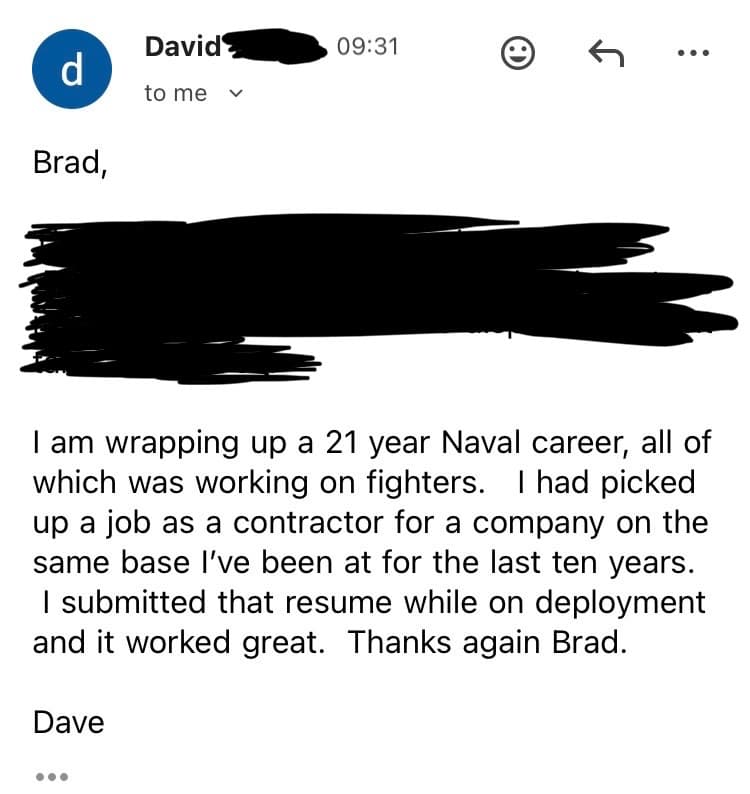
“I am wrapping up a 21 year Naval career, all of which was working on fighters. I had picked up a job as a contractor for a company on the same base I’ve been at for the last ten years. I submitted that resume while on deployment and it worked great. Thanks again Brad. Dave ”
Federal service is one of the few places a music background maps to a literal job series. The Office of Personnel Management (OPM) maintains the GS-1051 Music Specialist series for federal employees who produce, conduct, direct, arrange, or perform music within agency programs, often inside Morale, Welfare, and Recreation operations or military and government event programs. Qualification at GS-5 rests on conducting, directing, composing, arranging, orchestrating, or teaching music; grades above GS-5 require specialized experience staging or directing concerts, recitals, festivals, and clinics. Your audition-validated performance record and any ensemble-leadership time speak directly to those standards.
Beyond the music-specific series, your collateral-duty experience opens several adjacent paths:
Veterans' Preference applies across all of these, adding points to your rated score and giving you standing under hiring authorities like the Veterans Recruitment Appointment. Read the announcement carefully: the duties paragraph tells you which of your experiences to surface. The USAJOBS announcement decoder and the OPM qualification standards guide walk through how to match your record to the grade. A federal resume runs long and detailed by design. Start one with the federal resume builder, or get started here.
| GS Series | Federal Job Title | Typical Grades | Match | Explore |
|---|---|---|---|---|
| GS-0188 | Recreation Specialist | GS-7, GS-9, GS-11 | View Details → | |
| GS-1035 | Public Affairs | GS-7, GS-9, GS-11 | View Details → | |
| GS-1712 | Training Instruction | GS-7, GS-9 | View Details → | |
| GS-0301 | Miscellaneous Administration and Program | GS-7, GS-9, GS-11 | View Details → | |
| GS-1701 | General Education and Training | GS-7, GS-9 | View Details → | |
| GS-1710 | Education and Vocational Training | GS-7, GS-9 | View Details → |
Federal hiring uses keyword-matching and structured experience. BMR builds federal-format resumes (USAJobs-ready) with the right keywords, hours/week, and supervisor info — for any GS series above.
Free · No credit card · Federal + civilian resume formats included
Not everyone wants to stay in a related field. These career paths leverage your transferable skills — leadership, risk management, logistics, project planning — in completely different industries.
The ear training, breath and vocal-production knowledge, and patient repetition that define a musician map onto diagnosing and treating speech, voice, and swallowing disorders.
Capturing live speech verbatim in real time is the same rapid pattern-execution-under-pressure skill a musician uses to sight-read and perform unrehearsed material accurately on the first run.
Your community-relations performances were public diplomacy. The poise in front of an audience and the instinct for how an organization is perceived translate directly into managing public image and media.
Fundraising runs on confident public engagement and event execution. The same audience presence and community-relations instinct that drove your performances drives donor cultivation and benefit events.
Coaching newer players through sectional rehearsals is instructional design and delivery. You already know how to take a complex skill, break it down, and bring someone to standard on a schedule.
Your collateral duties, library cataloging, supply, and operations scheduling, are exactly the administrative and facilities coordination this role oversees, just under a different name.
The skills that made you a good Marine, Sailor, Airman, or Soldier transfer further than you think. BMR rewrites your bullets for any of the pivot careers above — without making you sound like you've never done the work.
Free · No credit card · Try unlimited career angles
If you are staying in music, performance, or production, skip this section. The people hiring you already speak the language of rehearsals, charts, and sectionals. This translation is for MUs targeting careers OUTSIDE music, where a hiring manager has never run a band and needs your experience in business terms.
The trap is listing what you played. The fix is naming the transferable capability underneath it. A few mappings that hold up:
Before and after, for a non-music role:
The 50 military terms translated to civilian language guide covers more of these swaps, and the Navy rating translation guide is rating-specific. To apply this to your own bullets, the military resume builder turns raw duties into civilian-readable accomplishments, or build your resume now.
BMR turns your MU duties and accomplishments into civilian bullets that match the job you're applying for — no manual translation, no rewriting.
Free · No credit card · Tailored to each job posting
Which certifications you need depends on where you're headed. Find your target career path below.
The wrong placement can sink an otherwise strong application. BMR knows where each cert ranks, what to call it, and how to frame it for ATS keyword matching and hiring manager attention.
Free · No credit card · Built around your real certs and clearance
Your next step depends on whether you are staying in music or leaving it. Both paths are below.
BMR tools: Explore career options with the military-to-civilian career crosswalk, draft a private-sector resume in the military resume builder, or build a GS application in the federal resume builder. When you are ready, build your resume now.
See also: Navy Mass Communication Specialist (MC) and Coast Guard Musician (MU) career paths. For interview preparation, informational interviews are the fastest way into the civilian music and production network.
Most veterans do this backwards — they wait until terminal leave to start, then panic. Here's the actual sequence that works.
Print this. Tape it to your monitor. Veterans who treat the transition like a 90-day op get hired faster than the ones who treat it like an emergency.
Stop rewriting from scratch every time you apply. BMR turns your military experience into civilian and federal resumes — tailored to each job.