Loading...
Loading...
The civilian and federal jobs that hire Navy Fire Control Technician (Submarine)s — with real salaries and the resume that gets callbacks.
Every FT has more options than a Google search will tell you. Below: career paths, BLS salary data, federal GS series, certifications by target career, and how to translate your experience without losing what made you valuable to the Navy in the first place.
Free · No credit card · Tailored resume in under 5 minutes
After the Navy I got hired into 6 federal career fields and tech sales, and sat on federal hiring panels along the way. I spent the last 2 years rebuilding everything I learned into BMR, tuned for how AI actually screens resumes today. This is the system I wish I'd had on day one.
If you held the FT rating, you ran the brains of the boat's weapons fight. Fire Control Technicians operate and maintain the submarine Combat Control System (CCS), the Submarine Warfare Federated Tactical System (SWFTS), Over-the-Horizon targeting, and the fire-control consoles that turn a sonar contact into a firing solution for a torpedo or a Tomahawk. This is software-driven combat systems work: building target motion analysis, maintaining tactical computers and their peripherals, troubleshooting digital electronics at sea with no depot to send a board to, and keeping a weapons-control suite mission-ready inside a steel hull.
The pipeline is real engineering. After boot camp you completed Basic Enlisted Submarine School in Groton, Connecticut, then Class "A" school and the FT specialty pipeline (roughly 18 to 24 weeks) covering electronics fundamentals, mathematics, computer theory, and fire-control systems, followed by platform "C" schools for Virginia-class, Los Angeles-class, or Ohio-class boats. The ASVAB bar is one of the highest in the Navy (line scores around AR+MK+EI+GS: 222), and the rating requires U.S. citizenship and security-clearance eligibility. That combination, advanced electronics plus a clearance plus disciplined documentation, is exactly what defense and high-reliability employers screen for.
This page is for the FT who is getting out and wants to know what that experience is actually worth on the outside. Your combat-systems electronics background is highly transferable, but only if the resume translates it out of Navy jargon. A surface-fleet equivalent exists in the FC Fire Controlman rating, and the closest same-boat ratings are the STS Sonar Technician (Submarine) and the ET Electronics Technician. Start mapping your skills with the military career crosswalk.
When I separated from the Navy I spent 18 months applying with no callbacks. The work was never the problem. The way I described it was. FTs get bitten by this harder than almost anyone, because "submarine fire control" reads like a weapons job to a civilian recruiter when it is really advanced electronics, software-driven systems, and troubleshooting under pressure. Translate it right and the same experience that ran a combat control system runs a calibration lab or a nuclear control room. That translation is what costs callbacks, not your skill set. — Brad Tachi, Navy Diver veteran & BMR founder
The number that matters when you're deciding what's next: how does civilian pay compare to what you make now?
Military comp is approximate (varies by location/dependents). Civilian is BLS median. Federal includes locality pay. Your real number depends on duty station, family status, GS step, and overtime.
The most direct civilian matches for FTs sit in electronics and instrumentation technician roles, where your hands-on troubleshooting of digital systems transfers almost without retraining. The U.S. Bureau of Labor Statistics (BLS) Occupational Employment and Wage Statistics (OEWS) program is the source for every salary below.
Electrical and electronic engineering technologists and technicians (BLS, May 2024) had a median wage of $77,180. This is the closest one-to-one to console maintenance and systems test work. Avionics technicians sit even higher at a $81,390 median (BLS, May 2024), and aerospace and defense employers actively recruit submarine electronics backgrounds for them. Calibration technologists and technicians had a $65,040 median (BLS, May 2024), a strong fit for anyone who lived in test equipment and precision measurement aboard the boat.
Field service and commercial-industrial repair is another live lane. Electrical and electronics installers and repairers had a $71,270 median (BLS OOH, May 2024), covering field service engineers who install and maintain complex electronic systems at customer sites. Defense primes that build combat and weapons-control systems, the same hardware lineage you maintained, hire heavily into integration, test, and depot roles.
Be honest with yourself about geography. The richest concentration of defense electronics work clusters around shipyards and primes: Groton and the Connecticut shoreline, Hampton Roads, Newport News, San Diego, Kings Bay, and the Puget Sound. Calibration and field-service roles are more evenly spread because every manufacturer needs them. If you are open to relocating toward a defense corridor, your clearance plus combat-systems pedigree is a genuine premium. For a broader pay comparison across ratings, see what your MOS is worth in civilian salary data, and the same combat-systems employers also recruit Air Force avionics test-station technicians. When you are ready to put it on paper, the military resume builder structures the bullets, or you can build your resume now.
| Civilian Job Title | Industry | BLS Median Salary | Outlook | Match |
|---|---|---|---|---|
Electrical and Electronics Engineering Technician O*NET: 17-3023.00 | Defense & Electronics | $77,180 | Little or no change projected (BLS) | strong |
Avionics Technician O*NET: 49-2091.00 | Aerospace & Defense | $81,390 | 4% (As fast as average) | strong |
Calibration Technologist and Technician O*NET: 17-3028.00 | Manufacturing & Test | $65,040 | Faster than average (BLS) | strong |
Electrical and Electronics Repairer, Commercial and Industrial Equipment O*NET: 49-2094.00 | Field Service | $71,270 | Little or no change projected (BLS) | strong |
Electronics Engineering Technologist O*NET: 17-3023.01 | Defense Systems Integration | $77,180 | Little or no change projected (BLS) | strong |
Field Service Engineer (Electronic Systems) O*NET: 49-2094.00 | Industrial Electronics | $71,270 | Little or no change projected (BLS) | moderate |
Electronics Test Technician O*NET: 17-3028.00 | Manufacturing | $65,040 | Faster than average (BLS) | moderate |
Aircraft Electronics (Avionics) Inspector O*NET: 49-2091.00 | Aerospace & Defense | $81,390 | 4% (As fast as average) | moderate |
BMR rewrites your FT experience for any of the civilian roles above — keywords, achievements, and language hiring managers actually scan for.
Free · No credit card · 2 tailored resumes included
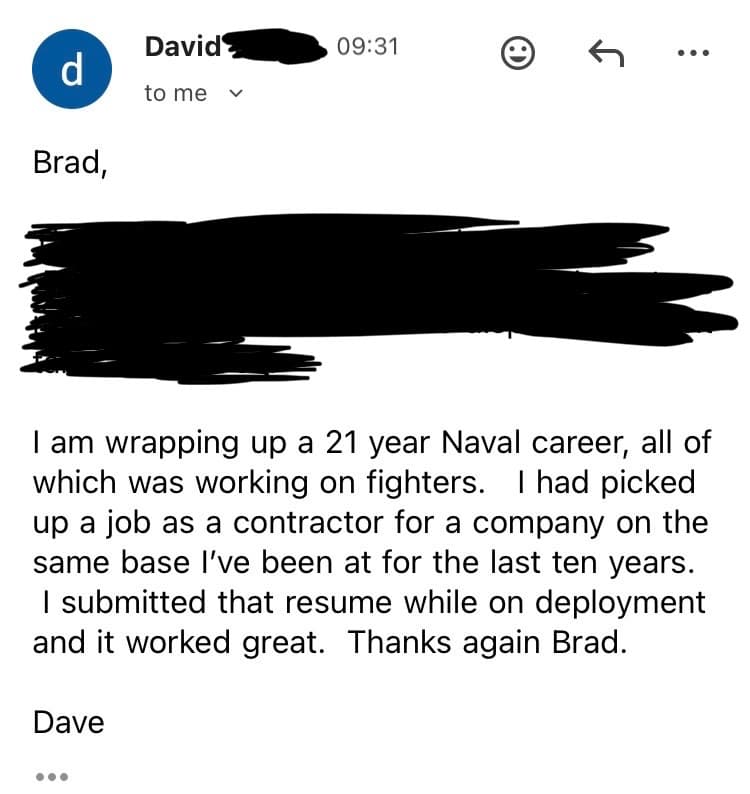
“I am wrapping up a 21 year Naval career, all of which was working on fighters. I had picked up a job as a contractor for a company on the same base I’ve been at for the last ten years. I submitted that resume while on deployment and it worked great. Thanks again Brad. Dave ”
Federal service rewards the FT skill set in a way the private market sometimes misses, because the government already speaks the language of systems, configuration management, and documented maintenance. The strongest target is the GS-0856 Electronics Technician series, which maps directly to console and combat-systems maintenance. Transitioning FTs with solid documentation commonly qualify at GS-7 through GS-11 depending on watch-station qualifications and supervisory time.
The GS-0802 Engineering Technician series fits test, integration, and in-service engineering support at NUWC Newport, NUWC Keyport, and the regional maintenance centers. For sailors who leaned into the software and tactical-computer side of SWFTS, the GS-2210 Information Technology Management series and the GS-0854 Computer Engineering series open systems-administration and embedded-systems roles. The GS-0855 Electronics Engineering series is reachable with an engineering degree, and several FTs use tuition assistance and the GI Bill to bridge into it. Quality and configuration backgrounds map to the GS-1910 Quality Assurance series at shipyards and depots.
Veterans' Preference adds 5 or 10 points to your rated score and, for many positions, lets you compete under special hiring authorities such as VEOA and VRA. The catch is that USAJobs resumes are graded against the published qualification standard line by line, so a private-sector one-pager will sink your application. Detail every system, every grade of maintenance, and every watch qualification. The federal resume builder is built for that length and structure, and ratings that share these series, including the ET Electronics Technician and the ITS Information Systems Technician (Submarine), compete for the same billets. New to USAJobs? Start by reading how your clearance status carries after separation, then start your federal resume.
| GS Series | Federal Job Title | Typical Grades | Match | Explore |
|---|---|---|---|---|
| GS-0802 | Engineering Technician | GS-7, GS-9, GS-11 | View Details → | |
| GS-0856 | Electronics Technician | GS-9, GS-11, GS-12 | View Details → | |
| GS-0854 | Computer Engineering | GS-9, GS-11, GS-12 | View Details → | |
| GS-2210 | Information Technology Management | GS-9, GS-11, GS-12 | View Details → | |
| GS-0855 | Electronics Engineering | GS-7, GS-9, GS-11 | View Details → | |
| GS-1910 | Quality Assurance | GS-7, GS-9, GS-11 | View Details → |
Federal hiring uses keyword-matching and structured experience. BMR builds federal-format resumes (USAJobs-ready) with the right keywords, hours/week, and supervisor info — for any GS series above.
Free · No credit card · Federal + civilian resume formats included
Not everyone wants to stay in a related field. These career paths leverage your transferable skills — leadership, risk management, logistics, project planning — in completely different industries.
Utilities prize the exact watch-standing temperament FTs built: calm, procedure-driven operation of a system where a mistake is unforgiving. The submarine watch culture maps cleanly onto a reactor control room.
Hospitals run on electronics that cannot fail, and an FT who kept combat systems alive at sea is exactly the troubleshooter biomedical departments hire. The diagnostic discipline transfers directly.
Nuclear technicians run the instrumentation and monitoring that an FT already understands from maintaining precision electronic systems and reading data under strict protocols.
Modern factories run mechatronic lines that blend electronics, software and machinery, the same mix an FT handled on a fire-control suite. The cross-disciplinary troubleshooting is the differentiator.
Running a freight or passenger locomotive rewards the same procedural, safety-first discipline a submarine watch demanded. Railroads actively recruit veterans for the temperament.
FTs lived inside configuration control and documented maintenance, which is the heart of quality inspection. The instinct to verify against a standard and record it is already trained.
The skills that made you a good Marine, Sailor, Airman, or Soldier transfer further than you think. BMR rewrites your bullets for any of the pivot careers above — without making you sound like you've never done the work.
Free · No credit card · Try unlimited career angles
If you are staying in electronics, instrumentation, or defense systems, your terminology already translates. Calibration labs, avionics shops, and defense integrators use words like "fault isolation" and "configuration item" every day. This section is for FTs targeting careers OUTSIDE combat-systems electronics, where a hiring manager has never heard of SWFTS and will not look it up.
The goal is to keep the substance and drop the acronym. A recruiter for a hospital's biomedical department or a manufacturer's maintenance team needs to see measurable systems work, not a Navy weapons billet.
| Military term | Civilian translation |
|---|---|
| Combat Control System (CCS) operator/maintainer | Mission-critical electronic systems technician |
| Organizational and intermediate-level maintenance | Tiered preventive and corrective maintenance |
| Target motion analysis / fire-control solution | Real-time data analysis and decision support |
| Casualty / fault isolation at sea | Field troubleshooting without depot support |
| SWFTS / tactical computer suite | Networked, software-driven control system |
Before: "Operated and maintained submarine Combat Control System and SWFTS, performed organizational and intermediate-level maintenance on fire-control consoles."
After (for a biomedical or industrial controls role): "Maintained a networked, software-driven control system valued in the tens of millions, performing tiered preventive and corrective maintenance and isolating faults to the component level with zero depot support, sustaining 99%+ system availability."
For more before-and-after patterns, see the 50 military terms translated to civilian language and hidden military skills civilians do not know you have. The military resume builder applies this translation automatically, or you can build your resume now.
BMR turns your FT duties and accomplishments into civilian bullets that match the job you're applying for — no manual translation, no rewriting.
Free · No credit card · Tailored to each job posting
Which certifications you need depends on where you're headed. Find your target career path below.
The wrong placement can sink an otherwise strong application. BMR knows where each cert ranks, what to call it, and how to frame it for ATS keyword matching and hiring manager attention.
Free · No credit card · Built around your real certs and clearance
SkillBridge is the highest-leverage move you can make before your EAOS. Defense primes and electronics manufacturers run programs that convert directly into offers, and a clearance plus combat-systems background makes you a priority candidate. Read the SkillBridge guide to landing a job before you separate and the SkillBridge programs by industry list. For credentialing, Navy COOL funds many electronics and IT exams while you are still in. Professional associations worth tracking include the Electronics Technicians Association International (ETA-I) and ISA for instrumentation and control.
If you are done with weapons systems entirely, your clearance is still an asset and your troubleshooting discipline transfers to healthcare, energy, manufacturing, and rail. American Corporate Partners (ACP) offers free veteran mentorship to map an outside-field move. A clearance carries measurable salary weight, covered in how much a Top Secret clearance is worth in salary and defense contractor jobs that reward a clearance.
Build a private-sector resume with the military resume builder or a USAJobs version with the federal resume builder. Explore adjacent ratings with the career crosswalk, and use the official TAP transition resources. When you are ready, build your resume now.
See also: FC Fire Controlman (surface), STS Sonar Technician (Submarine), and AT Aviation Electronics Technician.
Most veterans do this backwards — they wait until terminal leave to start, then panic. Here's the actual sequence that works.
Print this. Tape it to your monitor. Veterans who treat the transition like a 90-day op get hired faster than the ones who treat it like an emergency.
Stop rewriting from scratch every time you apply. BMR turns your military experience into civilian and federal resumes — tailored to each job.