Loading...
Loading...
The civilian and federal jobs that hire Navy Information Systems Technician (Submarine)s — with real salaries and the resume that gets callbacks.
Every ITS has more options than a Google search will tell you. Below: career paths, BLS salary data, federal GS series, certifications by target career, and how to translate your experience without losing what made you valuable to the Navy in the first place.
Free · No credit card · Tailored resume in under 5 minutes
After the Navy I got hired into 6 federal career fields and tech sales, and sat on federal hiring panels along the way. I spent the last 2 years rebuilding everything I learned into BMR, tuned for how AI actually screens resumes today. This is the system I wish I'd had on day one.
If you held the ITS rating, you ran the radio room and network of a submarine submerged for weeks at a time, with no help desk to call and no IT shop down the hall. You operated and maintained the boat's exterior communications suite: VLF and ELF buoyant-cable receivers, HF and UHF radio, and SATCOM links that only work in a narrow window when the boat is at periscope depth or has a mast raised. When that window opens, the traffic has to move fast and clean, because the boat goes back under and the link is gone.
The work was never just "IT." You handled COMSEC and crypto keying material under two-person integrity, loaded and zeroized cryptographic equipment, processed record message traffic through the broadcast, and administered the submarine LAN and tactical systems that the whole crew depended on. You did it in a sealed steel tube where a network outage or a comms failure is not a ticket, it is a mission problem. That is a level of ownership most civilian network and comms professionals never experience.
The training pipeline backs this up. After boot camp you completed roughly nine weeks of Basic Enlisted Submarine School in Groton, Connecticut, then about 25 weeks of ITS "A" school covering submarine exterior communications, network administration, cybersecurity fundamentals, and cryptographic systems. Many ITS Sailors carried a Top Secret/SCI clearance and earned IT and cyber credentials through Navy COOL along the way. In late 2023 the Navy realigned the ITS rating into specialized communications, cyber, and electronic-warfare service ratings, but the submarine comms, network, and crypto skill set you built is exactly what civilian employers in secure communications and network infrastructure are hiring for.
Civilian employers value this background because it is rare. Plenty of people can configure a switch. Very few have run SATCOM and RF links, defended a network, and accounted for cryptographic material in an environment where there is no fallback. If you are staying technical, our Navy IT Information Systems Technician and Electronics Technician pages cover adjacent paths, and you can explore the full military-to-civilian career crosswalk to see where the rating maps. For the language that makes recruiters take notice, start with breaking into tech without a degree.
After my Navy time I pivoted into tech sales, and ITS is one of the more underrated backgrounds for that move. You ran SATCOM links, secure comms, and network gear in the hardest environment there is. When you sit across from an engineering buyer for a comms or network vendor, you can talk about latency, link budgets, and crypto handling from real watches, not a slide deck. That technical credibility is what closes deals, and it opens doors at companies selling network gear, secure communications, and SATCOM services. — Brad Tachi, Navy Diver veteran & BMR founder
The number that matters when you're deciding what's next: how does civilian pay compare to what you make now?
Military comp is approximate (varies by location/dependents). Civilian is BLS median. Federal includes locality pay. Your real number depends on duty station, family status, GS step, and overtime.
The submarine communications and network background opens several civilian paths, and the salary picture is solid. All figures below are BLS Occupational Employment and Wage Statistics (OEWS) medians, May 2024.
Network and infrastructure roles. Network and computer systems administrators earn a median of $95,360 (BLS OEWS May 2024), and computer network architects $130,390. Your submarine LAN administration and tactical-network experience maps here directly. The honest caveat: many postings list a degree or specific certifications, so a CompTIA Network+ or a Cisco CCNA shortens the path and signals to a hiring manager that your military networking translates.
Telecommunications and RF. Telecommunications equipment installers and repairers earn a median of $63,200 (BLS OEWS May 2024). This is where your RF, antenna, and SATCOM line maintenance experience lands without much retraining. Demand is steady in coastal and metro markets and around satellite ground stations and maritime communications providers.
Cybersecurity. Information security analysts earn a median of $124,910 (BLS OEWS May 2024), and BLS projects 33% growth through 2033, far faster than average. Your COMSEC handling, security-controls implementation, and defensive-monitoring watches give you a real foundation. A Security+ certification is the common entry credential. See our guide to cybersecurity jobs veterans can land without a degree.
Field and depot technician roles. Electrical and electronics repairers of commercial and industrial equipment earn a median of $67,180 (BLS OEWS May 2024). Defense electronics firms and satellite providers hire submarine-trained technicians for radio room and antenna system work because the equipment families overlap.
Geography matters. Secure-comms and SATCOM employers cluster near coasts, satellite ground stations, and defense corridors in Virginia, Maryland, San Diego, Colorado, and the Gulf Coast. If you would rather sell the technology than maintain it, the same credibility supports a move into network and cyber operations sales roles. When you are ready to put this on paper, our military resume builder structures it for civilian hiring managers, or you can build your resume now.
| Civilian Job Title | Industry | BLS Median Salary | Outlook | Match |
|---|---|---|---|---|
Network and Computer Systems Administrator O*NET: 15-1244.00 | Information Technology | $95,360 | Little or no change (BLS 2023-33) | strong |
Telecommunications Equipment Installer and Repairer O*NET: 49-2022.00 | Telecommunications | $63,200 | Decline (BLS 2023-33) | strong |
Information Security Analyst O*NET: 15-1212.00 | Cybersecurity | $124,910 | 33% (Much faster than average) | strong |
Computer Network Architect O*NET: 15-1241.00 | Information Technology | $130,390 | 13% (Much faster than average) | moderate |
Electrical and Electronics Repairer, Commercial and Industrial Equipment O*NET: 49-2094.00 | Defense Electronics | $67,180 | 2% (Slower than average) | moderate |
Computer Network Support Specialist O*NET: 15-1231.00 | Information Technology | $72,610 | 7% (Faster than average) | strong |
Radio, Cellular, and Tower Equipment Installer and Repairer O*NET: 49-2021.00 | Telecommunications | $61,310 | Little or no change (BLS 2023-33) | moderate |
BMR rewrites your ITS experience for any of the civilian roles above — keywords, achievements, and language hiring managers actually scan for.
Free · No credit card · 2 tailored resumes included
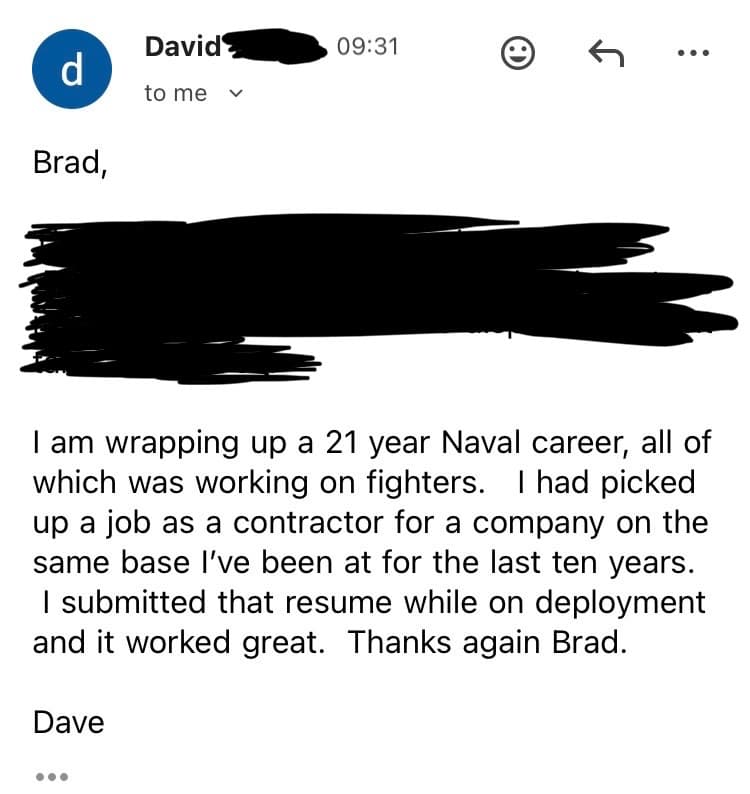
“I am wrapping up a 21 year Naval career, all of which was working on fighters. I had picked up a job as a contractor for a company on the same base I’ve been at for the last ten years. I submitted that resume while on deployment and it worked great. Thanks again Brad. Dave ”
Federal service is one of the strongest landing spots for an ITS, because the government runs the same secure-comms and network environments you already know, and your clearance carries real weight there. These are the General Schedule (GS) series worth targeting, with qualification context.
GS-2210 Information Technology Management. The core IT series, covering network services, systems administration, and information security specialties. Submarine LAN and tactical-network experience qualifies you, typically at the GS-7 to GS-11 entry band depending on time in rate and education. This series staffs Navy commands, DISA, and nearly every DoD component.
GS-0391 Telecommunications. A direct match for radio room and exterior-communications work. This series covers planning, installing, and operating telecommunications systems, including satellite and RF links. Your hands-on SATCOM and HF experience is the specialized experience these positions ask for.
GS-0855 Electronics Engineering and GS-0856 Electronics Technician. The 0856 series fits radio, antenna, and communications-equipment maintenance directly. The 0855 engineering series is reachable with the right degree and is worth noting if you used the GI Bill for an electronics or EE program.
GS-0080 Security Administration. Your COMSEC custodianship, two-person integrity, and crypto material accountability map to information and communications security roles. Few applicants arrive with documented crypto-handling experience, which makes this a quieter but strong target.
GS-0343 Management and Program Analyst. A path into program oversight of communications and IT efforts, useful if you supervised a radio division or managed maintenance programs at sea.
Veterans' Preference adds 5 or 10 points to your rating and can shift you ahead of non-veteran applicants. The federal resume is its own format, far longer and more detailed than a private-sector one. Our federal resume builder handles the structure, and you can read how a clearance translates in what a Top Secret clearance is worth. Army 25B Information Technology Specialists target the same GS-2210 series, so their federal path overlaps with yours.
| GS Series | Federal Job Title | Typical Grades | Match | Explore |
|---|---|---|---|---|
| GS-0391 | Telecommunications | GS-7, GS-9, GS-11 | View Details → | |
| GS-2210 | Information Technology Management | GS-9, GS-11, GS-12 | View Details → | |
| GS-0856 | Electronics Technician | GS-7, GS-9, GS-11 | View Details → | |
| GS-0080 | Security Administration | GS-7, GS-9, GS-11 | View Details → | |
| GS-0855 | Electronics Engineering | GS-7, GS-9, GS-11 | View Details → | |
| GS-0343 | Management and Program Analyst | GS-9, GS-11, GS-12 | View Details → | |
| GS-1550 | Computer Science | GS-7, GS-9, GS-11 | View Details → |
Federal hiring uses keyword-matching and structured experience. BMR builds federal-format resumes (USAJobs-ready) with the right keywords, hours/week, and supervisor info — for any GS series above.
Free · No credit card · Federal + civilian resume formats included
Not everyone wants to stay in a related field. These career paths leverage your transferable skills — leadership, risk management, logistics, project planning — in completely different industries.
Submarine radio room work is electronics and RF at its core. Aircraft communication and navigation systems use the same diagnostic mindset, and your habit of fixing comms gear with no outside help is exactly what flight-line work rewards.
Reading a sonar or RF return and reading an ultrasound image both reward someone who can sit on a console for hours and catch the signal that matters. The watch-stander discipline transfers cleanly to imaging.
You ran communications when a missed transmission was a real problem and no one was coming to help. Emergency dispatch is the same job in a different uniform: stay calm, move the right traffic fast, keep the log clean.
Broadcast engineering is RF, transmission lines, and live signal management, the same family of work you did in the radio room. When a station goes off the air, the fix-it-now instinct from underway casualties is exactly what is needed.
Survey crews run GPS receivers, electronic distance meters, and data collectors in the field, the kind of precise, instrument-driven work you did with comms and navigation gear. The attention to exact readings is the same.
PV systems are electrical wiring, inverters, and commissioning checks, and the by-the-book electrical discipline you used loading crypto gear and maintaining shipboard systems transfers directly. The field is growing fast.
The skills that made you a good Marine, Sailor, Airman, or Soldier transfer further than you think. BMR rewrites your bullets for any of the pivot careers above — without making you sound like you've never done the work.
Free · No credit card · Try unlimited career angles
If you are staying in submarine-adjacent or military communications work, your terminology already translates, because defense and SATCOM employers use the same language. This section is for ITS veterans targeting careers OUTSIDE of submarine communications, where a hiring manager has never heard your rating and will not decode the jargon for you.
The fix is to describe the function and the scale, not the acronym. Here are real ITS terms rewritten for a civilian recruiter, with before-and-after resume bullets.
"Stood radio watch and processed message traffic" becomes operating and monitoring mission-critical communications systems with measured throughput and uptime.
"COMSEC custodian" becomes accountable management of controlled cryptographic and security material.
"Administered the submarine LAN" becomes network administration with quantified user and uptime impact.
The pattern is the same every time: name the function in business terms, then attach a number. For more before-and-after examples, see 50 military terms translated to civilian language and hidden military skills civilians do not know you have. Our military resume builder applies this translation automatically.
BMR turns your ITS duties and accomplishments into civilian bullets that match the job you're applying for — no manual translation, no rewriting.
Free · No credit card · Tailored to each job posting
Which certifications you need depends on where you're headed. Find your target career path below.
The wrong placement can sink an otherwise strong application. BMR knows where each cert ranks, what to call it, and how to frame it for ATS keyword matching and hiring manager attention.
Free · No credit card · Built around your real certs and clearance
If you are keeping the technical track, lean on credentials that civilian employers already recognize. The Navy COOL program funds many of these while you are still in. CompTIA Security+ and Network+ are the baseline that gets a resume past automated screening. A Cisco CCNA backs up your network claims. For radio and SATCOM-heavy roles, look at the iNARTE and ETA International technician credentials. SkillBridge can place you in a comms or network role for your final months of service. See SkillBridge eligibility and timeline and the cybersecurity certifications guide.
If you are leaving the field, your clearance and leadership are the assets to lead with. A Project Management Professional (PMP) credential opens operations and program roles. For sales-track moves, your technical depth is the differentiator. American Corporate Partners (ACP) offers free one-on-one veteran mentorship to help you map the jump. Confirm your clearance status early using our guide to clearance status after separation.
Start with the military resume builder for private-sector roles or the federal resume builder for GS positions. Explore options with the career crosswalk, and use your TAP resources while you still have them. When you are ready, build your resume now.
Related ratings and roles: Navy CTN Cryptologic Technician Networks, Air Force Cyber Transport Systems, and Coast Guard Information Systems Technician.
Most veterans do this backwards — they wait until terminal leave to start, then panic. Here's the actual sequence that works.
Print this. Tape it to your monitor. Veterans who treat the transition like a 90-day op get hired faster than the ones who treat it like an emergency.
Stop rewriting from scratch every time you apply. BMR turns your military experience into civilian and federal resumes — tailored to each job.