Loading...
Loading...
The civilian and federal jobs that hire Air Force Data Engineerings — with real salaries and the resume that gets callbacks.
Every 1D7X4 has more options than a Google search will tell you. Below: career paths, BLS salary data, federal GS series, certifications by target career, and how to translate your experience without losing what made you valuable to the Air Force in the first place.
Free · No credit card · Tailored resume in under 5 minutes
After the Navy I got hired into 6 federal career fields and tech sales, and sat on federal hiring panels along the way. I spent the last 2 years rebuilding everything I learned into BMR, tuned for how AI actually screens resumes today. This is the system I wish I'd had on day one.
If you worked as a 1D7X4 Data Engineering Airman, you spent your enlistment doing the unglamorous work that every modern Air Force mission quietly depends on: moving data from where it was generated to where decisions get made, and making sure it arrived clean. This is the data-engineering shred inside the 1D7XX Cyberspace family, stood up when the legacy 1D7X1P data operations role was realigned in 2025. It is a distinct discipline from cyber defense (1D7X1) and cybersecurity (1D7X5). You were not chasing intrusions or hardening firewalls. You were building and operating the pipelines, databases, and data platforms underneath everything else.
Day to day, 1D7X4 work meant designing data models and data flows, building ETL and data-integration pipelines, standing up and tuning relational and non-relational databases, and maintaining the data infrastructure that analysts, operators, and AI applications pull from. You enforced data quality, governance, and access controls so a downstream analyst was not making a call on a corrupted feed. In a defense environment that means honoring strict separation between classification levels and guaranteeing no data ever lands on a system below its classification. That is a level of data-integrity discipline most civilian engineers never have to practice.
Civilian employers value this background because the hard part of data engineering is not the syntax. It is the judgment: knowing how to design a pipeline that survives messy upstream sources, how to model data so it answers real questions, and how to keep a platform trustworthy at scale. That judgment is exactly what you built. If you want to see how your specialty connects to other technical Air Force roles, the 1D7X1 Cyber Defense Operations and 1D7X5 Cybersecurity pages cover the security side of the house, and the military career crosswalk maps where every specialty leads. For a wider look at the field, our guide to tech careers for veterans without a degree is a useful starting point.
BMR has built more than 60,000 resumes across every branch and specialty, and 1D7X4 data engineers are some of the most under-sold transitions I see. The work is genuinely senior, building production pipelines and owning data quality on classified systems, but the resumes read like a list of tools instead of a record of platforms you kept trustworthy. Translate the judgment, not the tech stack, and the offers follow. — Brad Tachi, Navy Diver veteran & BMR founder
The number that matters when you're deciding what's next: how does civilian pay compare to what you make now?
Military comp is approximate (varies by location/dependents). Civilian is BLS median. Federal includes locality pay. Your real number depends on duty station, family status, GS step, and overtime.
Data engineering is one of the strongest-paying lanes in the civilian tech market, and the 1D7X4 skill set lines up with the highest-demand roles. The figures below are BLS Occupational Employment and Wage Statistics (OEWS) medians from May 2024.
Database Administrator and Architect roles (BLS median $104,620) are the closest civilian mirror of the database build-and-tune work you already did. Computer Systems Analyst roles (median $103,790) reward your ability to map data flows to mission requirements, the same modeling work you did when you designed a system''s interfaces and infrastructure. Data Scientist positions (median $112,590) are within reach if you lean into the analytics side, and Software Developer roles (median $133,080) open up if your pipeline work involved heavy custom code. BLS does not yet break out "data engineer" as its own occupation code, so most data-engineering listings sit under software developers, database administrators, or computer systems analysts depending on the employer.
Be realistic about the market. Hiring is strongest for engineers who can show production pipelines and cloud data platforms (AWS, Azure, GCP) rather than coursework. The cleared corner of the market is its own advantage: defense contractors and federal integrators pay a premium for engineers who already hold a clearance and understand classified data handling, and that demand is steadier than the commercial tech cycle. If you are weighing the cleared route, our breakdown of what a security clearance is worth in salary is worth reading.
Other branches run parallel data and IT specialties, and their veterans compete for the same civilian roles. If you are comparing notes, see the Army 25B Information Technology Specialist, Marine Corps 0671 Data Systems Administrator, and Navy ITN Information Systems Technician (Network) pages. When you are ready to put your pipeline work on paper, the military resume builder is built to translate technical roles, or you can build your resume now.
| Civilian Job Title | Industry | BLS Median Salary | Outlook | Match |
|---|---|---|---|---|
Database Administrator and Architect O*NET: 15-1242.00 | Information Technology | $104,620 | 9% (Faster than average) | strong |
Computer Systems Analyst O*NET: 15-1211.00 | Information Technology | $103,790 | 10% (Faster than average) | strong |
Data Scientist O*NET: 15-2051.00 | Information Technology | $112,590 | 36% (Much faster than average) | strong |
Software Developer O*NET: 15-1252.00 | Information Technology | $133,080 | 17% (Much faster than average) | moderate |
Computer Programmer O*NET: 15-1251.00 | Information Technology | $98,670 | -10% (Decline) | moderate |
Operations Research Analyst O*NET: 15-2031.00 | Analytics | $91,290 | 23% (Much faster than average) | moderate |
Statistician O*NET: 15-2041.00 | Analytics | $103,300 | 11% (Much faster than average) | moderate |
BMR rewrites your 1D7X4 experience for any of the civilian roles above — keywords, achievements, and language hiring managers actually scan for.
Free · No credit card · 2 tailored resumes included
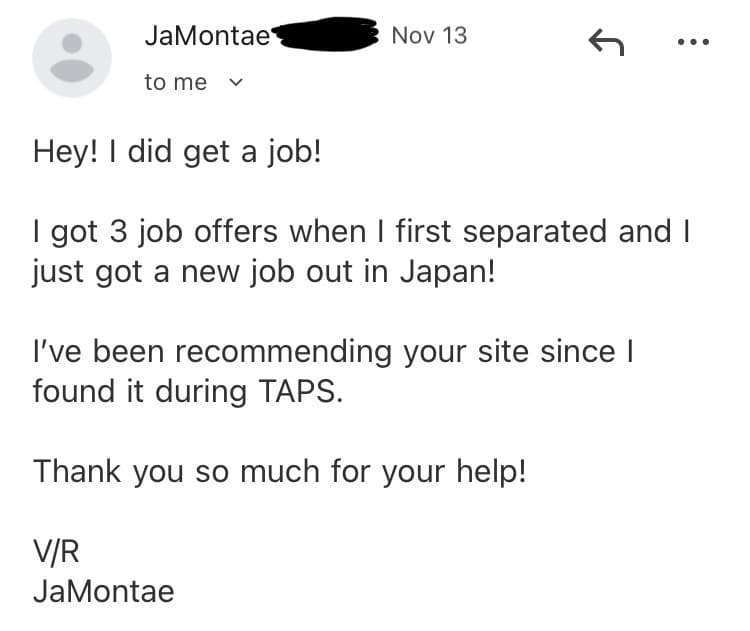
“Hey! I did get a job! I got 3 job offers when I first separated and I just got a new job out in Japan! I’ve been recommending your site since I found it during TAPS. Thank you so much for your help! V/R JaMontae ”
Federal service is one of the most direct destinations for a 1D7X4 background, partly because the federal government runs some of the largest data platforms in the country and partly because your security clearance and classified-data experience carry over without retraining.
The anchor series is GS-2210 Information Technology Management, which covers data management, applications software, and systems administration specialties. Data-engineering work maps cleanly to the data management and systems specialties within GS-2210, typically entering at GS-9 through GS-12 depending on experience and education. The newer GS-1560 Data Science series was created specifically for roles that build and exploit data at scale, and it is the best long-term home for engineers who want analytics depth. GS-1550 Computer Science fits engineers whose pipeline work is code-heavy, and GS-0854 Computer Engineering applies if you worked at the hardware-and-systems layer.
Beyond the pure-IT series, your ability to turn data into answers qualifies you for GS-0343 Management and Program Analyst (analytics and process work), GS-1530 Statistician and GS-1515 Operations Research (quantitative analysis), and GS-1529 Mathematical Statistician for the most technical statistical roles. Each has its own OPM qualification standard, so check the specific vacancy.
Veterans'' Preference adds 5 or 10 points to your rated score on competitive-service jobs, and many data and IT roles are filled through direct-hire authorities that move faster than the standard process. Our guide to leveraging a clearance on a federal resume and the 10-point Veterans'' Preference breakdown walk through how to claim what you have earned. A federal resume runs long and reads differently from a private-sector one, so use the federal resume builder built for USAJobs, or start your federal resume here.
| GS Series | Federal Job Title | Typical Grades | Match | Explore |
|---|---|---|---|---|
| GS-1560 | Data Science | GS-11, GS-12, GS-13 | View Details → | |
| GS-2210 | Information Technology Management | GS-9, GS-11, GS-12 | View Details → | |
| GS-1550 | Computer Science | GS-9, GS-11, GS-12 | View Details → | |
| GS-0854 | Computer Engineering | GS-9, GS-11, GS-12 | View Details → | |
| GS-1530 | Statistician | GS-9, GS-11, GS-12 | View Details → | |
| GS-1515 | Operations Research | GS-11, GS-12, GS-13 | View Details → | |
| GS-0343 | Management and Program Analyst | GS-9, GS-11, GS-12 | View Details → |
Federal hiring uses keyword-matching and structured experience. BMR builds federal-format resumes (USAJobs-ready) with the right keywords, hours/week, and supervisor info — for any GS series above.
Free · No credit card · Federal + civilian resume formats included
Not everyone wants to stay in a related field. These career paths leverage your transferable skills — leadership, risk management, logistics, project planning — in completely different industries.
Actuarial work is risk pricing built on rigorous data modeling and validation, which is the same quantitative discipline a data engineer applies to keep a platform trustworthy. The bar is statistical judgment, not insurance knowledge.
The core of market research is consolidating fragmented data into a clear answer for a business question, which is exactly the consolidation and quality work data engineers do every day. The subject changes; the skill does not.
Modern planning runs on integrating census, zoning, transportation, and GIS data into models that inform public decisions. A data engineer who can stitch messy sources into a coherent picture has the hard half of the job already.
Clinical research lives or dies on data integrity and reproducible workflows, the same rigor a data engineer applies on classified systems. Statisticians in pharma value engineers who already think in terms of clean, auditable data.
Commercial logistics firms hire operations research analysts to model routing, inventory, and throughput from operational data feeds. The pipeline-and-modeling combination a data engineer brings is the rare part of that skill set.
Management consulting rewards people who can pull signal from messy organizational data and present a clear recommendation. A data engineer's habit of structuring data to answer real questions transfers directly.
The skills that made you a good Marine, Sailor, Airman, or Soldier transfer further than you think. BMR rewrites your bullets for any of the pivot careers above — without making you sound like you've never done the work.
Free · No credit card · Try unlimited career angles
If you are staying in data engineering or a database role, your terminology already translates. Hiring managers at tech firms and defense integrators know what ETL, a data pipeline, and a data warehouse are. This section is for 1D7X4 Airmen targeting careers outside core data engineering, where a civilian reader has no idea what your acronyms mean.
The trap is listing the mission instead of the result. A line like "operated AF data systems" tells a non-technical hiring manager nothing. The fix is to name the business outcome your data work produced. Here are translations that work for analyst, planning, and consulting roles:
Notice the pattern: lead with what the data enabled, not the tool you used. For a deeper reference, our glossary of 50 military terms translated to civilian language covers the most common offenders, and the guide to explaining military experience in a civilian interview helps you do the same out loud. The military resume builder handles this translation automatically, or you can get started here.
BMR turns your 1D7X4 duties and accomplishments into civilian bullets that match the job you're applying for — no manual translation, no rewriting.
Free · No credit card · Tailored to each job posting
Which certifications you need depends on where you're headed. Find your target career path below.
The wrong placement can sink an otherwise strong application. BMR knows where each cert ranks, what to call it, and how to frame it for ATS keyword matching and hiring manager attention.
Free · No credit card · Built around your real certs and clearance
Use these resources to move from a 1D7X4 background into your next role, whether you are staying in data and IT or pivoting into a different field.
When you are ready, the fastest next step is to build your resume now and get your pipeline work in front of the right hiring managers.
Most veterans do this backwards — they wait until terminal leave to start, then panic. Here's the actual sequence that works.
Print this. Tape it to your monitor. Veterans who treat the transition like a 90-day op get hired faster than the ones who treat it like an emergency.
Stop rewriting from scratch every time you apply. BMR turns your military experience into civilian and federal resumes — tailored to each job.