Loading...
Loading...
The civilian and federal jobs that hire Marines Personnel Retrieval and Processing Specialists — with real salaries and the resume that gets callbacks.
Every 0471 has more options than a Google search will tell you. Below: career paths, BLS salary data, federal GS series, certifications by target career, and how to translate your experience without losing what made you valuable to the Marines in the first place.
Free · No credit card · Tailored resume in under 5 minutes
After the Navy I got hired into 6 federal career fields and tech sales, and sat on federal hiring panels along the way. I spent the last 2 years rebuilding everything I learned into BMR, tuned for how AI actually screens resumes today. This is the system I wish I'd had on day one.
If you held the 0471 MOS, you carried one of the most solemn responsibilities in the Marine Corps. Personnel Retrieval and Processing Specialists run mortuary affairs: the search and recovery, processing, tentative identification, interment and disinterment, and transportation of human remains and personal effects. You established Collection Points and interment sites, maintained custody of remains and effects through every transfer, and did it with composure in the hardest conditions a service member will ever work in. The work honors the fallen and gives families the certainty of an accounting. It is low-density and Reserve-heavy, which means most civilian recruiters have never seen the MOS before and have no idea what it represents.
Training ran through two formal courses at the Joint Mortuary Affairs Center, Fort Gregg-Adams, Virginia: the Mortuary Affairs Specialist Course (Phase I) and the Marine Corps PR&P Specialist Course (Phase II). You learned recovery procedures, decedent processing and documentation, chain-of-custody discipline, personal-effects inventory, and the standards for establishing and operating a mortuary collection point. Those are real, transferable competencies. The trouble is that the job title does not say what you can do. A hiring manager reads "Personnel Retrieval and Processing" and has no frame of reference, so the translation has to do the work the title cannot.
Civilian employers who understand the role value it deeply. Meticulous documentation, evidence-grade chain of custody, the steadiness to follow exact protocol under emotional and physical strain, and respectful handling of the deceased and their families map directly onto funeral service, death care, and forensic-support work, and the same disciplines open doors in fields you might not expect. This guide lays out both: the direct death-care careers your experience lines up with, and the different-industry pivots your skill signature supports. Start with the military career crosswalk tool to compare paths, see how a logistics-adjacent MOS translates on the 0431 Logistics/Embarkation Specialist page, and review how administration and records experience reads to employers on the 0111 Administrative Specialist page. For a primer on rendering military duties in plain civilian terms, the 50 military terms translated to civilian language guide is a good place to begin.
When I left the Navy I spent 18 months applying with no callbacks, and the issue was never the work, it was how I described it. The 0471 carries that problem more than almost any MOS I know of, because the title gives a civilian recruiter nothing to grab onto and the work itself is hard to talk about. Done right, your record reads as disciplined chain-of-custody handling, precise documentation, and composure under conditions most people could not stand in. That is exactly why I built this. — Brad Tachi, Navy Diver veteran & BMR founder
The number that matters when you're deciding what's next: how does civilian pay compare to what you make now?
Military comp is approximate (varies by location/dependents). Civilian is BLS median. Federal includes locality pay. Your real number depends on duty station, family status, GS step, and overtime.
The most direct path uses your mortuary background in death care. The Bureau of Labor Statistics projects funeral service employment to grow about 4 percent from 2024 to 2034, roughly as fast as the average across occupations, with about 5,800 openings each year. The field is steady rather than booming, and it is also one where formal licensing matters, so plan for the credential path described in the certifications section.
Morticians, undertakers, and funeral arrangers (O*NET 39-4031.00) earned a median of $49,800 in May 2024 per BLS, with the top 10 percent above $85,940. Most states license this role through an accredited mortuary science program, the National Board Examination, and a supervised internship. Embalmers (O*NET 39-4011.00) earned a median of $56,280, and the work centers on the preparation and restoration skills closest to your decedent-processing training. Funeral attendants (O*NET 39-4021.00, median $37,190) is the common entry point that lets you start earning while you complete schooling. Funeral home managers (O*NET 11-9171.00) earned a median of $76,830 and is a realistic mid-career target once you carry a license plus operations experience.
Your documentation and identification work also reaches into forensic support. Forensic science technicians (O*NET 19-4092.00) earned a median of $67,440 in May 2024, and medical and clinical laboratory technicians (O*NET 29-2012.00) earned $61,890, both fields where chain-of-custody handling and exact recordkeeping are core competencies rather than nice-to-haves. Be honest with yourself about geography: funeral homes and medical examiner offices cluster around population centers, and forensic technician roles sit mostly with state and local government labs that hire on cycles. Pay and openings vary widely by region. For a side-by-side look at how a related processing-and-accountability MOS translates, compare the Army 92A Automated Logistical Specialist and Navy LS Logistics Specialist pages, since both share the inventory and custody discipline employers screen for. When you are ready to write it up, the military resume builder structures these into civilian language, or you can build your resume now.
| Civilian Job Title | Industry | BLS Median Salary | Outlook | Match |
|---|---|---|---|---|
Funeral Arranger / Funeral Director O*NET: 39-4031.00 | Death Care Services | $49,800 | 4% (As fast as average) | strong |
Embalmer O*NET: 39-4011.00 | Death Care Services | $56,280 | 4% (As fast as average) | strong |
Funeral Attendant O*NET: 39-4021.00 | Death Care Services | $37,190 | 4% (As fast as average) | strong |
Funeral Home Manager O*NET: 11-9171.00 | Death Care Services | $76,830 | 4% (As fast as average) | moderate |
Forensic Science Technician O*NET: 19-4092.00 | Forensic & Investigative Support | $67,440 | 11% (Much faster than average) | moderate |
Autopsy / Medical Laboratory Technician O*NET: 29-2012.00 | Forensic & Clinical Laboratory | $61,890 | 5% (Faster than average) | moderate |
Crematory Operator O*NET: 39-4021.00 | Death Care Services | $37,190 | 4% (As fast as average) | moderate |
BMR rewrites your 0471 experience for any of the civilian roles above — keywords, achievements, and language hiring managers actually scan for.
Free · No credit card · 2 tailored resumes included
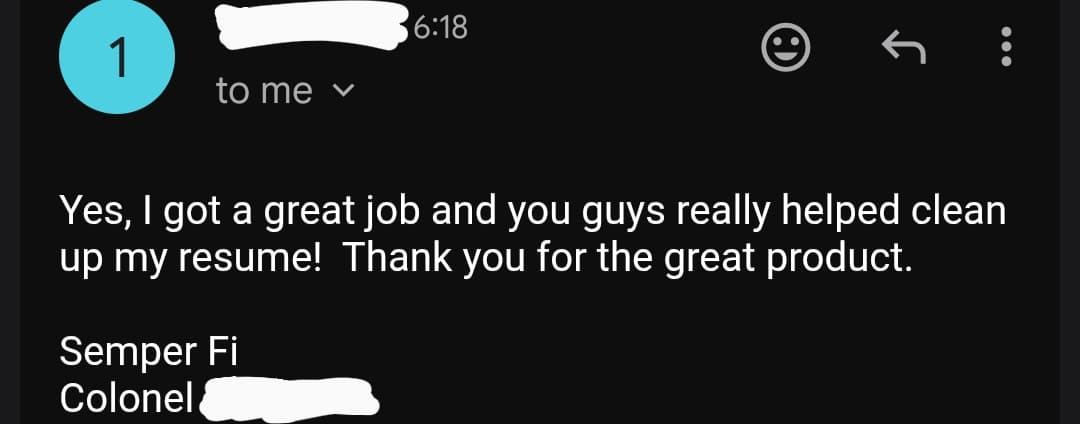
“Hey Brad, Just wanted to send out a quick thank you. You've created something amazing with BMR and your continued advocacy for transitioning service members does not go unnoticed. It was the most effective resource I used in my transition and I know it played a key role in landing a six figure…”
Federal service is one of the strongest landing spots for a 0471, in part because the government runs its own mortuary affairs and casualty operations and understands the work without translation. The Joint POW/MIA Accounting Agency, the Armed Forces Medical Examiner System, Army mortuary affairs offices, and Department of Veterans Affairs national cemeteries all employ people whose background is exactly what you carry.
The Miscellaneous Administration and Program series (GS-0301) is the broadest fit and covers mortuary affairs program work, casualty assistance, and remains-disposition coordination at the GS-7 through GS-11 range for veterans entering with this experience. The Miscellaneous Clerk and Assistant series (GS-0303) covers the processing, recordkeeping, and custody side at GS-5 through GS-7 and is a common entry point. Health Aid and Technician (GS-0640) and Health System Specialist (GS-0671) apply to roles inside medical examiner and pathology operations. Emergency Management (GS-0089) values your experience standing up collection points and operating under mass-casualty conditions. The Management and Program Analyst series (GS-0343) and Administrative Officer series (GS-0341) reward the documentation, reporting, and operations-coordination side as you move up.
Veterans preference is a real advantage here. Eligible veterans receive 5 or 10 additional points on competitive examinations, and the rules are worth understanding before you apply, which the veterans preference points guide breaks down clearly. Federal resumes follow a different format than private-sector ones, longer and more detailed, and the federal resume format and OPM requirements guide walks through what the hiring officials expect. The 10 federal job series every veteran should search article is a useful starting filter on USAJOBS. The federal resume builder formats your experience to OPM standards, or you can start your federal resume here.
| GS Series | Federal Job Title | Typical Grades | Match | Explore |
|---|---|---|---|---|
| GS-0301 | Miscellaneous Administration and Program | GS-7, GS-9, GS-11 | View Details → | |
| GS-0303 | Miscellaneous Clerk and Assistant | GS-5, GS-6, GS-7 | View Details → | |
| GS-0640 | Health Aid and Technician | GS-5, GS-6, GS-7 | View Details → | |
| GS-0089 | Emergency Management | GS-7, GS-9, GS-11 | View Details → | |
| GS-0343 | Management and Program Analyst | GS-9, GS-11, GS-12 | View Details → | |
| GS-0671 | Health System Specialist | GS-9, GS-11, GS-12 | View Details → | |
| GS-2005 | Supply Clerical and Technician | GS-5, GS-6, GS-7 | View Details → |
Federal hiring uses keyword-matching and structured experience. BMR builds federal-format resumes (USAJobs-ready) with the right keywords, hours/week, and supervisor info — for any GS series above.
Free · No credit card · Federal + civilian resume formats included
Not everyone wants to stay in a related field. These career paths leverage your transferable skills — leadership, risk management, logistics, project planning — in completely different industries.
Operating rooms reward exactly what mortuary affairs built: steady hands under pressure, precise adherence to protocol, and comfort in clinical conditions that unsettle most people.
Health information work runs on the same precise, confidential recordkeeping you used to document cases and effects, where a single error has real consequences.
Quality control rewards people who follow exact procedures and document every result without shortcuts, the discipline at the core of decedent processing and effects accountability.
You already worked with families and casualty channels during the hardest moments of their lives; that compassion plus documentation discipline transfers directly to community health outreach.
Managing programs that serve people in crisis draws on your experience coordinating collection-point operations and casualty support with steadiness and accountability.
The processing, accountability, and transfer discipline of mortuary affairs is the same accountability logistics runs on; the BLS projects logistician demand to grow much faster than average.
The skills that made you a good Marine, Sailor, Airman, or Soldier transfer further than you think. BMR rewrites your bullets for any of the pivot careers above — without making you sound like you've never done the work.
Free · No credit card · Try unlimited career angles
If you are staying in death care or forensic work, your terminology already translates: funeral directors, medical examiners, and lab managers use the same language for chain of custody, decedent processing, and personal-effects accounting. This section is for the careers OUTSIDE mortuary affairs, where a hiring manager has no military frame of reference and the words on your resume have to carry the meaning by themselves.
The instinct is to write the MOS title and the duties as they were named in service. The fix is to describe the underlying skill in language a civilian recruiter recognizes, with a number attached wherever you have one. A few mappings that work for non-field roles:
Here is the difference it makes. A "before" bullet might read: "Performed search and recovery and processed remains and personal effects at a mortuary collection point." Rewritten for a non-field resume: "Maintained unbroken chain of custody and audit-ready documentation across 100 percent of processed cases under field conditions, with zero accountability discrepancies." Same work, language a civilian hiring manager can score. The 50 military terms translated to civilian language glossary and the MOS-to-civilian translation guide show the pattern across many bullets. The military resume builder does this translation for you, or build your resume now and start from your real experience.
BMR turns your 0471 duties and accomplishments into civilian bullets that match the job you're applying for — no manual translation, no rewriting.
Free · No credit card · Tailored to each job posting
Which certifications you need depends on where you're headed. Find your target career path below.
The wrong placement can sink an otherwise strong application. BMR knows where each cert ranks, what to call it, and how to frame it for ATS keyword matching and hiring manager attention.
Free · No credit card · Built around your real certs and clearance
Treat your transition as two tracks and use the resources that match the one you choose.
Licensing is the gate. Look for a mortuary science program accredited by the American Board of Funeral Service Education (ABFSE), typically a two-year associate degree, then the National Board Examination and a supervised internship to license as a funeral director or embalmer in most states. Your GI Bill can fund accredited programs, and the GI Bill certifications directory helps confirm eligibility. The National Funeral Directors Association (NFDA) is the primary professional body for the field. For forensic and lab-adjacent roles, state and local medical examiner offices post openings on their own portals and on USAJOBS for federal positions like the Armed Forces Medical Examiner System.
If you are leaving the specialty entirely, lean on the cross-industry destinations in the career-change section below, and build the resume to match. SkillBridge can place you with a civilian employer in your last months of service, and the SkillBridge program guide covers eligibility and timing. SFL-TAP and the broader transition checklist help you sequence everything: see the SFL-TAP transition resources. American Corporate Partners (ACP) offers free year-long mentorship pairing veterans with corporate professionals, which is worth setting up early. For interview preparation, the STAR method for behavioral interviews guide helps you structure answers about work you may find hard to discuss.
Whichever track you pick, the military resume builder and federal resume builder turn your record into civilian language, and the career crosswalk tool lets you explore paths side by side. When you are ready, get started here. See also related Marine logistics and admin paths on the 3043 Supply Administration and 0161 Postal Clerk pages.
Most veterans do this backwards — they wait until terminal leave to start, then panic. Here's the actual sequence that works.
Print this. Tape it to your monitor. Veterans who treat the transition like a 90-day op get hired faster than the ones who treat it like an emergency.
Stop rewriting from scratch every time you apply. BMR turns your military experience into civilian and federal resumes — tailored to each job.