Loading...
Loading...
The civilian and federal jobs that hire Marines Signals Intelligence Analysts — with real salaries and the resume that gets callbacks.
Every 2629 has more options than a Google search will tell you. Below: career paths, BLS salary data, federal GS series, certifications by target career, and how to translate your experience without losing what made you valuable to the Marines in the first place.
Free · No credit card · Tailored resume in under 5 minutes
After the Navy I got hired into 6 federal career fields and tech sales, and sat on federal hiring panels along the way. I spent the last 2 years rebuilding everything I learned into BMR, tuned for how AI actually screens resumes today. This is the system I wish I'd had on day one.
As a 2629 Signals Intelligence Analyst, you turned intercepted communications and electronic signals into finished intelligence that commanders acted on. You built and maintained communications order-of-battle files, tracked target emitters, fused SIGINT with other sources, and wrote the intelligence reports, technical reports, and summaries that drove targeting and force-protection decisions. The 2629 is a necessary MOS (NMOS) assigned at the staff NCO level, so by the time you held it you were already supervising collection and analysis, not just running a position yourself.
The pipeline behind this work is real and verifiable: SIGINT analysts attend formal training at Goodfellow AFB, Texas, and complete the Marine analysis and reporting coursework that teaches structured reporting and target development. The job requires a GT score of 100 or higher, a Top Secret clearance, and eligibility for Sensitive Compartmented Information (SCI) access based on a Single Scope Background Investigation. That clearance and SCI access is the single most valuable thing you carry out the door, and it is the part civilian recruiters and federal hiring managers understand instantly.
Employers value this background because the work is analysis under real consequences. You correlated fragmentary data, separated signal from noise, and produced written products that decision-makers trusted. Those are the exact habits cleared analyst roles and cyber threat intelligence teams are built around. If you want to see how your skill set maps across the services, the military career crosswalk tool lays it out, and Marines coming from collection backgrounds like 2621 Special Communications Signals Collection or the broader 0231 Intelligence Specialist field often land in the same civilian job postings.
I have hired for cleared federal roles, and a 2629 resume that names the TS/SCI and shows real reporting volume moves to the top of the stack fast. The clearance is the rare, expensive thing a hiring manager cannot conjure on their own, and the GS-0132 Intelligence series exists for backgrounds exactly like yours. Lead with the clearance, then prove the analytic tradecraft. — Brad Tachi, Navy Diver veteran & BMR founder
The number that matters when you're deciding what's next: how does civilian pay compare to what you make now?
Military comp is approximate (varies by location/dependents). Civilian is BLS median. Federal includes locality pay. Your real number depends on duty station, family status, GS step, and overtime.
The strongest civilian demand for a 2629 background sits in cleared analysis. Defense contractors and federal agencies hire all-source and SIGINT analysts, and the active TS/SCI is often a hard requirement that screens most applicants out before skills are even compared. That scarcity is what holds these salaries up.
Cyber Threat Intelligence and SOC analysis is the fastest-growing landing zone. The Bureau of Labor Statistics (BLS) reports a median wage of $124,910 for information security analysts (May 2024), with employment projected to grow 29% through 2034, much faster than average. The pattern-of-life and adversary-tracking instincts you built in SIGINT map cleanly onto tracking threat actors across network telemetry.
All-source and intelligence analysis roles with contractors and agencies pay well, though BLS does not track a standalone "Intelligence Analyst" occupation. The closest tracked analytic occupations give honest anchors: operations research analysts had a median of $91,290 and computer systems analysts $103,790 (BLS, May 2024). Data analysis is another natural move, with data scientists at a $112,590 median and 34% projected growth, because the core of the job is making decisions from incomplete data.
Be honest with yourself about geography. Most cleared analyst work clusters around the National Capital Region, San Antonio, Augusta (Fort Eisenhower), Hawaii, and Colorado Springs. If you are not near a cleared-work hub, expect to relocate or compete for a smaller pool of remote-eligible postings. Marines from adjacent fields such as 0651 Cyber Network Operator chase the same employers, and the cross-service equivalents at Army 35N Signals Intelligence Analyst and Navy CTR Cryptologic Technician Collection show how the same resume reads to a contractor recruiter. For a sense of where a cleared background carries the most weight, our guide to high-paying jobs for veterans with a security clearance is a useful read.
| Civilian Job Title | Industry | BLS Median Salary | Outlook | Match |
|---|---|---|---|---|
Cyber Threat Intelligence Analyst O*NET: 15-1212.00 | Cybersecurity | $124,910 | 29% (Much faster than average) | strong |
Security Operations Center (SOC) Analyst O*NET: 15-1212.00 | Cybersecurity | $124,910 | 29% (Much faster than average) | strong |
All-Source / SIGINT Analyst (Defense Contractor) O*NET: 33-3021.06 | Defense Contracting | $91,290 | 23% (Much faster than average) | strong |
Intelligence Systems Analyst O*NET: 15-1211.00 | Information Technology | $103,790 | 10% (Faster than average) | moderate |
Data Analyst / Data Scientist O*NET: 15-2051.00 | Technology | $112,590 | 34% (Much faster than average) | moderate |
Operations Research Analyst O*NET: 15-2031.00 | Professional Services | $91,290 | 23% (Much faster than average) | moderate |
BMR rewrites your 2629 experience for any of the civilian roles above — keywords, achievements, and language hiring managers actually scan for.
Free · No credit card · 2 tailored resumes included
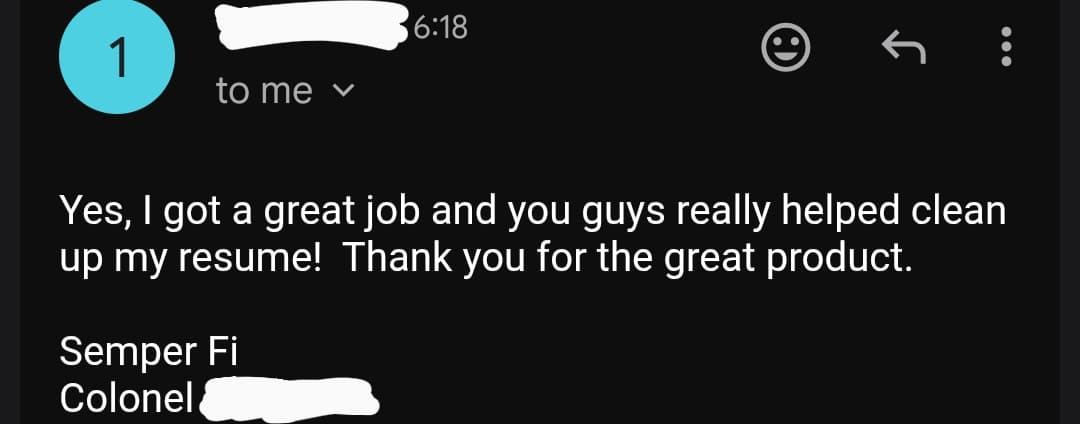
“Hey Brad, Just wanted to send out a quick thank you. You've created something amazing with BMR and your continued advocacy for transitioning service members does not go unnoticed. It was the most effective resource I used in my transition and I know it played a key role in landing a six figure…”
Federal service is the most direct path for a 2629, because the same agencies you supported in uniform hire the same analytic skill set as civilians. The anchor is the GS-0132 Intelligence series, which covers all-source, SIGINT, and target-development work across the Defense Intelligence Agency, NSA, the service intelligence commands, and the combatant commands. With staff NCO-level reporting experience and an active TS/SCI, a 2629 commonly qualifies at GS-9 to GS-12, with GS-12 reachable where you can document independent analytic production.
Beyond the 0132, several series reward the same background. GS-0343 Management and Program Analyst fits the requirements, tasking, and process-analysis side of an intelligence shop. GS-0080 Security Administration values your clearance-handling and information-protection experience. GS-2210 Information Technology Management and GS-0391 Telecommunications suit Marines whose SIGINT work leaned technical, into systems, networks, and the radio-frequency spectrum. GS-0150 Geography connects for those who worked geospatial or geolocation problems, and GS-1801 General Inspection, Investigation, Enforcement opens federal investigative roles that prize analytic rigor.
Veterans preference applies to most of these announcements, adding 5 or 10 points to your rated score, and the SSBI you already hold is a real cost an agency avoids by hiring you. Read each USAJobs announcement against the OPM qualification standard for the series and mirror its language. Marines targeting the same series include 0231 Intelligence Specialist and 0241 Imagery Analysis Specialist. Our walkthrough on how to write a federal resume covers the format these announcements demand, and you can start your federal resume now when you are ready.
| GS Series | Federal Job Title | Typical Grades | Match | Explore |
|---|---|---|---|---|
| GS-0132 | Intelligence | GS-9, GS-11, GS-12 | View Details → | |
| GS-0343 | Management and Program Analyst | GS-9, GS-11, GS-12 | View Details → | |
| GS-0080 | Security Administration | GS-7, GS-9, GS-11 | View Details → | |
| GS-2210 | Information Technology Management | GS-9, GS-11 | View Details → | |
| GS-0391 | Telecommunications | GS-7, GS-9, GS-11 | View Details → | |
| GS-1801 | General Inspection, Investigation, Enforcement | GS-7, GS-9, GS-11 | View Details → | |
| GS-0150 | Geography | GS-7, GS-9, GS-11 | View Details → |
Federal hiring uses keyword-matching and structured experience. BMR builds federal-format resumes (USAJobs-ready) with the right keywords, hours/week, and supervisor info — for any GS series above.
Free · No credit card · Federal + civilian resume formats included
Not everyone wants to stay in a related field. These career paths leverage your transferable skills — leadership, risk management, logistics, project planning — in completely different industries.
Outbreak investigation is the same cognitive job as target development: build a picture from partial signals, test it, and brief a conclusion that drives action.
Actuarial work rewards the same disciplined reasoning under uncertainty that SIGINT forecasting demands, applied to financial and insurance risk instead of adversary activity.
You already wrote intelligence reports that decision-makers had to grasp quickly. Technical writing is that exact skill applied to software, hardware, and process documentation.
SIGINT work builds a deep feel for how signals and networks actually move. That intuition transfers to designing the data and communication networks that businesses run on.
Reading a market is structurally the same as reading an adversary: collect noisy data, find the signal, and tell leadership what it means for their next move.
The tasking, process, and reporting side of running an intelligence shop is the same work consultants do: study how an organization operates and recommend how to do it better.
The skills that made you a good Marine, Sailor, Airman, or Soldier transfer further than you think. BMR rewrites your bullets for any of the pivot careers above — without making you sound like you've never done the work.
Free · No credit card · Try unlimited career angles
If you are staying in intelligence, cyber, or cleared analysis, your terminology already translates. Contractor and agency recruiters know what SIGINT, all-source, and TS/SCI mean. This section is for 2629s targeting careers OUTSIDE the intelligence field, where a hiring manager has never read a SIGINT report and will not decode acronyms for you.
The move is to describe the cognitive work, not the classified subject. You analyzed large volumes of ambiguous data, found the meaningful pattern, and communicated a defensible conclusion to leaders on a deadline. Stated in plain business language, that is what corporate analysts, researchers, and writers are paid to do.
| Military Term | Civilian Translation |
|---|---|
| SIGINT analysis and target development | Data analysis and subject identification from incomplete information |
| Communications order of battle | Structured database of entities, relationships, and activity patterns |
| Intelligence reports and summaries | Executive briefings and analytic written products |
| All-source fusion | Multi-source data integration and corroboration |
Before (military): Performed SIGINT analysis and target development, maintained communications order-of-battle files, and produced intelligence reports for the supported command.
After (civilian, non-field): Analyzed high-volume, fragmentary data to identify subjects and activity patterns, maintained a structured relational database of entities, and authored decision-ready written reports for senior leadership on daily deadlines.
The translation is the work that wins callbacks, not the experience itself. Our military-to-civilian resume translation guide walks through more examples, and the BMR military resume builder handles the rewrite for you. When you are ready to build it for real, you can get started here.
BMR turns your 2629 duties and accomplishments into civilian bullets that match the job you're applying for — no manual translation, no rewriting.
Free · No credit card · Tailored to each job posting
Which certifications you need depends on where you're headed. Find your target career path below.
The wrong placement can sink an otherwise strong application. BMR knows where each cert ranks, what to call it, and how to frame it for ATS keyword matching and hiring manager attention.
Free · No credit card · Built around your real certs and clearance
Keep your clearance active and tracked. A current TS/SCI with a recent SSBI is the asset employers screen for first, and a lapse is expensive to reinstate. SkillBridge is the cleanest on-ramp: many defense contractors run SkillBridge internships specifically for cleared SIGINT and all-source Marines, and our SkillBridge guide for veterans explains how to line one up before your terminal leave. Professional grounding through organizations like AFCEA and the certification paths below keep you competitive.
If you are leaving the field, lean on transferable credentials. A PMP or a Google Data Analytics certificate signals you can run a project or work a dataset in language a civilian manager trusts. American Corporate Partners (ACP) pairs you with a corporate mentor for free, which is the fastest way to learn how a new industry hires. For federal options outside pure intelligence, work the USAJobs announcements and read each qualification standard closely.
Start with these BMR tools and resources:
See also: Air Force 1N2X1 Signals Intelligence Analyst and Navy CTN Cryptologic Technician Networks for how the same career reads in other branches. For interview preparation, our veteran interview tips help you talk about classified work without crossing a line.
Most veterans do this backwards — they wait until terminal leave to start, then panic. Here's the actual sequence that works.
Print this. Tape it to your monitor. Veterans who treat the transition like a 90-day op get hired faster than the ones who treat it like an emergency.
Stop rewriting from scratch every time you apply. BMR turns your military experience into civilian and federal resumes — tailored to each job.