NavyRating: AME

Aviation Structural Mechanic (Safety Equipment)

The civilian and federal jobs that hire Navy Aviation Structural Mechanic (Safety Equipment)s — with real salaries and the resume that gets callbacks.

Every AME has more options than a Google search will tell you. Below: career paths, BLS salary data, federal GS series, certifications by target career, and how to translate your experience without losing what made you valuable to the Navy in the first place.

Free to start · Tailored resume in under 5 minutes

$47K–$81K
Salary Range
BLS-verified median salaries
14
Career Paths
14
Companies Hiring
8
Resume Examples
8
Federal GS Series
7
Certification Paths
10
FAQs Answered
BT
Brad Tachi
Navy Diver · BMR Founder

After the Navy I got hired into 6 federal career fields and tech sales, and sat on federal hiring panels along the way. I spent the last 2 years rebuilding everything I learned into BMR, tuned for how AI actually screens resumes today. This is the system I wish I'd had on day one.

65,000+ resumes built·Success stories every week
Free Sample · Emailed to You

Get a free AME Aviation Structural Mechanic (Safety Equipment) sample resume

One page, built in our template, with your military experience translated into civilian terms hiring managers and ATS systems read. Use it as a reference for your own. Drop your email and we'll send you the download link.

Free. We'll also send occasional job-search tips. Unsubscribe anytime.

Military Role Overview

As a Navy AME you owned the systems that keep aircrew alive when everything else fails. Ejection seats and canopy jettison charges, gaseous and liquid oxygen (LOX), the On-Board Oxygen Generating System (OBOGS), cabin pressurization, environmental control, fire-extinguishing bottles, life-raft ejection, and the anti-G systems that keep a pilot conscious in a high-G turn. Every one of those is a single-point-of-failure system. There is no second chance on an egress seat that does not fire or an oxygen regulator that reads wrong at altitude.

The AME pipeline starts with about nine weeks of "A" School at NATTC Pensacola, Florida. If you were assigned to a squadron flying ejection-seat aircraft, you added roughly two more weeks of Egress training before you ever touched a live cartridge-actuated device. From there you signed for explosive components, torqued ejection-seat hardware to spec, ran LOX converter and regulator tests, and logged every safety-of-flight action. Many AMEs earn a Collateral Duty Inspector (CDI) or Quality Assurance Representative (QAR) qualification, where your signature is the last check before an aircraft flies.

Civilian employers value this background because it is precision work under a documentation and inspection standard most industries never see. You handled pyrotechnic egress charges, pressurized oxygen systems, and emergency equipment where the maintenance record is a legal document. That discipline transfers to aircraft maintenance, medical-gas and life-support equipment, calibration, and any safety-critical field that lives and dies by inspection sign-off. Explore where your rating leads on the military career crosswalk tool, and see the closely related AM Aviation Structural Mechanic and PR Aircrew Survival Equipmentman paths if you want to stay close to the flight line. For the resume itself, our military-to-civilian terms glossary is a good first stop.

I went a year and a half after the Navy with my applications going nowhere. The experience was there; the problem was that nobody reading my resume could see it. AME work has that same trap. "Maintained egress systems" is some of the most precise, high-stakes maintenance in the fleet, but a civilian recruiter reads it as jargon and moves on. Name what you actually did in civilian terms, pressurized oxygen systems, pyrotechnic safety devices, inspection sign-off, and the callbacks start. The translation is the work. — Brad Tachi, Navy Diver veteran & BMR founder

Security ClearanceNone (Secret only for aircrew volunteers)
ASVAB RequirementVE+AR+MK+AS=210 or VE+AR+MK+MC=210
TrainingAbout 9 weeks of A School at NATTC Pensacola, FL. AMEs assigned to ejection-seat aircraft add roughly 2 weeks of Egress training. Platform-specific C Schools and FRC training follow for advanced oxygen, environmental-control, and egress systems.
Certs Earned in ServiceCollateral Duty Inspector (CDI), Quality Assurance Representative (QAR), Egress / ejection-seat qualification (ejection-seat squadrons), LOX and OBOGS systems qualification, HAZMAT handling

Pay Reality Check

The number that matters when you're deciding what's next: how does civilian pay compare to what you make now?

Navy mid-career
$58K–$82K
E-5 to E-7 total comp (base + BAH + BAS + tax advantage)
Civilian Aviation Structural Mechanic (Safety Equipment)
$47K–$81K
BLS median across direct-match civilian roles
Federal (GS-9 to GS-13)
$58K–$120K
8 matching GS series + locality pay + step increases
Comparable on average
Civilian pay for Aviation Structural Mechanic (Safety Equipment)s lands within the same range as mid-career enlisted total comp.

Military comp is approximate (varies by location/dependents). Civilian is BLS median. Federal includes locality pay. Your real number depends on duty station, family status, GS step, and overtime.

Private Sector Career Paths

The most direct civilian path is aircraft maintenance. Per BLS OEWS (May 2024), Aircraft Mechanics and Service Technicians earned a median of $78,680, and the FAA Airframe (A) certificate is the credential that unlocks it. Avionics Technicians ran higher at a median of $81,390. Your AME experience does not directly grant the A&P, but documented organizational-level maintenance hours count toward the FAA experience requirement, and the inspection discipline you already have is exactly what shop leads want.

Beyond the flight line, your oxygen and life-support background opens medical and equipment fields. Medical Equipment Repairers, who service ventilators, anesthesia machines, and oxygen-delivery systems, earned a BLS median of $62,630 (May 2024). The aviation maintenance field overall is projected to grow about 5% through 2033 per BLS, roughly average, with airlines and MRO (maintenance, repair, overhaul) providers competing hard for licensed mechanics as a wave of legacy technicians retires.

Geography matters. Aircraft and life-support maintenance jobs cluster around airline hubs, military depot regions, and aerospace manufacturing corridors: the Dallas-Fort Worth metroplex, Atlanta, Phoenix, Charlotte, Wichita, Tulsa, and San Diego. If you are open to relocating to where the MRO work is, you will see more openings and stronger offers. Defense MRO contractors near Naval Air Stations frequently hire former AMEs directly because the platform knowledge transfers with zero ramp-up. Several of the Coast Guard AMT and Army 15T helicopter repairer civilian paths overlap with yours. When you are ready to write it up, the Navy rating-to-civilian resume guide walks through it, and you can build your resume now when you are set.

Civilian Job Title Translations

Aircraft Mechanic and Service Technician
Aviation Maintenance
strong
$78,680median
5% (As fast as average)
O*NET: 49-3011.00
Avionics Technician
Aviation Maintenance
strong
$81,390median
5% (As fast as average)
O*NET: 49-2091.00
Aircraft Mechanic (Egress / Ejection Seat)
Defense MRO
strong
$78,680median
5% (As fast as average)
O*NET: 49-3011.00
Medical Equipment Repairer
Healthcare Equipment
moderate
$62,630median
3% (As fast as average)
O*NET: 49-9062.00
Calibration Technologist and Technician
Precision Instrumentation
moderate
$65,040median
3% (As fast as average)
O*NET: 17-3028.00
Quality Control Inspector
Manufacturing
moderate
$47,460median
-3% (Decline)
O*NET: 51-9061.00
Aircraft Pneudraulic Systems Mechanic
Aviation Maintenance
strong
$78,680median
5% (As fast as average)
O*NET: 49-3011.00
Industrial Machinery Mechanic
Industrial Maintenance
moderate
$63,510median
13% (Much faster than average, 2024-34)
O*NET: 49-9041.00

Companies That Hire This Background

Builds oxygen, egress, and aircrew life-support systems; hires AMEs into systems maintenance and manufacturing.
Ejection-seat manufacturer and service provider; direct fit for egress-system experience.
Naval aircraft programs and MRO across multiple platforms; structured veteran hiring pipeline.
F-35 and other platforms with egress and life-support sustainment work; hires former AMEs.
Aircraft sustainment and depot maintenance roles aligned to Navy aviation backgrounds.
Contract aircraft maintenance at Navy and DoD sites; hires AMEs directly into life-support and airframe shops.
Aviation maintenance and logistics support contracts at naval air stations.
One of the largest airline MRO operations; hires licensed and experienced military mechanics.
Line and base maintenance across major hubs; A&P-focused hiring with veteran support.
Engine and component overhaul MRO; values military aircraft maintenance experience.
Civilian aircraft mechanic and engineering roles at Fleet Readiness Centers; AMEs transition with platform knowledge intact.
Component manufacturing, test, and MRO roles suited to precision systems backgrounds.
Anesthesia, ventilation, and oxygen-delivery equipment; a fit for AME life-support and gas-systems experience.
Aviation safety, inspection, and technical roles; Veterans Preference applies on USAJobs.

See a salary you want? Build a resume targeting it.

BMR rewrites your AME experience for any of the civilian roles above — keywords, achievements, and language hiring managers actually scan for.

Free to start · 2 tailored resumes included

Build My Resume Free
Real Navy success story
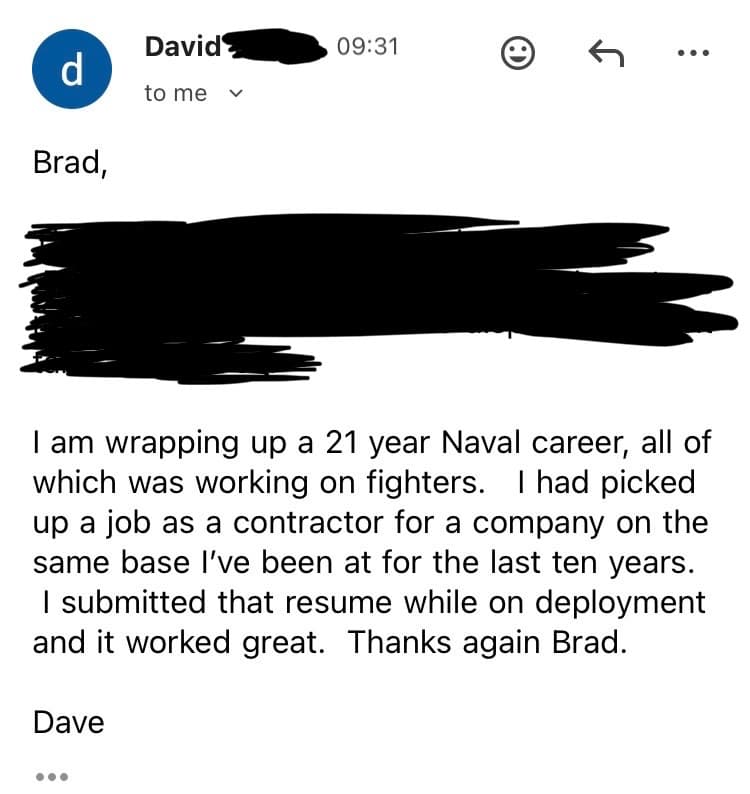
I am wrapping up a 21 year Naval career, all of which was working on fighters. I had picked up a job as a contractor for a company on the same base I’ve been at for the last ten years. I submitted that resume while on deployment and it worked great. Thanks again Brad. Dave
David· Chief Petty Officer (E-7)· Navy
Aviation
Read the full story

Federal Career Paths

Federal service rewards the AME skill set in ways the private sector often cannot match, partly because the largest employer of aircraft and life-support mechanics in the country is the federal government itself. The wage-grade and GS systems both have a home for you, and Veterans' Preference plus your existing security background give you a real edge on USAJobs.

On the wage-grade (WG) side, the closest match is the WG-8852 Aircraft Mechanic series, which covers the exact organizational and intermediate maintenance you performed on the flight line. WG-8268 Aircraft Pneudraulic Systems Mechanic and WG-8840 Aircraft Mechanical Parts Repair pick up the pressurization, oxygen, and component-overhaul side of your work. WG-5378 Powered Support Systems Mechanic and WG-5306 Air Conditioning Equipment Mechanic map to the environmental-control and ground-support equipment you maintained.

If you want to move off the tools and into the GS side, the GS-1670 Equipment Services series and GS-1601 General Facilities and Equipment series fit equipment-management and program roles. Safety is a natural pivot given your inspection background: GS-0018 Safety and Occupational Health Management and GS-0019 Safety Technician hire heavily from maintenance veterans, and GS-1910 Quality Assurance is built for QARs and CDIs. NAVAIR, the Fleet Readiness Centers, Air Force depots at Tinker, Hill, and Robins, and the FAA all hire this background. Veterans' Preference and prior federal-adjacent service matter on every one of these announcements. Our MOS-to-federal-series guide shows how to line your experience up to the qualification standard, and you can start your federal resume here.

GS Series & Position Matches

GS-8268
Aircraft Pneudraulic Systems Mechanic
Typical grades: WG-08, WG-10
View Details
GS-8852
Aircraft Mechanic
Typical grades: WG-08, WG-10, WL-10
View Details
GS-8840
Aircraft Mechanical Parts Repair
Typical grades: WG-08, WG-10
View Details
GS-1910
Quality Assurance
Typical grades: GS-7, GS-9, GS-11
View Details
GS-0802
Engineering Technician
Typical grades: GS-7, GS-9, GS-11
View Details
GS-5378
Powered Support Systems Mechanic
Typical grades: WG-08, WG-10
View Details
GS-1670
Equipment Services
Typical grades: GS-7, GS-9, GS-11
View Details
GS-0018
Safety and Occupational Health Management
Typical grades: GS-7, GS-9, GS-11
View Details

Federal resumes follow different rules. We know them.

Federal hiring uses keyword-matching and structured experience. BMR builds federal-format resumes (USAJobs-ready) with the right keywords, hours/week, and supervisor info — for any GS series above.

Free to start · Federal + civilian resume formats included

Build My Federal Resume Free

Want to Change Careers Entirely?

Not everyone wants to stay in a related field. These career paths leverage your transferable skills — leadership, risk management, logistics, project planning — in completely different industries.

Respiratory Therapist

$80,450
Healthcare(O*NET: 29-1126.00)BLS OEWS May 202413% (Much faster than average)
Oxygen-delivery and gas-system precision (LOX, OBOGS)Life-support equipment operation under protocolReading regulators and pressure tolerances accuratelyCalm execution when equipment failure is life-threatening

AMEs already manage pressurized oxygen and life-support systems where an error costs a life. Respiratory therapy applies that exact gas-delivery and equipment discipline to patients.

How to get there: Earn an associate degree in respiratory therapy (about 2 years, GI Bill eligible) and pass the NBRC credentialing exam to become licensed.

Surgical Technologist

$62,830
Healthcare(O*NET: 29-2055.00)BLS OEWS May 20246% (Faster than average)
Sterile, contamination-controlled procedure disciplineLife-critical equipment readiness and setupStrict step-by-step protocol adherencePerforming precisely under time pressure

The AME mindset of never skipping a step on a life-safety system is the same standard a surgical tech holds in the operating room. The contamination-control habits from FOD prevention transfer directly.

How to get there: Complete a surgical technology certificate or associate program (12-24 months, GI Bill eligible) and earn the CST credential.

Calibration Technologist

$65,040
Precision Instrumentation(O*NET: 17-3028.00)BLS OEWS May 20243% (As fast as average)
Testing regulators and converters to documented tolerancesPrecision measurement and instrument verificationTraceable documentation of every readingDetecting out-of-spec readings before they cause failure

Bench-testing LOX converters and oxygen regulators is calibration work. AMEs already verify precision instruments against a standard and document every result.

How to get there: Pair your military testing experience with the ASQ Certified Calibration Technician credential; many labs hire and train candidates with a strong measurement background.

Medical Equipment Repairer

$62,630
Healthcare Equipment(O*NET: 49-9062.00)BLS OEWS May 20243% (As fast as average)
Servicing pressurized oxygen and gas-delivery equipmentComponent-level troubleshooting and overhaulFollowing manufacturer maintenance specifications exactlyMaintaining auditable service records

Ventilators, anesthesia machines, and oxygen systems run on the same pressurized-gas principles AMEs maintain daily. The maintenance-documentation discipline is identical.

How to get there: Many employers hire on electronics and equipment aptitude and train on the job; the CBET credential and an associate degree accelerate advancement.

HVAC Mechanic and Installer

$59,810
Building Systems(O*NET: 49-9021.00)BLS OEWS May 20249% (Faster than average)
Pressurization, heating, cooling, and ventilation systemsRefrigerant and pressurized-system handlingDiagnosing environmental-control system faultsReading schematics and pressure readings

AME cabin pressurization and environmental-control work is HVAC at altitude. The pressurized-system fundamentals and troubleshooting logic carry straight over.

How to get there: Complete a short HVAC program or apprenticeship and earn EPA 608 certification; the GI Bill funds most HVAC training programs.

Wind Turbine Service Technician

$62,580
Renewable Energy(O*NET: 49-9081.00)BLS OEWS May 202460% (Much faster than average)
Hydraulic, pneumatic, and mechanical system troubleshootingWorking safely at height in pressurized and energized systemsComponent overhaul to manufacturer specificationMethodical fault isolation in a no-fallback environment

Servicing turbine gearboxes, hydraulics, and pitch systems uses the same diagnose-and-overhaul discipline an AME applies to aircraft environmental and egress systems, in one of the fastest-growing trades in the country.

How to get there: A short wind-tech certificate (community college or manufacturer academy) plus tower-rescue and safety training; employers hire mechanically strong veterans and train on the platform.

Pivoting industries? You don't need to start from scratch.

The skills that made you a good Marine, Sailor, Airman, or Soldier transfer further than you think. BMR rewrites your bullets for any of the pivot careers above — without making you sound like you've never done the work.

Free to start · Try as many career angles as you want

Tailor My Resume to a New Career

Skills Translation Guide

If you are staying in aviation maintenance, your terminology already translates. A&P shops, MRO providers, and avionics employers know what an egress system and a LOX converter are. This section is for AMEs targeting careers OUTSIDE aircraft maintenance, where a hiring manager has never heard your rating and will not look it up.

The goal is to describe the SYSTEM and the STANDARD in plain civilian language, not to drop the acronym and hope. A recruiter in a hospital, a calibration lab, or a manufacturing plant should read your bullet and immediately recognize a transferable skill.

Military TermCivilian Translation
OBOGS / LOX systems maintenancePressurized medical and industrial gas systems maintenance
Egress / ejection-seat CAD/PAD workPyrotechnic and energetic-device safety handling under strict protocol
Collateral Duty Inspector (CDI)Final quality-control inspector with sign-off authority
Quality Assurance Representative (QAR)Quality assurance auditor enforcing documented standards
Maintenance Action Form (MAF) documentationRegulated work-order and compliance recordkeeping

Before: "Performed organizational-level maintenance on aircraft OBOGS and LOX systems and rigged ejection-seat egress components."

After (for a calibration or medical-equipment role): "Maintained, tested, and calibrated pressurized oxygen-delivery systems and life-critical safety equipment to documented tolerances, with zero discrepancy findings across recurring quality audits."

For more examples across every category, see the military jargon decoder and how to translate military experience. Our military resume builder handles this translation as you write.

Resume Bullet Examples

Before (Military)
Maintained aircraft OBOGS and liquid oxygen (LOX) systems, including converter and regulator testing.
After (Civilian)
Maintained and tested pressurized oxygen-delivery systems and regulators to documented tolerances across a fleet of equipment.
Before (Military)
Installed, inspected, and rigged ejection-seat cartridge-actuated devices (CADs) and egress components.
After (Civilian)
Handled, installed, and inspected pyrotechnic safety devices under strict written procedures with a zero-incident record.
Before (Military)
Served as Collateral Duty Inspector, providing final sign-off on safety-of-flight maintenance actions.
After (Civilian)
Acted as final quality inspector with authority to approve or reject completed work before release.
Before (Military)
Performed Quality Assurance Representative audits of maintenance programs and tool control.
After (Civilian)
Audited maintenance and compliance programs against documented standards and corrected discrepancies.
Before (Military)
Maintained aircraft cabin pressurization, heating, cooling, and ventilation systems.
After (Civilian)
Maintained and troubleshot pressurization, heating, cooling, and ventilation systems to spec.
Before (Military)
Maintained and tested aircraft fire-extinguishing bottles and discharge systems.
After (Civilian)
Maintained, inspected, and tested fire-suppression systems and pressurized extinguishing equipment.
Before (Military)
Documented all maintenance in Maintenance Action Forms (MAFs) within the Naval Aviation maintenance system.
After (Civilian)
Created and maintained detailed, auditable work-order records meeting regulatory documentation requirements.
Before (Military)
Enforced Tool Control Program accountability and Foreign Object Damage (FOD) prevention on the flight line.
After (Civilian)
Enforced tool and asset accountability and contamination-control procedures in a high-stakes work environment.

Get bullets like these auto-generated for your resume.

BMR turns your AME duties and accomplishments into civilian bullets that match the job you're applying for — no manual translation, no rewriting.

Free to start · Tailored to each job posting

Generate My Resume Bullets

Certifications by Career Path

Which certifications you need depends on where you're headed. Find your target career path below.

Aviation Maintenance

FAA Airframe and Powerplant (A&P) Certificate
Essential
Federal Aviation Administration
Cost: Check current pricingTime: 18-24 months (or military-experience path)GI Bill Eligible
The core credential for civilian aircraft mechanics. Military maintenance hours can count toward the FAA experience requirement.
FAA Inspection Authorization (IA)
Recommended
Federal Aviation Administration
Cost: Check current pricingTime: After 3 years holding A&P
Adds authority to approve major repairs and inspections. A natural next step for former CDIs and QARs.
NCATT Aircraft Electronics Technician (AET)
Recommended
NCATT / ASTM
Cost: Check current pricingTime: 2-4 monthsGI Bill Eligible
Validates avionics and aircraft electronics knowledge for systems-focused maintenance roles.

Facilities Management

EPA Section 608 Technician Certification
Optional
EPA-approved providers
Cost: $20-$150Time: 1-2 weeks
Required to handle refrigerants; useful for the HVAC and environmental-control pivot.
HVAC EPA Universal Certification
Optional
EPA-approved providers
Cost: Check current pricingTime: 1-3 monthsGI Bill Eligible
Entry credential for HVAC and refrigeration work that builds on pressurization-systems experience.

Federal Employment

USAJobs Federal Resume and Veterans Preference Workshop
Recommended
USAJobs / OPM
Cost: FreeTime: 1-2 weeks self-paced
Not a certification, but understanding the federal hiring process is critical for WG-8852 and GS roles.

General Career Transition

Project Management Professional (PMP)
Optional
Project Management Institute (PMI)
Cost: Check current pricingTime: 3-6 months prepGI Bill Eligible
For AMEs moving toward maintenance-program or operations leadership roles.

Healthcare

Certified Biomedical Equipment Technician (CBET)
Optional
AAMI
Cost: Check current pricingTime: 6-12 months (with experience)GI Bill Eligible
For AMEs pivoting to medical-equipment repair on ventilators, anesthesia, and oxygen-delivery systems.

Quality Assurance

Certified Quality Inspector (CQI)
Recommended
American Society for Quality (ASQ)
Cost: Check current pricingTime: 2-4 monthsGI Bill Eligible
Formalizes CDI and QAR inspection experience for manufacturing and aerospace QA roles.
Certified Quality Technician (CQT)
Optional
American Society for Quality (ASQ)
Cost: Check current pricingTime: 2-4 monthsGI Bill Eligible
Covers inspection, sampling, and basic statistics for quality-technician positions.
Certified Calibration Technician (CCT)
Optional
American Society for Quality (ASQ)
Cost: Check current pricingTime: 3-6 monthsGI Bill Eligible
Directly relevant to former AMEs who tested LOX converters and oxygen regulators against tolerances.

Safety & EHS

OSHA 30-Hour General Industry
Recommended
OSHA Training Institute
Cost: $150-$400Time: 4 days
Baseline safety credential that signals workplace-safety competence to civilian employers.
Associate Safety Professional (ASP)
Recommended
Board of Certified Safety Professionals (BCSP)
Cost: Check current pricingTime: 3-6 months prepGI Bill Eligible
Entry credential toward the CSP. Strong fit given AME inspection and safety-of-flight background.
Certified Safety Professional (CSP)
Optional
Board of Certified Safety Professionals (BCSP)
Cost: Check current pricingTime: 6-12 months (after ASP + experience)GI Bill Eligible
The gold-standard safety credential for senior EHS roles.

Got a cert? Don't bury it. List it the right way.

The wrong placement can sink an otherwise strong application. BMR knows where each cert ranks, what to call it, and how to frame it for ATS keyword matching and hiring manager attention.

Free to start · Built around your real certs and clearance

Build My Resume the Right Way

Transition Resources

For Staying in Aviation and Life-Support Maintenance

Your fastest route is the FAA Airframe and Powerplant (A&P) certificate. Document your organizational-level maintenance hours, because they count toward the FAA experience requirement at a certified repair station or through the military-experience path. SkillBridge can place you at an MRO or airline before you separate, so review the SkillBridge program guide early. Industry associations worth joining include the Aircraft Mechanics Fraternal Association and the Professional Aviation Maintenance Association.

For Careers Outside Aviation Maintenance

If you are leaving the flight line entirely, lean on your inspection and safety record. The Board of Certified Safety Professionals (BCSP) credentials and OSHA 30 open safety roles. For federal work, study USAJobs qualification standards and lead with Veterans' Preference. American Corporate Partners (ACP) offers free veteran mentorship that helps you map your background to an unfamiliar industry. The GI Bill can fund a calibration, biomedical-equipment, or healthcare program if you are pivoting fields.

Build the Resume

Start with the military resume builder for private-sector roles or the federal resume builder for USAJobs. When you are ready to commit, get started here. Explore other paths on the career crosswalk and review TAP resources at SFL-TAP.

See also: AD Aviation Machinist's Mate and Coast Guard AET career paths. For interview prep and search strategy, the civilian job-search terms guide helps you find the right openings.

Your 30 / 60 / 90-Day Transition Plan

Most people do this backwards. They wait until terminal leave to start, then panic. Here's the sequence that works. Already out? Same plan, start at day one today.

1Days 0–30

Set the foundation

  • Pull your DD-214 (request from Milconnect if separated)
  • List your top 3 civilian roles AND top 3 GS series
  • Build your tailored AME resume — BMR does it free
  • Write 1 strong LinkedIn headline (not "veteran seeking opportunities")
  • Pull together your evals/performance reports for accomplishments
Build my resume free
2Days 30–60

Apply with intent

  • Apply to 5–10 jobs/week — quality over quantity
  • Tailor every resume to the job description (BMR auto-tailors)
  • Connect with 5 people/week on LinkedIn (not a spray)
  • Set up a USAJobs profile and a saved-search alert for your GS series
  • Practice translating your military bullets out loud — explain to a civilian friend
Tailor my next resume
3Days 60–90

Close the offer

  • Track every application — date, status, contact, notes
  • Follow up 7–10 days after each application
  • Prep for behavioral interviews using the STAR method
  • Negotiate salary — don't take the first offer (BLS median is your floor)
  • Stay applying even after one offer — leverage = options
Track my applications

Print this. Tape it to your monitor. Veterans who treat the job search like a 90-day op get hired faster than the ones who treat it like an emergency.

Frequently Asked Questions

What civilian jobs can a Navy AME get?
The most direct path is aircraft maintenance. Per BLS OEWS (May 2024), Aircraft Mechanics and Service Technicians earned a median of $78,680 and Avionics Technicians $81,390. Your oxygen and life-support experience also crosses into medical-equipment repair ($62,630 median, BLS May 2024) and calibration work. If you want to leave aviation entirely, see the Want to Change Careers Entirely section for options like respiratory therapy and surgical technology.
Do I need an A&P license to work as a civilian aircraft mechanic?
Most airline and MRO mechanic jobs require the FAA Airframe and Powerplant (A&P) certificate. Your AME organizational-level maintenance hours count toward the FAA experience requirement, so you do not start from zero. Some repair stations hire uncertified mechanics into apprentice roles while you finish the certificate, and SkillBridge can place you at a certified shop before you separate.
What is the AME ASVAB requirement and clearance level?
The AME rating requires ASVAB line scores of VE+AR+MK+AS=210 or VE+AR+MK+MC=210. No security clearance is required for the base rating; only AMEs who volunteer for aircrew duty need a clearance. For civilian work, your maintenance record and FAA credentials carry more weight than clearance, though any clearance you do hold is a plus for defense MRO contractors.
What if I want to leave aircraft maintenance entirely?
Your distinctive signature is pressurized oxygen and gas systems, pyrotechnic safety devices, and inspection sign-off authority. Those map to respiratory therapy (median $80,450, BLS May 2024), surgical technology ($62,830), calibration technology ($65,040), and medical-equipment repair ($62,630). Each requires retraining, but your safety-critical discipline is exactly what those fields screen for. See the Want to Change Careers Entirely section for entry paths.
How much do federal aircraft mechanic jobs pay compared to airlines?
Federal wage-grade aircraft mechanic pay (WG-8852) varies by locality rather than a single national median, and it competes well with regional MRO work while adding federal benefits and pension. The bigger advantage is stability and Veterans' Preference. NAVAIR, the Fleet Readiness Centers, Air Force depots, and the FAA all hire AMEs into WG and GS roles.
Which federal job series fit an AME best?
On the wage-grade side: WG-8852 Aircraft Mechanic, WG-8268 Aircraft Pneudraulic Systems Mechanic, WG-8840 Aircraft Mechanical Parts Repair, and WG-5378 Powered Support Systems Mechanic. On the GS side: GS-1670 Equipment Services, GS-1601 General Facilities and Equipment, GS-0018 Safety and Occupational Health Management, GS-0019 Safety Technician, and GS-1910 Quality Assurance for former QARs and CDIs.
Is Veterans' Preference enough to land a federal job?
Veterans' Preference adds points and can break ties, but it does not replace a qualifying resume. You still have to show your experience meets the GS or WG qualification standard for the series. The most common mistake is a too-short federal resume. Federal resumes are detailed by design, and our federal resume builder is set up for that length and format.
Does my egress and oxygen-systems experience help in healthcare?
Yes, more than most AMEs expect. Respiratory therapists and surgical technologists work with oxygen-delivery and life-support equipment under strict protocol, which is the same discipline you applied to LOX, OBOGS, and emergency systems. You will need a certificate or associate program to enter those fields, but the GI Bill can fund it and your equipment background shortens the learning curve.
Where are the best job markets for aircraft and life-support mechanics?
Jobs cluster around airline hubs and aerospace corridors: Dallas-Fort Worth, Atlanta, Phoenix, Charlotte, Wichita, Tulsa, and San Diego. Defense MRO contractors near Naval Air Stations hire former AMEs directly because the platform knowledge transfers immediately. If you can relocate to where the MRO work is, you will see more openings and better offers.
How do I write my AME experience so civilians understand it?
Describe the system and the standard in plain language instead of leading with the rating or acronym. Maintained egress systems becomes maintained pyrotechnic safety devices and pressurized oxygen systems to documented tolerances. Our military resume builder translates this automatically, and the skills translation section above shows before-and-after examples.
Free for every veteran

Translate your AME Aviation Structural Mechanic (Safety Equipment) experience into a resume that gets callbacks

Stop rewriting from scratch every time you apply. BMR turns your military experience into civilian and federal resumes — tailored to each job.

What you get — all free:
2
Tailored resumes
AI-rewritten for each job posting
2
Cover letters
Matched to the role
LinkedIn optimization
Profile rewrite for civilian recruiters
Elevator pitch generator
For interviews and networking
2
Company research reports
Know who you're applying to
Job tracker
Manage every application in one place
Start My Free Resume
Free to start · 90 seconds to sign upBuilt by a Navy Diver veteran. More than 65,000 resumes built for the military community.