Loading...
Loading...
The civilian and federal jobs that hire Navy Cyber Warfare Technicians — with real salaries and the resume that gets callbacks.
Every CWT has more options than a Google search will tell you. Below: career paths, BLS salary data, federal GS series, certifications by target career, and how to translate your experience without losing what made you valuable to the Navy in the first place.
Free · No credit card · Tailored resume in under 5 minutes
After the Navy I got hired into 6 federal career fields and tech sales, and sat on federal hiring panels along the way. I spent the last 2 years rebuilding everything I learned into BMR, tuned for how AI actually screens resumes today. This is the system I wish I'd had on day one.
The Cyber Warfare Technician (CWT) rating was established in June 2023, absorbing the disestablished Cryptologic Technician Networks (CTN) rating into a single rating focused on full-spectrum cyberspace operations. If you held the CTN rating before the merge, your computer network operations background is the lineage this rating was built on. As a CWT you operate inside the Navy's portion of the Department of Defense Information Network, conducting defensive cyberspace operations, offensive cyberspace operations, and the network analysis that supports both. The work sits under Navy Information Forces and feeds directly into U.S. Fleet Cyber Command and the Navy component of U.S. Cyber Command.
Day to day, CWTs run host and network forensics, hunt for adversary activity on Navy and joint networks, build and analyze tool signatures, and document intrusions with the precision a courtroom or an intelligence product would demand. You work in Cyber Mission Force teams alongside Army 17Cs, Air Force operators, and civilian analysts on the same joint missions. The training pipeline runs through the Center for Information Warfare Training, with the Joint Cyber Analysis Course (JCAC) at Corry Station in Pensacola, Florida as the long technical schoolhouse, followed by work-role qualification at a Cyber Mission Force unit. Most CWTs hold a Top Secret/SCI clearance with a counterintelligence or full-scope polygraph.
Civilian employers value this background because the skill is scarce and the vetting is expensive to replicate. A CWT shows up already cleared, already trained on real adversary tradecraft, and already used to writing findings that survive scrutiny. That combination is exactly what security operations centers, threat intelligence teams, and federal cyber components pay a premium for. If you are mapping where the rating leads, the Navy CTN Cryptologic Technician Networks and IT Information Systems Technician pages cover the adjacent ratings, and the military skills translator shows how the work lines up across branches. For the broader picture of how cyber experience converts, our guide on breaking into InfoSec after the military is a useful read.
I was a Navy Diver, not a cyber operator, so I will not pretend I ran network forensics. But after the Navy I pivoted into tech sales, and CWTs have a path there almost nobody talks about. When you have actually defended a network against a real adversary, you can sell security tooling to a SOC director in a way a career sales rep never can. That technical credibility is the whole game in cyber sales, and it is one of the most underrated exits a Navy cyber operator has. — Brad Tachi, Navy Diver veteran & BMR founder
The number that matters when you're deciding what's next: how does civilian pay compare to what you make now?
Military comp is approximate (varies by location/dependents). Civilian is BLS median. Federal includes locality pay. Your real number depends on duty station, family status, GS step, and overtime.
The direct civilian matches for a CWT sit in security operations, threat intelligence, and network defense. These are the jobs where your rating maps almost one to one, and the cleared private sector is the strongest near-term market. Salary figures below are BLS Occupational Employment and Wage Statistics (OEWS) medians, May 2024.
A Cybersecurity Analyst (BLS Information Security Analysts, O*NET 15-1212.00) earns a median of $124,910, and the field is projected to grow 33 percent through 2033, far faster than average. A Network Security Engineer falls under the same Information Security Analysts series and commands similar pay, with cleared roles at defense primes often paying above the published median. A Threat Intelligence Analyst maps to the same occupation and rewards the exact adversary-tradecraft knowledge you built running CMF missions. Beyond those three direct hits, incident response, digital forensics, and penetration testing roles pull from the same skill base.
Be honest with yourself about the market. The cleared cyber market is hot, but it clusters geographically. The densest hiring is around Fort Meade and the Baltimore-Washington corridor, San Antonio, Augusta near Fort Eisenhower, Hampton Roads, and Colorado Springs. Remote roles exist but cleared SCIF work usually is not remote. If you are open to relocating to a cyber hub, your clearance plus CMF experience moves fast. If you are anchored to a low-cyber-density metro, expect a longer search or a willingness to commute to a SCIF.
Veterans from other branches compete for the same roles, so it helps to see how the field reads across services. The Army 17C Cyber Operations Specialist, Air Force 1B4X1 Cyber Warfare Operations, and Coast Guard IT Information Systems Technician pages cover the same civilian destinations from a different starting rating. For the no-degree path into these roles, see cybersecurity jobs veterans can land without a degree, and when you are ready to write it up, our military resume builder turns CMF work into recruiter-readable bullets.
| Civilian Job Title | Industry | BLS Median Salary | Outlook | Match |
|---|---|---|---|---|
Cybersecurity Analyst O*NET: 15-1212.00 | Information Security | $124,910 | 33% (Much faster than average) | strong |
Network Security Engineer O*NET: 15-1212.00 | Information Security | $124,910 | 33% (Much faster than average) | strong |
Threat Intelligence Analyst O*NET: 15-1212.00 | Information Security | $124,910 | 33% (Much faster than average) | strong |
Incident Response Analyst O*NET: 15-1212.00 | Information Security | $124,910 | 33% (Much faster than average) | strong |
Digital Forensics Examiner O*NET: 15-1212.00 | Information Security | $124,910 | 33% (Much faster than average) | moderate |
Penetration Tester O*NET: 15-1212.00 | Information Security | $124,910 | 33% (Much faster than average) | moderate |
Computer Network Architect O*NET: 15-1241.00 | Networking | $130,390 | 13% (Faster than average) | moderate |
Security Operations Center (SOC) Manager O*NET: 15-1212.00 | Information Security | $124,910 | 33% (Much faster than average) | moderate |
BMR rewrites your CWT experience for any of the civilian roles above — keywords, achievements, and language hiring managers actually scan for.
Free · No credit card · 2 tailored resumes included
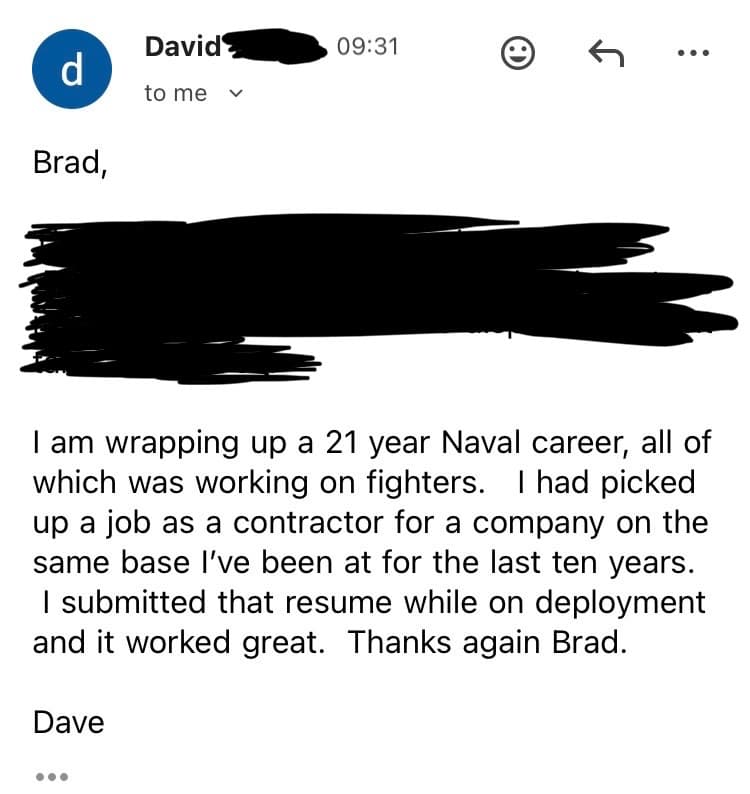
“I am wrapping up a 21 year Naval career, all of which was working on fighters. I had picked up a job as a contractor for a company on the same base I’ve been at for the last ten years. I submitted that resume while on deployment and it worked great. Thanks again Brad. Dave ”
Federal cyber hiring is where a CWT clearance does the most work, because the agencies that need cyber talent are the same ones that already trust the vetting you carry. The anchor series is GS-2210 Information Technology Management, which covers the INFOSEC and Network Services parspecialties that match defensive and offensive cyberspace work. Many cyber 2210 roles now hire under the Cyber Excepted Service rather than the traditional GS table, which lets DoD components pay market-competitive cyber rates. Our breakdown of Cyber Excepted Service pay bands explains how that structure pays outside the standard GS scale.
Because CWT work blends network operations with all-source analysis, you also qualify for GS-0132 Intelligence, where your target development and reporting experience reads directly, and GS-1550 Computer Science for roles weighted toward tool development and scripting. Hardware and signature-analysis depth opens GS-0855 Electronics Engineering and GS-0854 Computer Engineering for those with the technical coursework. GS-0080 Security Administration fits if you move toward the accreditation and authorization side. At the journeyman level, expect GS-9 through GS-12 entry depending on your qualifying experience, with senior CMF veterans landing GS-13 and above.
Veterans' Preference adds 5 or 10 points to your competitive rating, and a 30 percent or more service-connected disability can route you through the VRA or 30% Disabled Veteran authorities that let agencies hire you noncompetitively. Preference is verified with your service documents during the federal hiring paperwork, not pulled from your resume. The agencies hiring hardest for this background are NSA, the Cyber Command components, CISA, DISA, DIA, and the FBI Cyber Division. To target the 2210 series specifically, read the GS-2210 IT Specialist resume guide, and build the document itself with our federal resume builder. The Navy CTR Cryptologic Technician Collection page shares several of these same GS targets.
| GS Series | Federal Job Title | Typical Grades | Match | Explore |
|---|---|---|---|---|
| GS-0132 | Intelligence | GS-9, GS-11, GS-12 | View Details → | |
| GS-2210 | Information Technology Management | GS-9, GS-11, GS-12, GS-13 | View Details → | |
| GS-1550 | Computer Science | GS-9, GS-11, GS-12 | View Details → | |
| GS-0080 | Security Administration | GS-9, GS-11, GS-12 | View Details → | |
| GS-0854 | Computer Engineering | GS-9, GS-11 | View Details → | |
| GS-0855 | Electronics Engineering | GS-9, GS-11 | View Details → |
Federal hiring uses keyword-matching and structured experience. BMR builds federal-format resumes (USAJobs-ready) with the right keywords, hours/week, and supervisor info — for any GS series above.
Free · No credit card · Federal + civilian resume formats included
Not everyone wants to stay in a related field. These career paths leverage your transferable skills — leadership, risk management, logistics, project planning — in completely different industries.
Cyber operators spend their careers modeling the probability and impact of rare events on large systems. That is the core of actuarial work, applied to financial and insurance risk instead of network risk.
The network-analysis work behind threat hunting is applied statistics: finding the signal in noise and proving it. That skill transfers directly into research, healthcare, and policy analytics.
CWTs write intrusion reports and findings that survive scrutiny from people who were not in the room. That ability to make complex technical events readable is exactly what technical writing pays for.
Hunting adversary behavior in data is the same analytical muscle as finding consumer behavior patterns in market data. Different dataset, identical method.
Examining institutions for fraud and illicit activity is investigative work against an adversary who is hiding. That is the same mindset a cyber operator brings to hunting an intruder who does not want to be found.
CWTs spend their careers measuring real systems against strict standards and documenting the gaps. Compliance work is the same accountability discipline applied to regulations instead of network defense baselines.
The skills that made you a good Marine, Sailor, Airman, or Soldier transfer further than you think. BMR rewrites your bullets for any of the pivot careers above — without making you sound like you've never done the work.
Free · No credit card · Try unlimited career angles
If you are staying in cybersecurity, your terminology already matches the industry. A SOC manager knows what an IOC, a TTP, and a kill chain are. This section is for CWTs targeting careers OUTSIDE cyber and intelligence, where a hiring manager has never run a network defense mission and needs your experience in plain business language.
The trick is to keep the measurable scope and drop the classified specifics. Here is how the core CWT work translates:
The pattern is consistent: name the business outcome, quantify the scope, and let the rigor show. For more conversions like these, our 50 military terms translated to civilian language glossary is the companion reference, and translating military jobs into civilian search terms helps you find the listings in the first place. When you are ready to draft, the military resume builder handles the translation, or you can build your resume now.
BMR turns your CWT duties and accomplishments into civilian bullets that match the job you're applying for — no manual translation, no rewriting.
Free · No credit card · Tailored to each job posting
Which certifications you need depends on where you're headed. Find your target career path below.
The wrong placement can sink an otherwise strong application. BMR knows where each cert ranks, what to call it, and how to frame it for ATS keyword matching and hiring manager attention.
Free · No credit card · Built around your real certs and clearance
Use these resources based on whether you are staying in cyber or moving into a different field.
SkillBridge is the fastest on-ramp while you are still on active duty. Cyber-heavy SkillBridge partners include Microsoft Software and Systems Academy (MSSA), VetsInTech, and Onward to Opportunity, all of which place transitioning operators into security roles. Stack a recognized certification on top of your clearance: the path runs through Security+, then CySA+ or the CISSP Associate, then a specialty like GCIH or OSCP depending on whether you lean defense or offense. Our guides on cybersecurity certifications for veterans and the DoD 8140 certification requirements map which certs unlock which roles. Professional associations worth joining: ISC2, ISACA, and SANS community resources.
If you are leaving the field, lead with the transferable rigor rather than the tooling. American Corporate Partners (ACP) pairs you with a corporate mentor for a year, which is the single best move for breaking into an industry where you have no network. The PMP certification converts your team-lead time into recognized project credentials, and the GI Bill covers degree completion if you are pivoting into a field that gates on one. The career crosswalk tool shows where the skill signature lands, and SFL-TAP resources cover the formal transition timeline.
Whichever direction you go, the resume is what gets the interview. Use the military resume builder for private-sector roles or the federal resume builder for USAJobs, and when you know what you want, get started here.
For more depth on the clearance advantage, see what your security clearance is worth in salary.
Most veterans do this backwards — they wait until terminal leave to start, then panic. Here's the actual sequence that works.
Print this. Tape it to your monitor. Veterans who treat the transition like a 90-day op get hired faster than the ones who treat it like an emergency.
Stop rewriting from scratch every time you apply. BMR turns your military experience into civilian and federal resumes — tailored to each job.