Loading...
Loading...
The civilian and federal jobs that hire Navy Information Systems Technician (Communications)s — with real salaries and the resume that gets callbacks.
Every ITR has more options than a Google search will tell you. Below: career paths, BLS salary data, federal GS series, certifications by target career, and how to translate your experience without losing what made you valuable to the Navy in the first place.
Free · No credit card · Tailored resume in under 5 minutes
After the Navy I got hired into 6 federal career fields and tech sales, and sat on federal hiring panels along the way. I spent the last 2 years rebuilding everything I learned into BMR, tuned for how AI actually screens resumes today. This is the system I wish I'd had on day one.
ITR is the communications service rating that came out of the submarine IT realignment. NAVADMIN 257/23 split the Information Systems Technician, Submarines (ITS) rating into three tracks. Network (ITN), Electronic Warfare (ITE), and Communications (ITR). The first ITR advancement exams ran in September 2024 (Cycle 264) for E-5/E-6 active duty, with E-7 boards following in January 2025. If you held ITS before the split, your communications work now lives under the ITR rating.
As an ITR you run the radio room. You operate and maintain the radio frequency, satellite communications, and cryptographic equipment a submarine uses to stay connected while submerged or surfaced. That means SATCOM terminals and antenna systems, HF/VHF/UHF transmission gear, baseband and circuit patching, message handling and traffic management, and the COMSEC accounting that keeps keyed material accountable. You stand communications watches where a dropped circuit is not an inconvenience, it is a mission failure, so you troubleshoot RF and transmission faults under real time pressure.
The training pipeline runs through IT "A" School followed by submarine communications "C" School, where you specialize in the radio, SATCOM, and crypto systems specific to the platform. Sea duty puts you on fast attack or ballistic missile submarines, with shore rotations at communications stations and squadron support commands. Most ITRs hold a Top Secret/SCI clearance because of the cryptographic and message traffic they handle.
Civilian employers value this background because it is rare. Plenty of people can configure a router. Far fewer understand RF link budgets, antenna alignment, satellite modem provisioning, and encryption key management at the level a submarine radioman lives in every day. That combination of transmission systems, secure communications, and disciplined operations under pressure is exactly what satellite operators, defense electronics firms, and secure-network vendors are short on. Related Navy paths worth comparing are the broader Information Systems Technician (IT) rating and the submarine-wide Information Systems Technician (Submarines) rating. To see how your rating maps to civilian work, start with the military to civilian career crosswalk, and if you want the resume framing first, read how to translate military experience to a civilian resume.
After my Navy time I pivoted into tech sales, and ITR is one of the most underrated backgrounds for that move. You already understand RF, SATCOM, and secure-comms systems at a depth most sales engineers never reach, and that technical credibility is what opens doors at companies selling network gear, secure communications, and SATCOM services. Customers trust the person who has actually run the radio room over the rep reading a spec sheet. — Brad Tachi, Navy Diver veteran & BMR founder
The number that matters when you're deciding what's next: how does civilian pay compare to what you make now?
Military comp is approximate (varies by location/dependents). Civilian is BLS median. Federal includes locality pay. Your real number depends on duty station, family status, GS step, and overtime.
Your radio-room background lines up with several civilian paths, and the pay is competitive. Every figure below is a BLS Occupational Employment and Wage Statistics (OEWS) median, May 2024.
Telecommunications and RF technician roles. Telecommunications equipment installers and repairers earn a median of $63,200 (BLS OEWS May 2024). This is the closest civilian fit for your antenna, transmission, and SATCOM line maintenance, and it usually needs little retraining. Demand is steady near coastal markets, satellite ground stations, and maritime communications providers.
Network administration and infrastructure. Network and computer systems administrators earn a median of $95,360 (BLS OEWS May 2024). The submarine LAN and circuit-management side of your job maps here. The honest caveat is that many postings ask for a degree or certifications, so a CompTIA Network+ or Cisco CCNA shortens the path and tells a hiring manager your military networking translates.
Cybersecurity. Information security analysts earn a median of $124,910 (BLS OEWS May 2024), with BLS projecting 33% growth through 2033, far faster than average. Your COMSEC accounting and cryptographic key management give you a genuine foundation, and a Security+ certification is the common entry credential.
Electronics repair and depot work. Electrical and electronics repairers of commercial and industrial equipment earn a median of $67,180 (BLS OEWS May 2024). Defense electronics firms and satellite providers hire submarine-trained technicians for radio and antenna system work because the equipment families overlap.
Geography matters. Secure-comms and SATCOM employers cluster near coasts, satellite ground stations, and defense corridors in Virginia, Maryland, San Diego, Colorado, and the Gulf Coast. Cross-branch, the same skills support roles held by Army 25U Signal Support Systems Specialists and Marine 0621 Field Radio Operators, so those pages are worth reading for path ideas. When you are ready to put this on paper, our military resume builder structures it for civilian hiring managers, or you can build your resume now.
| Civilian Job Title | Industry | BLS Median Salary | Outlook | Match |
|---|---|---|---|---|
Telecommunications Equipment Installer and Repairer O*NET: 49-2022.00 | Telecommunications | $63,200 | Little or no change (BLS) | strong |
Network and Computer Systems Administrator O*NET: 15-1244.00 | Information Technology | $95,360 | 2% (Little or no change) | strong |
Information Security Analyst O*NET: 15-1212.00 | Cybersecurity | $124,910 | 33% (Much faster than average) | moderate |
Electrical and Electronics Repairer, Commercial and Industrial Equipment O*NET: 49-2094.00 | Electronics Repair | $67,180 | 1% (Little or no change) | strong |
Radio, Cellular, and Tower Equipment Installer and Repairer O*NET: 49-2021.00 | Telecommunications | $61,310 | Little or no change (BLS) | strong |
Computer Network Support Specialist O*NET: 15-1231.00 | Information Technology | $75,380 | 7% (Faster than average) | moderate |
Avionics / Electronics Engineering Technician O*NET: 17-3023.00 | Defense Electronics | $76,680 | 4% (As fast as average) | moderate |
Computer Network Architect O*NET: 15-1241.00 | Information Technology | $130,390 | 13% (Much faster than average) | emerging |
BMR rewrites your ITR experience for any of the civilian roles above — keywords, achievements, and language hiring managers actually scan for.
Free · No credit card · 2 tailored resumes included
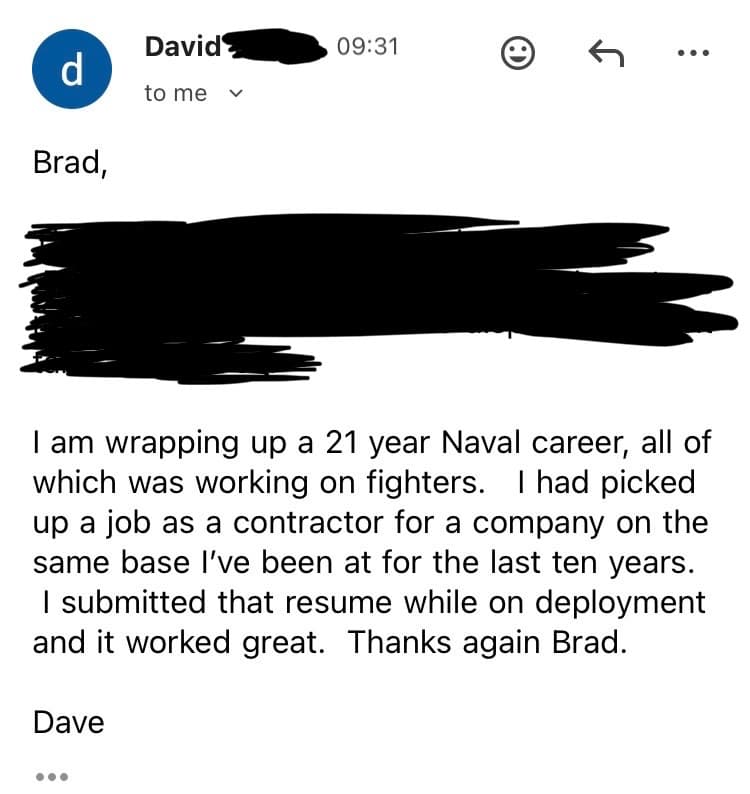
“I am wrapping up a 21 year Naval career, all of which was working on fighters. I had picked up a job as a contractor for a company on the same base I’ve been at for the last ten years. I submitted that resume while on deployment and it worked great. Thanks again Brad. Dave ”
Federal service is one of the strongest landing spots for an ITR because the cryptographic and transmission work you already do has direct General Schedule equivalents, and your clearance carries straight over. Veterans' Preference adds 5 or 10 points to your rated score, and for many of these series your submarine communications experience satisfies the specialized-experience requirement on its own.
GS-0391 Telecommunications is the most direct match. This series covers planning and managing communications systems, circuits, and transmission paths. Submarine radiomen typically qualify around the GS-7 to GS-9 entry band, with GS-11 reachable as you document supervisory or systems-management experience.
GS-0392 General Telecommunications covers the hands-on installation, operation, and repair of communications equipment. Your antenna, SATCOM terminal, and transmission gear work lines up here, commonly at the GS-6 through GS-9 range.
GS-2210 Information Technology Management is the broad IT series, with specialty areas in network services and information security where your LAN and COMSEC work applies. With a Security+ certification and your clearance, GS-9 and GS-11 entry points are realistic.
GS-0856 Electronics Technician fits the RF and electronics maintenance side of the radio room, and GS-0854 Computer Engineering is reachable if you completed an engineering degree on the GI Bill. Agencies that hire heavily into these series include DISA, Naval Information Warfare Systems Command, the Coast Guard, NSA, and Fleet Cyber Command's civilian workforce. Build the application around the federal resume builder, and read how your TS/SCI clearance translates to civilian value before you apply. Other ratings that share these GS targets include the Electronics Technician (ET) rating.
| GS Series | Federal Job Title | Typical Grades | Match | Explore |
|---|---|---|---|---|
| GS-0391 | Telecommunications | GS-7, GS-9, GS-11 | View Details → | |
| GS-0392 | General Telecommunications | GS-6, GS-7, GS-9 | View Details → | |
| GS-0856 | Electronics Technician | GS-7, GS-9, GS-11 | View Details → | |
| GS-2210 | Information Technology Management | GS-9, GS-11, GS-12 | View Details → | |
| GS-0301 | Miscellaneous Administration and Program | GS-7, GS-9, GS-11 | View Details → | |
| GS-0854 | Computer Engineering | GS-7, GS-9, GS-11 | View Details → |
Federal hiring uses keyword-matching and structured experience. BMR builds federal-format resumes (USAJobs-ready) with the right keywords, hours/week, and supervisor info — for any GS series above.
Free · No credit card · Federal + civilian resume formats included
Not everyone wants to stay in a related field. These career paths leverage your transferable skills — leadership, risk management, logistics, project planning — in completely different industries.
Broadcast transmission is RF work in a different industry. The antenna, transmitter, and signal-path skills from the radio room transfer almost directly to TV and radio station transmission engineering.
Live audio and signal routing is the same patch-and-troubleshoot logic as circuit management in the radio room, applied to concert, theater, and production sound.
Sonography runs on the physics of transmitted and reflected signals, the same wave behavior radiomen reason about with RF. Veterans comfortable with signal physics and precise equipment operation adapt well.
Grid control rooms run on the same continuous-watch, calm-under-fault discipline as a submarine comms watch. The job is monitoring a critical networked system and acting fast when something drops.
Cockpit work rewards the exact habits a radioman already has: procedural rigor, clean radio communications, and steady systems monitoring. The comms background removes one of the harder learning curves.
Corporate AV and conferencing integration is signal routing and connectivity troubleshooting in office and venue settings, a clean match for circuit-management instincts.
Emergency operations centers run on communications continuity and coordinated information flow, the heart of a radioman job. Comms planning experience is directly applicable to keeping an EOC connected.
The skills that made you a good Marine, Sailor, Airman, or Soldier transfer further than you think. BMR rewrites your bullets for any of the pivot careers above — without making you sound like you've never done the work.
Free · No credit card · Try unlimited career angles
If you are staying in communications, RF, or IT, your terminology already translates. Satellite operators and defense electronics firms use the same language you do, so this section is for ITRs targeting careers OUTSIDE the radio room, where a hiring manager has never heard a Navy rating spoken out loud.
The fix is not dumbing your experience down. It is naming the civilian-business outcome instead of the Navy system. Here are before-and-after bullets aimed at non-communications roles.
For a project or operations role:
Before: "Managed COMSEC account and circuit patching for submarine radio division during deployment."
After: "Owned accountability for classified equipment and configuration changes across a 24/7 operation, with zero discrepancies across two audit cycles."
For a technical sales or solutions role:
Before: "Operated and maintained SATCOM terminals and HF/UHF transmission systems aboard a fast attack submarine."
After: "Configured, troubleshot, and sustained satellite and radio-frequency communications hardware in a high-stakes environment, translating technical performance into mission outcomes for senior decision-makers."
For a quality or compliance role:
Before: "Stood communications watch and logged message traffic per fleet procedures."
After: "Executed standardized operating procedures under continuous watch conditions, maintaining accurate records that withstood inspection."
For a deeper list, our 50 military terms translated to civilian language guide is the fastest reference, and military skills for a resume covers the phrasing. When you are ready, the resume builder handles the structure, or you can get started here.
BMR turns your ITR duties and accomplishments into civilian bullets that match the job you're applying for — no manual translation, no rewriting.
Free · No credit card · Tailored to each job posting
Which certifications you need depends on where you're headed. Find your target career path below.
The wrong placement can sink an otherwise strong application. BMR knows where each cert ranks, what to call it, and how to frame it for ATS keyword matching and hiring manager attention.
Free · No credit card · Built around your real certs and clearance
SkillBridge Programs: Satellite operators, defense electronics firms, and secure-network vendors participate in DOD SkillBridge, letting you work a civilian comms or IT job during your last 180 days of service. Search the SkillBridge database for openings in SATCOM, RF engineering, and network operations, and read our SkillBridge guide first.
Certification Strategy: A CompTIA Security+ meets the DoD 8140 baseline and is the fastest credential to make your COMSEC and security work legible to civilian employers. From there, target Network+ or a Cisco CCNA for infrastructure roles, or an iNARTE / SATCOM-focused credential if you want to stay on the RF side.
Industry Associations: The CompTIA community supports certification pathways, and SATCOM and broadcast professionals network through industry groups tied to satellite operators and the defense electronics sector.
Technical Sales: Companies selling network gear, secure communications, and SATCOM services hire technical sales engineers who can speak the customer's language. Your hands-on radio-room experience gives you credibility a pure sales rep cannot fake. A Sales Development Rep role at a tech vendor is a common entry point, and many run veteran hiring programs.
Federal Employment (USAJobs): Create your USAJobs profile six months before separation. Federal resumes run longer than civilian ones, and the federal resume builder handles the format.
Veteran Networking: American Corporate Partners (ACP) pairs you with a corporate mentor in your target field, free for veterans.
Clearance Leverage: An active TS/SCI saves employers thousands of dollars and months of processing. Your clearance stays usable for up to 24 months after separation, so start the search before it lapses. See what your clearance is worth in salary.
Next steps and SFL-TAP: Work the SFL-TAP transition resources, explore options on the career crosswalk, and when you are ready, build your resume now.
See also: Air Force 3D1X2 Cyber Transport Systems | Coast Guard ET Electronics Technician | How to translate military jobs on Indeed
Most veterans do this backwards — they wait until terminal leave to start, then panic. Here's the actual sequence that works.
Print this. Tape it to your monitor. Veterans who treat the transition like a 90-day op get hired faster than the ones who treat it like an emergency.
Stop rewriting from scratch every time you apply. BMR turns your military experience into civilian and federal resumes — tailored to each job.