Veterans Service Representative Resume: How to Qualify
Christopher was selected for GS-13 on his first-ever USAJOBS application.
Christopher, E-7, Coast Guard, now writes policy for the work he did on active duty
Open the Veterans Service Representative posting VBA put on USAJOBS on October 1, 2026. Find the section on how you'll be rated. One line is in all caps.
"WE WILL NOT MAKE ASSUMPTIONS REGARDING YOUR EXPERIENCE".
That line is written for you. Maybe you spent years building case files and checking packets for errors. Maybe you explained rules to people who didn't want to hear them. A lot of that is claims work. But say your resume reads "S1 NCOIC" or "Legal LPO". The posting already told you it won't fill in the rest.
I picked candidates from the cert for openings I oversaw. All I had was the page in front of me. I couldn't give credit for work I couldn't see. The VA posting says the same thing in capital letters.
If you're a senior NCO or officer, you're likely asking two things. What grade can I get? And how do I fit 20 years of admin, legal, or investigative work on two pages?
This veterans service representative resume guide answers both, using the real wording from fall 2026 VA postings. You'll get the specialized experience line at each grade. You'll see how to translate your duties into claims language. You'll get example bullets and a look at what the questionnaire checks. This post covers how to write the resume. For pay and the series overview, see the GS-0996 Veterans Claims Examiner series page.
Which title should you apply for: VSR, RVSR, or Veterans Claims Examiner?
Both job titles live in one series, GS-0996. The OPM classification standard for the Veteran Claims Examining series lists two basic titles. They are Veterans Service Representative and Veterans Claims Examiner.
OPM describes the work a little differently for each. A Veterans Service Representative explains benefit programs and runs interviews. They also gather evidence, decide claims, and authorize payment. A Veterans Claims Examiner develops and weighs evidence to decide who gets a benefit and how much. They also authorize benefits and reconsider claims.
The Veterans Benefits Administration (VBA) adds a word in parentheses to show the job's focus. These titles showed up in VBA postings in the fall of 2026.
- Veterans Service Representative: The main entry door. One posting opened October 1, 2026 ran GS-7, GS-9, and GS-10.
- VSR (Rating), often called RVSR: Posted at GS-9 through GS-12. This is the person who rates the claim.
- VSR (Authorizer): Posted at GS-11. It asks for experience deciding and authorizing claims.
- Fiduciary roles (FAR and FSR): Posted from GS-7 up to GS-11.
- Veterans Claims Examiner: Shows up in education benefits work and in senior roles.
Watch the senior titles. A GS-13 Veterans Claims Examiner posting opened October 8, 2026. It asked for recent time as a Rating Veterans Service Representative (RVSR). It also took a Rating Quality Review Specialist (RQRS) or a Decision Review Officer (DRO). That time had to fall within the last three years.
So a GS-13 claims title may not be your first door, even after a long career. For many people coming from the military, the door is VSR or RVSR. One more fence. OPM's standard says helping people fill out claims is a different series. That's Contact Representative, GS-0962. If your posting is 0962, the language in this guide won't match it.
What does specialized experience say at each grade?
OPM's qualification page for series 0996 says there are "no Individual Occupational Requirements" for this series. It points to the group standard for administrative and management jobs. So each posting writes its own specialized experience line. That line is your target. New to the term? Start with this guide to specialized experience on a federal resume.
The lines below come from two real postings. One is the VSR posting from October 1, 2026. The other is a VSR (Rating) posting from September 30, 2026. Yours may word it differently, so read your own.
What does GS-7 VSR ask for?
The GS-7 line asks for one year at the GS-5 level or higher. It names this work.
- Applying laws, regulations, or procedures to analyze evidence.
- Making determinations from that evidence.
- Researching routine issues to resolve discrepancies.
- Using computer systems for data entry and to keep case files.
What changes at GS-9?
At GS-9, the verb moves up. You "analyze evidence to make recommendations". You also follow procedures "to process eligibility claims for benefits". The posting lists disability, insurance, loans, education, and retirement programs as examples.
What does GS-10 add?
The GS-10 line has three parts, joined by "AND". You ask questions about military service or medical evidence to decide eligibility. You review claims to make sure all laws are addressed. And you tell claimants what evidence they still need.
What do GS-11 and GS-12 RVSR ask for?
The rating posting goes higher. GS-11 asks for two things. One is "explaining federal or state-administered benefits decisions to claimants". The other is "evaluating evidence and allegations to draw sound conclusions regarding benefit claims".
GS-12 asks you to determine eligibility for benefits and apply federal or state laws to process claims. That posting offers no education swap at GS-12.
See the word "AND" in those lines? It means you need both halves on the page. Say your resume shows the evidence work but never shows you explaining a decision. That covers half the line.
Volunteer work counts too.
Both postings say you get credit for unpaid and volunteer experience. If you helped vets with benefits through a community group, list it like a job. Give it dates and hours per week.
Which grade can a senior NCO or officer reach?
There's no GS grade for your rank. Two E-7s can land at different grades. It depends on what each one ran. What sets your level is scope. That means how many people, how much gear, how much money, and how far your decisions reached. Put that on the page and the grade follows. Leave it off and they guess low.
Above GS-7, each grade asks for one year at the grade below it on the ladder. For GS-9, that's GS-7. So test yourself against the line, not your rank.
Read the GS-11 line again. Did you weigh evidence and reach a finding? Did you then explain that finding to the person it affected? If both are true, write both down with real numbers.
If you only reviewed packets and passed them up the chain, GS-9 may be the honest fit. That's not a step back. The October 1 VSR posting lists a ladder of GS-07/09/10. It says the selectee "may be promoted to the full performance level without further competition". It also says a lower-grade start "does not guarantee promotion".
Two more grade notes for senior folks.
- Apply at every grade you meet: A posting may list GS-7, 9, and 10. Check each line against your work. Don't skip the lower grade out of pride.
- Time-in-grade is for federal workers: It covers people who held a GS grade in the past 52 weeks. If you're coming straight off active duty, it likely doesn't apply.
For more on the lower grades, see how to qualify for GS-7 and GS-9 positions. If you're reaching for RVSR or Authorizer, the GS-11 federal resume guide goes deeper.
How do you turn military admin, legal, and investigative work into claims language?
Claims work runs on a few moves. You gather evidence. You check it against a rule. You find what's missing or wrong. You make or recommend a call. Then you explain it. A lot of military jobs do those moves every day. They just use different words.
Were you a paralegal or legalman?
An Army 27D Paralegal Specialist or Navy Legalman may have the closest match. Look for these in your own history.
- Claims office time: Reviewing proof of loss, checking it against the rules, and figuring an amount.
- Line of duty determinations: Preparing line of duty packets from medical and duty records for legal review.
- Separation and discipline packets: Checking each packet for missing documents and errors before it moved up.
- Legal assistance: Explaining rules and options to service members in plain words.
Did you work in an S1 or personnel office?
An Army 42A Human Resources Specialist spends a lot of time on eligibility. So do Navy Personnel Specialists, who audit pay records and figure entitlements. Navy Yeomen keep records and build admin packets.
Pay fixes, entitlement checks, records corrections, and award packets all start with a rule. Then you check whether the person's paperwork meets it. That's close to the GS-9 rating example of finding "errors, inconsistencies, or omissions".
Did you work as an investigator?
If you were an Army CID Special Agent, you know evidence. You ran interviews and weighed statements. Then you wrote findings someone else acted on. That maps to the GS-11 line about "evaluating evidence and allegations". For more on that lane, the GS-1810 investigations resume guide covers how investigators write for federal jobs.
What if you led the work instead of doing it?
Senior NCOs and officers often did this work as an extra duty. Maybe you were the investigating officer on an inquiry. Or you reviewed findings before they went to the commander. Both are evidence work. Name it as a duty, with the number of cases and what you decided.
Only claim what you did.
Use the posting's words for work you really did. If a phrase has no real duty behind it, cut it. A matching word with nothing to back it up won't help you.
What do strong VSR resume bullets look like?
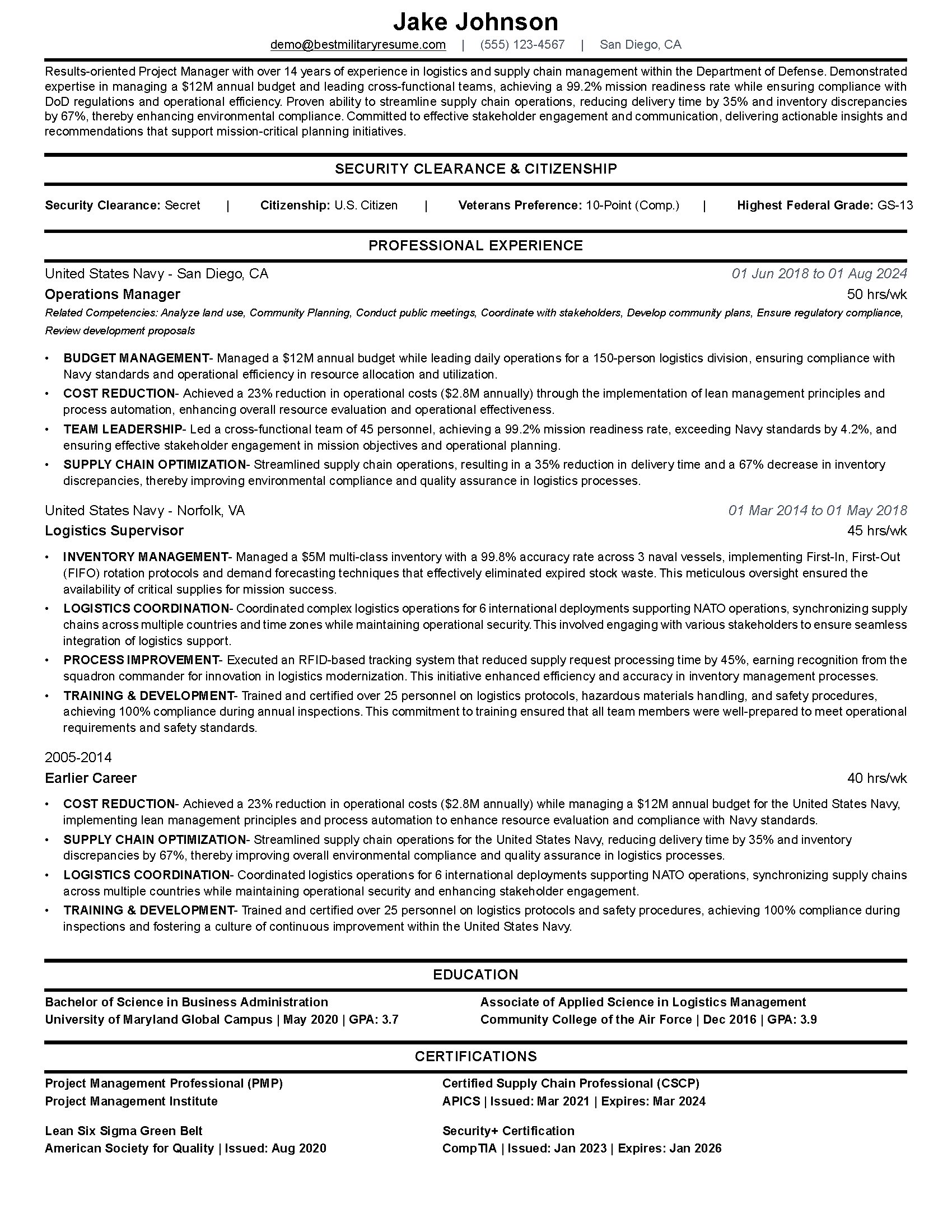
Get the format right first. The October 1 VSR posting spells it out. Each job needs a start and end date by month and year. Each job needs a description of duties. A federal job also needs its grade. The posting says a resume without those is "insufficient to determine basic qualifications".
Hours matter too. That posting counts full time as at least 35 hours a week. Part-time work gets prorated credit, so list your average hours. Read more on how to list hours per week on a federal resume.
Now the bullets. Below is a common way people write an S1 job. Next to it is a version built from the GS-9 line.
Battalion S1 NCOIC. Responsible for all personnel actions and admin support.
Reviewed [number] pay and entitlement cases a month against Army rules. Found errors and missing documents. Requested the needed evidence and recommended a decision.
The first line names a billet. The second shows the work the GS-9 line asks for. Fill the brackets with your real numbers. Four more bullets you can adapt are below. Each one maps to a grade line above.
- GS-7 line (apply rules to evidence): Checked [number] separation packets against the regulation. Flagged missing forms and returned each with a fix list.
- GS-9 line (process eligibility claims): Processed [number] personnel claims for lost or damaged property. Verified proof of loss and recommended payment amounts.
- GS-10 line (inform claimants): Told service members which records they still needed. Tracked each case until the file was complete.
- GS-11 line (evaluate and explain): Weighed witness statements and records in [number] investigations. Wrote findings and briefed the outcome to the people involved.
Keep the scope in every bullet. Say how many cases and how often. The rank comes off, but the size of what you ran stays. For more on adding numbers, see how to quantify military accomplishments.
What does the occupational questionnaire check?
The questionnaire asks you to rate your own experience on tasks from the posting. Read it before you write your resume. The October 1 VSR posting links a preview of the questionnaire right in the announcement.
That posting also names the skills it will look at. They include Attention to Detail, Customer Service, Decision Making, and Reasoning. Written and oral communication are on the list too. Each one should show up in a real bullet somewhere.
Hold yourself to one rule. Every time you pick a top answer, point to the bullet that proves it. The posting warns that overstating your experience "may result in your removal from consideration". So your answers and your resume need to tell the same story. Our guide to the USAJOBS occupational questionnaire walks through each answer level.
Do you write essays or take a test?
The same posting says "Narrative responses are not required at this time". If you're referred, they may ask for more later. That could include a work sample or an interview.
Some VSR postings also use USA Hire assessments. You get a link after you submit. The October 1 posting says to set aside about two hours. It says your answers get reused for a year on jobs with the same tests, in most cases. So take it seriously the first time.
1 Preview the questionnaire.
2 Match each task to a bullet.
3 Check the grade line.
4 Block time for the test.
How do you fit a long career on two pages, and what else goes in the package?
Federal resumes are two pages for most jobs. Always check the announcement, because some are exceptions. One VSR posting puts it in writing. A resume longer than two pages "will result in ineligibility for further consideration". More on the rule in our post on the federal resume two-page limit.
So what stays? Start with the jobs that match the specialized experience line. Give those the most room. Older jobs that don't match can shrink to a line or two. The posting's own tips say the same thing. Put relevant and recent work first. Use the language from the announcement. Remove outdated or unrelated experience.
Don't spend lines on duties that sound big but don't match. Twenty years of range control won't help a VSR resume much. One year of claims office work might carry the whole thing.
Which documents go with it?
The October 1 VSR posting asked for more than a resume. These items applied to veterans.
- DD-214, Member-4 copy: This shows your dates and character of service.
- Still on active duty: Getting out within 120 days? Send a certification instead of the DD-214.
- 10-point preference: Add an SF-15 and the proof the form asks for.
- Disability rating letter: Include it if it applies to you.
- Transcripts: Only if you're using education to qualify.
For how preference points work, read veterans preference explained. OPM's FedsHireVets lists the special hiring authorities open to veterans.
Late papers don't count.
The October 1 VSR posting says it won't ask for missing documents after it closes. Upload everything before you hit submit.
What to Do Next
Pick one live VSR or RVSR posting. Find the specialized experience line for each grade you'll apply for. Then build each bullet to answer that line, with your real numbers. Need help reading the rest of the posting? See how to decode a USAJOBS job announcement.
That's the step BMR's Federal Resume Builder does for you. Paste the posting, and BMR reads it and copies your base resume. It rewrites your summary, work bullets, and skills in the posting's own words. It won't add work you never did. For federal jobs, it grades you against the minimum qualification and tells you if you don't meet it. Then it can condense the result to two pages.
The free tier includes one federal tailored resume and one private one. That's enough to build your first VSR version tonight.
Once it's in, the wait starts. Read up on the VA hiring timeline. When the call comes, get ready for the federal structured interview.
Frequently Asked Questions
What series is a Veterans Service Representative job?
What grade does a Veterans Service Representative start at?
Do I need a degree to become a VSR?
How long can a Veterans Service Representative resume be?
What is the difference between a VSR and an RVSR?
Does military legal or admin work count as specialized experience?
Do I have to write essays for a VSR job?
About the Author
Brad Tachi is the CEO and founder of Best Military Resume and a 2025 Military Friendly Vetrepreneur of the Year award recipient for overseas excellence. A former U.S. Navy Diver with over 20 years of combined military, private sector, and federal government experience, Brad brings unparalleled expertise to help veterans and military service members successfully transition to rewarding civilian careers. Having personally navigated the military-to-civilian transition, Brad deeply understands the challenges veterans face and specializes in translating military experience into compelling resumes that capture the attention of civilian employers. Through Best Military Resume, Brad has helped thousands of service members land their dream jobs by providing expert resume writing, career coaching, and job search strategies tailored specifically for the veteran community.
