Michigan Veterans Preference: Rule 3-8's Three Forms and How to Claim
"Still getting interviews left and right. Now I have to say no."
Taranjeet, E-5, Army, optimized her LinkedIn and resume with BMR
Michigan's veterans preference for state jobs comes in three forms, and the agency's hiring method decides which apply. Civil Service Rule 3-8, amended September 5, 2021, grants exam points, a screening percent or a pool spot. It covers first hires and later promotions. It does not promise you the job.
Many people who search this land on a 2021 state press release first. It gets two of the three forms wrong and skips the papers.
Below, find which form your posting uses and the papers that keep the preference yours.
The three forms of preference, side by side
Rule 3-8.3 ties each form to the way the agency narrows the field. The agency's method sets the form, not you.
| How the agency selects | What Rule 3-8.3 adds | Worked math |
|---|---|---|
| A scored written exam, in whole or in part | 5 or 10 points on your final passing score | [your passing score] + 5, or [your passing score] + 10 |
| A numeric screening score, in whole or in part | 5 or 10 percent of the highest screening score anyone got | [your screening score] + 5 percent of [the top screening score] |
| Mechanical or random screening | No points. You must be "retained and placed in the candidate pool." | None. You stay in. |
Look at the second row closely. The percent comes from the top score, not your own. So every 5 percent veteran on that posting gets the same size bump.
Who gets 5 and who gets 10 is the same on both scored rows:
- 5 points or 5 percent: a veteran or a surviving spouse.
- 10 points or 10 percent: a disabled veteran. A spouse of a disabled veteran with greater than 50 percent service-connected disability. A surviving spouse who has a child under 18. A surviving spouse with continuing parental care of a disabled child.
Two limits sit on all three rows. First, you must request the preference when you apply. Second, the agency still uses "the same merit appraisal methods used for other applicants." Rule 3-8.1 says a person granted a preference "is not guaranteed appointment."
Checked November 2026 against Rule 3-8 as amended September 5, 2021, in the rulebook dated April 15, 2022. Claim steps checked against the state's veterans preference registration posting, revised October 10, 2023.
Where the 2021 press release and the rule part ways
The top search result for Michigan veterans preference is a state press release. It is the Michigan Veterans Affairs Agency release of November 5, 2021. It differs from the rule in three ways.
- Exams: the release says "A 5% or 10% preference" on passing exam scores. The rule says 5 or 10 points. Percent shows up only in the screening row.
- Random screening: the release says "Automatic advancement." The rule says you are "retained and placed in the candidate pool." Staying in the pool is not moving ahead.
- The claim: the release says you apply online on the state jobs website. It leaves out the papers. It also leaves out the step that must come first.
When the two disagree, I go with the rule. The release does add one useful fact. Since the 2021 change, more than one form can apply to a single posting. Current state workers can now use the preference for promotions, too. The registration posting says it covers "initial hires and later promotional opportunities."
Who qualifies under Rule 3-8.2
A veteran must meet both parts of the test:
- Service: "90 or more days of active-duty service in the armed forces of the United States."
- Discharge: "honorably discharged from active duty."
Still in uniform? You may count if you are "scheduled to separate from active service within six months." Your branch must give "suitable proof of a likely honorable discharge." If the discharge is not honorable in the end, you must tell civil service staff.
A disabled veteran is a veteran found eligible for disability compensation for a service-connected disability. Under the rule, that finding comes from the VA or a branch of the armed forces.
The Commission's own handout, revised September 5, 2021, words it a bit differently. It adds the Department of Defense to that list. It also says the disabled veteran must be "released from active military duty." The rule text uses neither phrase.
Spouses need to read the tiers with care. A surviving spouse sits in the 5 tier. The surviving spouse moves to 10 with a child under 18 or a disabled child in their care.
A spouse of a living veteran shows up only in the 10 tier. That spouse qualifies only when the veteran is disabled with greater than 50 percent service-connected disability.
The handout adds one bar for everyone. You must meet "the minimum qualifications for the job classification and any position-specific selection criteria." Preference starts after that, not instead of it.
Federal jobs run on a separate system with its own rules. For that one, see how federal veterans preference works.
Guard and Reserve service: what the rule text says
Rule 3-8.2 names "active-duty service in the armed forces." It does not mention Guard or Reserve drill time at all. The registration posting does accept an NGB Form 22 as proof of service.
Drill-only service is a different case. No state text we found says it counts under Rule 3-8. None says it does not. Ask before you count on it. The handout lists [email protected] for questions.
Reading a Michigan posting for its selection method
You can't pick the form, but you can plan for it. I'd do this before writing a single line of the resume. Find where the posting says how applicants get scored or narrowed. Then match it to the rule.
- It names a written exam with a score: plan on the exam row. Your points land on a passing score, so you must pass first.
- It scores applications to cut the pool: plan on the screening row. Your add-on is a slice of the top score. So your own score still matters.
- It narrows the pool at random: plan on staying in. Nothing gets added. But a qualified eligible applicant who requested preference can't be cut by the draw.
- It uses none of these: Rule 3-8.3 names no add-on for that case. Rule 3-8.1 still makes you eligible for "a preference in consideration." Request it anyway.
A posting with a scored step and a random cut may use two forms. That is the 2021 change at work.
Other states build this in other ways. The Ohio exam credit guide shows a percent on the exam itself. Michigan's exam preference is flat points.
Claiming it: register first, then request it on each application
The order matters. The Commission's military and veteran page says you "must first register" "before applying to an open position." You do it in NEOGOV, the state's job portal. The registration is its own posting. It is job number 1999-16, open on a continuous basis.
- Open the registration posting: read the eligibility and document list. Then click Apply and sign in to NEOGOV.
- Attach your proof: the Commission's FAQ says "You must attach proof of eligibility to the registration application."
- Apply to each job: once registered, you apply on the state's Job Openings page.
- Request the preference on each application: Rule 3-8.3 gives it to an applicant "who requests a preference in consideration when applying."
Official military forms "must be from" the VA or the Department of Defense, the posting says. By group, it asks for these papers:
- Veteran released from active duty: "a DD Form 214-Member 4, NGB Form 22 or equivalent DVA form." Not sure which copy you have? This guide to DD-214 copies walks through it.
- Disabled veteran: that same form. Add DVA or DOD proof of your current disability pay or disability retirement.
- Within six months of separation: a Statement of Service. It shows your branch, periods of service, and campaign badges or expeditionary medals. It also shows your separation or approved terminal leave date. Last, it shows your expected discharge date under honorable conditions.
- Spouse of a disabled veteran over 50 percent: the veteran's form, the DVA or DOD pay paper, and a marriage certificate.
- Surviving spouse: the veteran's form, a marriage certificate, and the veteran's death certificate. With a child, add a birth or adoption certificate or proof of legal guardianship. For a disabled child, add proof of the disability.
Were you eligible, did you ask on time, and still not get the preference the rule requires? Rule 3-8.4 lets you file a technical appointment complaint.
County, city and township jobs: the 1897 Act
Rule 3-8 covers the state classified service. Local public jobs fall under an older law. It is the Veterans Preference Act, 1897 PA 205 (MCL 35.401 to 35.404).
Section 35.401 covers public departments of the state and of every county and municipal corporation. There, "a veteran shall be preferred for appointment and employment." It sets no points and no percent.
The Act has three conditions. You must be "of good moral character." You must be a state resident "for at least 2 years." And you must hold the other qualifications for the job.
Its veteran test differs from Rule 3-8. It uses MCL 35.61, which counts service "including the reserve components." That section requires a discharge under conditions other than dishonorable. Section 35.401 then adds that you must have been honorably discharged. It sets no 90-day floor.
When the Act and the state civil service law conflict, Section 35.401 says the civil service law wins. So for a state classified posting, Rule 3-8 sets your preference.
What to Do Next
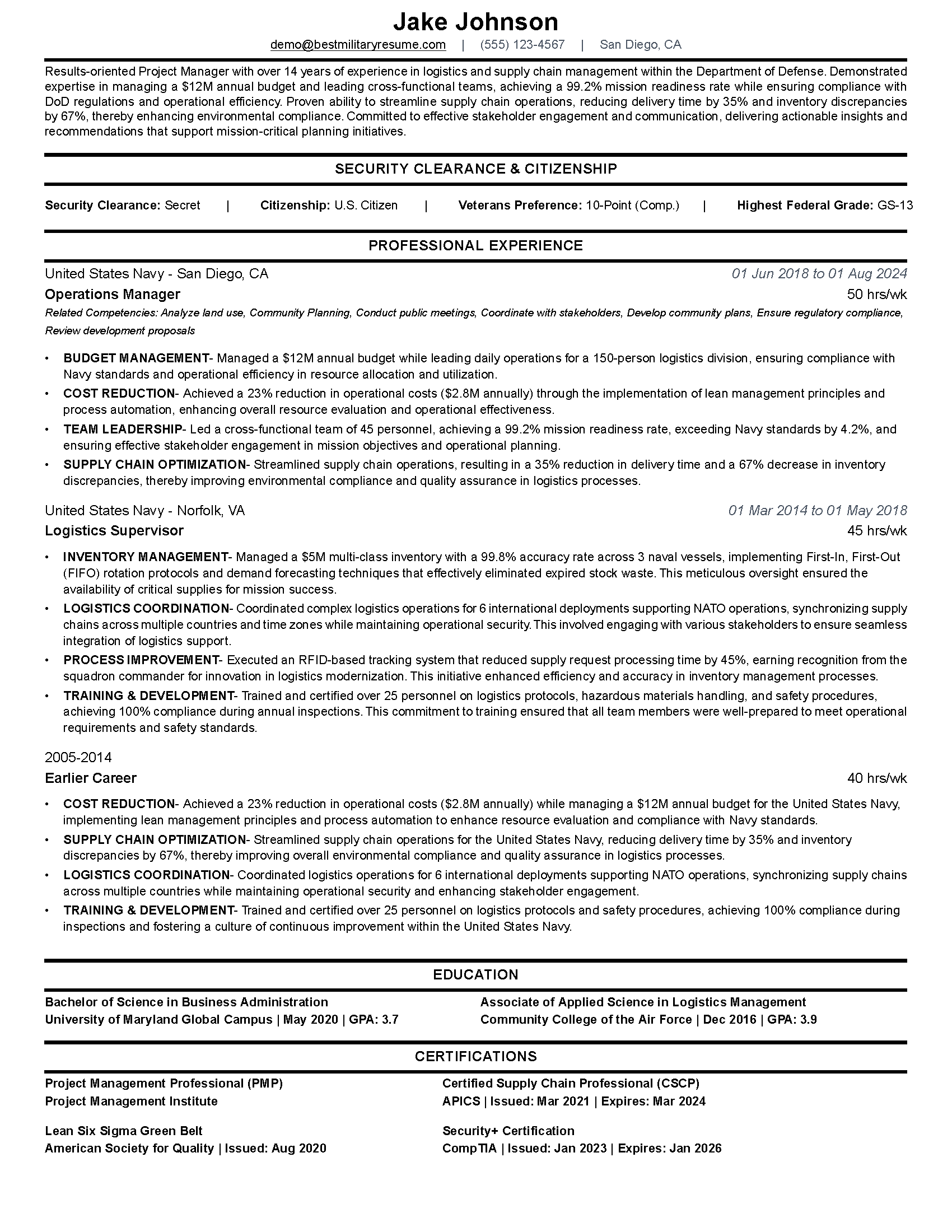
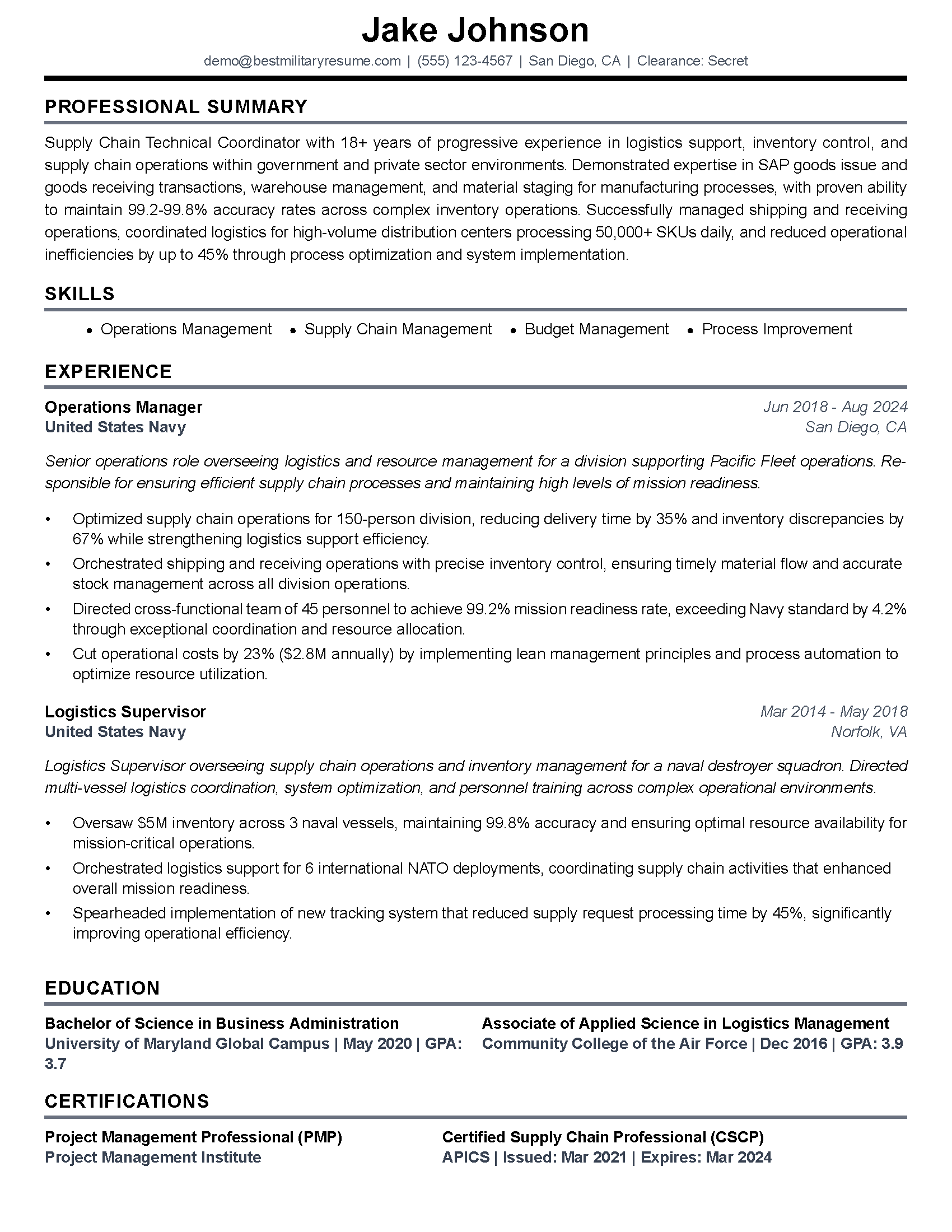
Register on the 1999-16 posting this week, before you find the job you want. Then build a resume for the Michigan posting you plan to apply for.
Michael, a Navy Senior Chief, tailored a resume to each job he targeted. He wrote: "I used BMR to tailor my conventional and federal resume for 50+ targeted jobs." He landed "a job as a Program Manager for a government agency." His note does not say if it was state or federal.
Open the military resume builder, sign in, and paste the Michigan posting. It reads the posting and copies your base resume. Then it rewrites your summary, work bullets and skills in the posting's own words. To run one resume against many jobs, see how to tailor one resume to different postings.
Frequently Asked Questions
Can a military retiree use Michigan's state veterans preference?
Should my uploaded DD-214 show my Social Security number?
I'm still serving and don't have a DD-214 yet. What do I upload?
Does a Michigan public job count my military time toward pay?
Does veterans preference let me skip a drug test?
About the author
Brad Tachi is the CEO and founder of Best Military Resume and a 2025 Military Friendly Vetrepreneur of the Year award recipient for overseas excellence. A former U.S. Navy Diver with over 20 years of combined military, private sector, and federal government experience, Brad brings unparalleled expertise to help veterans and military service members successfully transition to rewarding civilian careers. Having personally navigated the military-to-civilian transition, Brad deeply understands the challenges veterans face and specializes in translating military experience into compelling resumes that capture the attention of civilian employers. Through Best Military Resume, Brad has helped thousands of service members land their dream jobs by providing expert resume writing, career coaching, and job search strategies tailored specifically for the veteran community.
