Pennsylvania Veterans Preference: 10 Points and the Rule of Three
"Still getting interviews left and right. Now I have to say no."
Taranjeet, E-5, Army, optimized her LinkedIn and resume with BMR
Pennsylvania adds 10 points to a veteran's passing civil service exam score, under 51 Pa.C.S. § 7103. Within the Rule of Three, or another number the state sets, a veteran gets mandatory preference over non-veterans.
Some state jobs have no exam at all. On those, a veteran who meets the minimum and requisite qualifications "will be interviewed." Meet every requirement after the interview, and you "MUST be given a conditional offer of employment." Both lines come from the Office of Administration's veterans' preference page.
The law is strong, but the paperwork trips people up. You'll leave with the paperwork list in order and a fill-in template for each requisite qualification.
Rules checked against 51 Pa.C.S. Chapter 71, 51 Pa.C.S. Chapter 72, 71 Pa.C.S. § 2402, 4 Pa. Code § 608.4 and the two state agency pages in November 2026.
Which rule covers your job: civil service or non-civil service?
The posting tells you. The OA page says each posting will show whether the job is civil service or non-civil service. Find that line before you write anything. It decides which column below is yours.
| What you get | Civil service job (exam) | Non-civil service job (no exam) |
|---|---|---|
| Points. | 10 points on a passing final exam score. | No exam, so no points. |
| Next step. | Mandatory preference if you're inside the Rule of Three, or the other number the state set. | An interview if you meet the minimum and requisite qualifications. |
| The offer. | Subject to a background check. | A conditional offer if you meet all posted requirements after the interview. |
| Also covers. | Civil service exams for state jobs. | Internships and fellowship programs, per the OA page. |
| The law. | Sections 7103(a) and 7104(b). | Section 7104(a). |
Florida's rule for no-exam jobs promises an interview too. You can compare it on our Florida veterans preference page. Pennsylvania's agency page names both the interview and the conditional offer.
How do the 10 points and the Rule of Three work together?
Think of it as two steps. The points can move you up the list. The Rule of Three then sets who can be picked.
Step 1: the points set your rank
Pass the exam first. The 10 points go on top of your final score. That score sets your spot on the list. The list an agency gets marks your veteran status and the added points. That comes from 4 Pa. Code § 608.4, in effect since March 12, 2025.
Federal jobs work differently. Our guide to federal veterans preference explains that system. Pennsylvania's law gives every eligible veteran the same 10 points.
Step 2: the Rule of Three sets who can be picked
Under 71 Pa.C.S. § 2402, the agency picks from the three highest ranked people available. The state can set a different number, or everyone on the list. It has to set that before the test.
Inside that group, rank matters less for you. Section 7104(b) says the agency "shall give preference to the veteran, notwithstanding the veteran's standing on the eligible list." The OA page calls this a mandatory preference over non-veterans. So third place in the top three still gets it.
Say your score puts you just outside the top three before the points. The 10 points may lift you into the top three, or they may not. It depends on the other scores. Once you're in, you hold the preference over the non-veterans in that group.
Not on the list the agency got? Section 7104(c) says an agency "may" still give you preference. You must have passed the exam and hold the requisite qualifications. That's a may, not a must.
Two list rules in § 2402
- The certification expires: A certification of eligibles issued under § 2402 is valid for 90 business days.
- Passed over three times: This one isn't just for veterans. After three rejections by one agency from one list, a person isn't sent to that agency again. The agency can ask in writing to change that.
Does your service count? The five groups in the law
The law's definition of "veteran" is in § 7101.2. You count if you fit one of these five groups. The first four groups each include the reserve components and the National Guard.
- Finished your contract and got out: You completed your initial service obligation. Your last discharge or release was under conditions other than dishonorable.
- Wartime tour, still serving: You served in a period of war or armed conflict set by DoD. You finished an active duty tour for purposes other than training. You were released from it under conditions other than dishonorable, and you still serve.
- Still serving after your first contract: You completed an initial service obligation and you continue to serve.
- Discharged for a disability: Your last discharge was due to a disability and under conditions other than dishonorable.
- About to get out: You're on active duty, finishing a tour of three years or more. You're within 90 days of an approved discharge or release. You have papers showing a projected discharge under conditions other than dishonorable.
Group 4 is easy to miss. The State Civil Service Commission's veterans page leaves it out of its list. The statute has it. The OA page adds a note. It counts only if your DD 214 gives "Disability" as the reason. A VA disability rating alone isn't the same thing.
"Under conditions other than dishonorable" also has a set meaning in § 7101.2. It covers an honorable discharge and a general, under honorable conditions, discharge. It also covers an other than dishonorable discharge if VA has found you eligible for benefits.
Can a spouse use it?
Yes, in two cases. Section 7108 gives "the same preference" to a surviving spouse or the spouse of a disabled veteran. Each one has its own conditions.
- Surviving spouse: The law means an unmarried spouse of a deceased veteran. It also covers the unmarried spouse of a service member who died on active duty. That includes the reserves and Guard.
- Spouse of a disabled veteran: The veteran must have a permanent total disability. VA's Veterans Benefits Administration makes that call.
The OA page also says the deceased or disabled member must meet the law's definition of "veteran." If your case is a death on active duty, ask the OA unit below which papers it needs.
The papers differ by case. A surviving spouse sends the veteran's service papers. Add a certified copy of the death certificate, not a photocopy, and proof of marriage. The OA page also asks for a statement that you have not remarried.
The spouse of a disabled veteran sends the veteran's service papers. Add a current VA letter verifying permanent total disability, and proof of marriage. The OA page also asks for a signed statement from the veteran agreeing to transfer credit to you.
Still in uniform, in the Guard, or on terminal leave?
You can claim it before your DD 214 exists. Two paths cover this.
Within 90 days of getting out. This is group 5 above. Send your papers showing the projected discharge with the application. If the agency picks you, send the final form before you start. Section 608.4(c)(1) names the DD 214 (member 4 copy), DD 215, NGB-22 or statement of service.
Still serving, or on terminal or transitional leave. Use a statement of service. Section 7101.2 says it must be "signed by, or at the direction of the adjutant, personnel office or commander of the unit or higher headquarters." Ask your unit for it early. A signature can take time.
Whatever your path, the deadline for proof is firm. Under §§ 7103 and 7104, a veteran "may not begin or hold the public position" until the papers reach the agency.
What to send, and when: the checklist in order
- Read the posting: Find the civil service or non-civil service line. Note any requisite qualifications it lists.
- Pick your paper: Section 608.4(c)(1) lists the DD 214 (member 4 copy), DD 215 and NGB-22. It also lists a statement of service or projected discharge papers.
- Check what it shows: It must show your date of entry and character of service. Where it applies, it must show you finished your initial contract.
- Make a copy: Send a photocopy of your service papers. The OA page says originals can't be returned. You may be asked to show the original later.
- Send it with the application: Section 608.4(c)(1) says "during the application process." Don't wait for an interview.
- Spouses, add your papers: Use the list in the spouse section above.
- Close out projected discharge: If you used projected discharge papers, send the final form before your start date.
Need a copy of your records? The OA page lists the National Personnel Records Center. It also lists Pennsylvania's Department of Military and Veterans Affairs. That one helps if you were discharged after 1994 and registered your papers there.
The OA page doesn't say where in the online application the file goes. Follow the posting's steps, or ask the OA unit.
How do you prove each requisite qualification in the posting's words?
This part matters most on a no-exam job. The law defines "requisite qualifications" in § 7101.2. They're "the experience, education, academic success, training, certifications, proficiencies, interpersonal skills and intangibles required for an applicant to successfully perform in a public position."
Your military training counts here. Section 7105(a) says agencies "shall consider relevant training or education received by a veteran during the veteran's service" in place of formal training and education. Section 7105(b) adds that age, or an impairment that doesn't incapacitate you, can't disqualify you. That holds if you have the requisite qualifications.
So copy each requisite qualification from the posting into a list. Under each one, write a line of proof with this template:
Fill-in template for one requisite qualification.
Posting says: [the requisite qualification, copied word for word].
Your line: [posting's key phrase] for [number] people or [dollar value], with [your result].
Training line: [course or school name], [length], finished [year], where the posting asks for training or education.
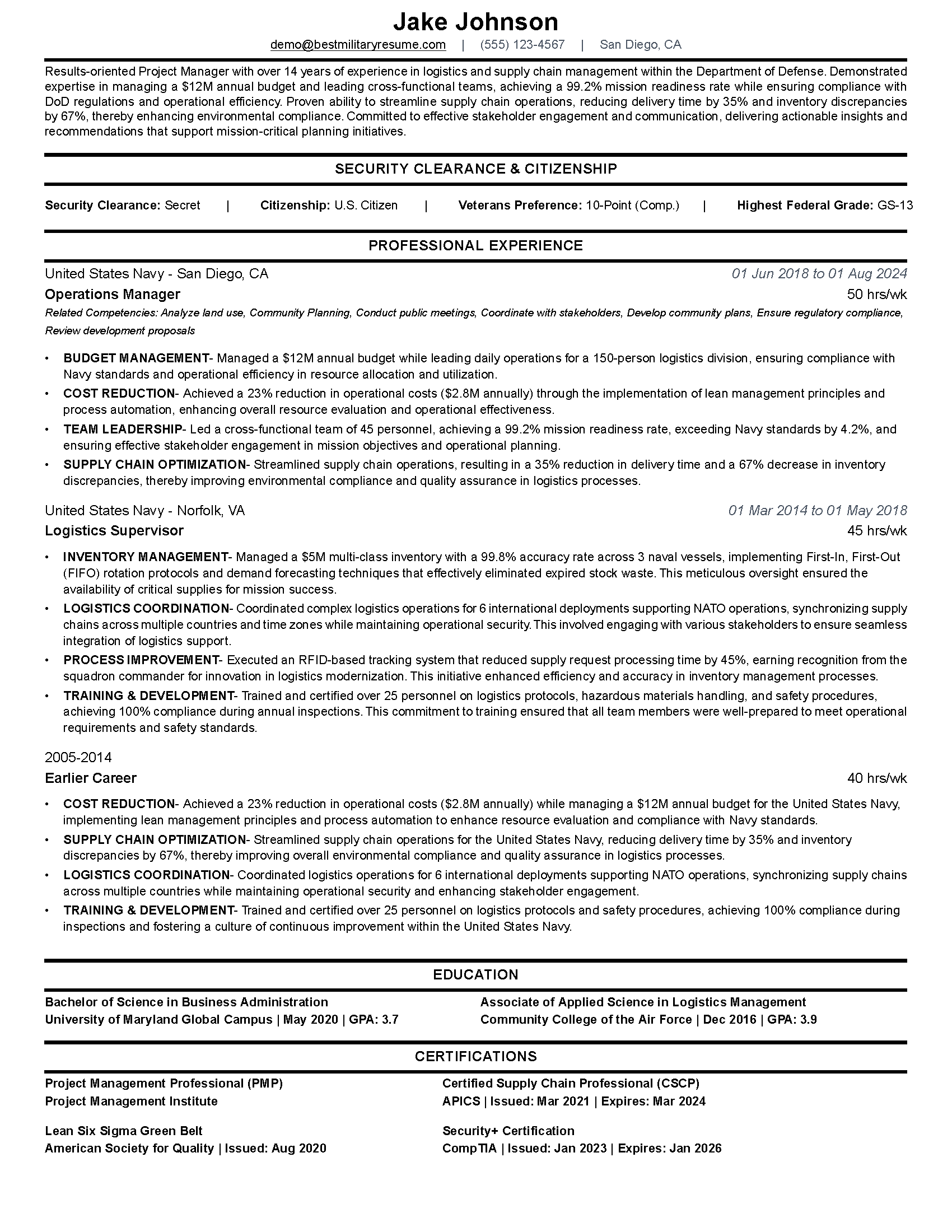
Use the posting's own words in each line. Fill the brackets only with facts from your record. If a line has no real work behind it, cut it. Need to split minimums from extras? See how to read a job posting and decide if you qualify.
Do this for each listed qualification, not just the easy ones. The OA's offer rule turns on meeting "all established requirements." One missing line can cost you the conditional offer the OA page promises. Our guide to tailoring one military resume to each posting shows the same move on a full resume.
What doesn't the preference cover?
The OA page is plain about this. It says "veterans' preference does NOT apply to promotions or internal civil service postings." Its non-civil service section repeats the promotion point. So the 10 points help you get hired, not move up once you're in.
Questions about your case go to the OA's Veterans' Preference unit. That covers eligibility periods, documents or anything above.
- Email: [email protected].
- Phone: 717.783.6655, or TRS 711 for hearing or speech impaired callers.
- Mail: Office of Administration, 513 Finance Building, 613 North Street, Harrisburg, PA 17120.
Next step: write the proof lines for your Pennsylvania posting
The paperwork is a checklist. The proof under each requisite qualification is the part only you can write. On a no-exam job, Pennsylvania veterans preference gets you the interview if you meet the posted qualifications. Those lines help carry you to the offer.
Eli, a Marine Colonel (O-6), sent BMR this note after he tailored his resume job by job: "I used the resume program to transition a very government centric resume into one that could be easily understood and appreciated in the civilian sector. I applied to several government and corporate jobs using the resume builder to adjust my details according to the job I was applying for. I recently signed a contract making over 6 figures plus yearly bonuses, part ownership in the project I am directing and full use of the company's assets globally."
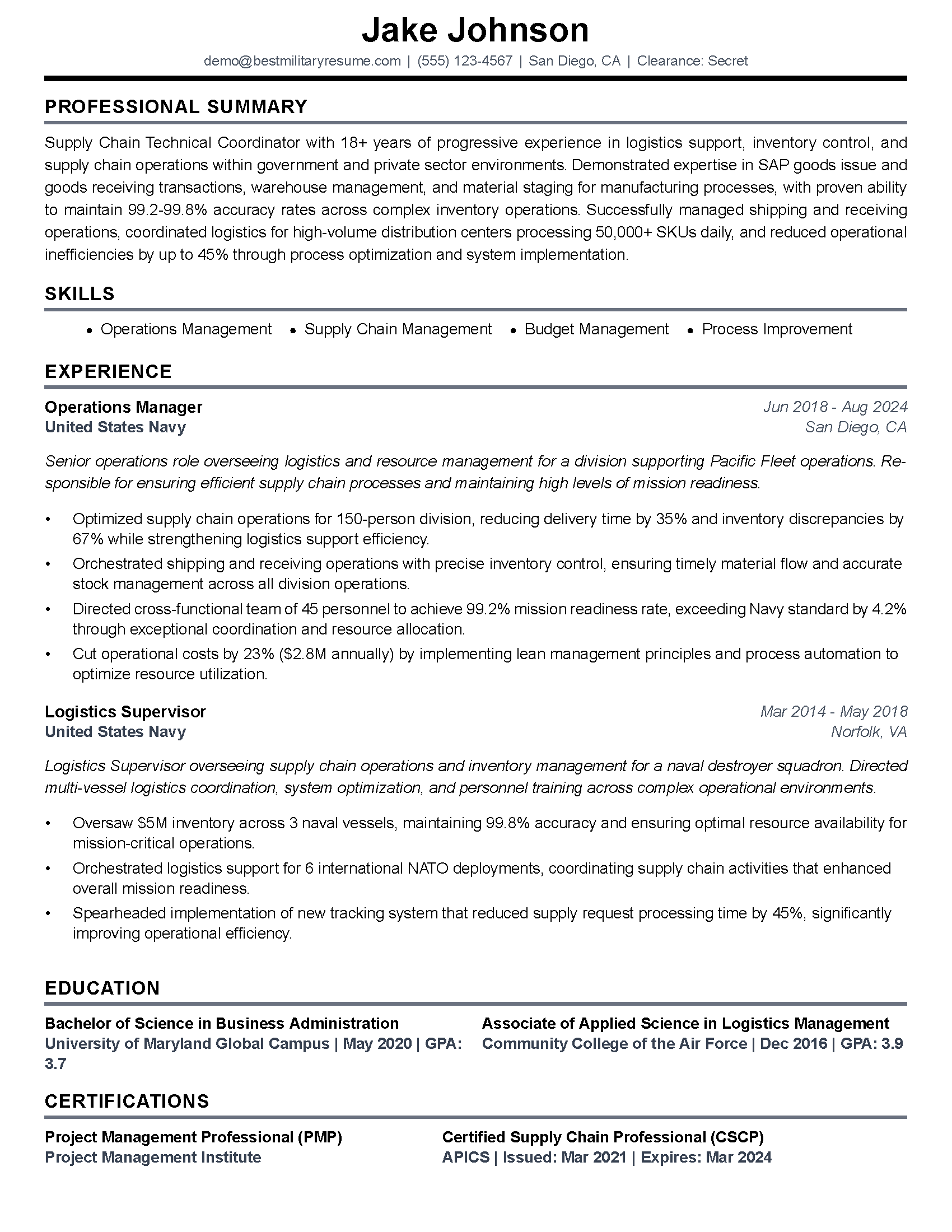
Do what Eli did, one Pennsylvania posting at a time. Write your requisite-qualification list first. Then sign in to the Military Resume Builder and paste the posting in. Build the version for that job, and send it with your service papers.
Frequently Asked Questions
Does Pennsylvania veterans preference apply to city and county jobs?
Do Pennsylvania public works contractors have to give veterans preference?
Does military service count in a Pennsylvania public job layoff?
Who checks that Pennsylvania agencies follow veterans preference?
Do private employers in Pennsylvania have to give veterans preference?
About the author
Brad Tachi is the CEO and founder of Best Military Resume and a 2025 Military Friendly Vetrepreneur of the Year award recipient for overseas excellence. A former U.S. Navy Diver with over 20 years of combined military, private sector, and federal government experience, Brad brings unparalleled expertise to help veterans and military service members successfully transition to rewarding civilian careers. Having personally navigated the military-to-civilian transition, Brad deeply understands the challenges veterans face and specializes in translating military experience into compelling resumes that capture the attention of civilian employers. Through Best Military Resume, Brad has helped thousands of service members land their dream jobs by providing expert resume writing, career coaching, and job search strategies tailored specifically for the veteran community.
