Navy Eval to Resume: Turn Your NAVPERS 1616/26 Into Bullets
Desiree landed a $135K hybrid senior financial consultant role.
Desiree, E-5, Army National Guard, the interviewer loved the resume from the top down
I got out of the Navy after about nine years as a diver. My evals were the best record of my work I had. They had the numbers. They had the jobs. But they were written in Navy shorthand for a promotion board. A civilian recruiter can't do much with "SUPERB LS2! EP!"
There's a reason your eval never talks about civilian jobs. The Navy's own eval manual tells the people who write them not to. That rule sits in the current Navy Performance Evaluation System instruction, BUPERSINST 1610.10H. It's dated 30 July 2025, with changes through 26 May 2026. It bans comments on a member's potential for civilian employment. So the translation is your job. The Navy left it out on purpose.
This Navy eval to resume guide covers the enlisted EVAL, NAVPERS 1616/26, for E-1 to E-6. It also covers the CHIEFEVAL, NAVPERS 1616/27, where it differs. You'll get a block-by-block map, four before-and-after bullets you can copy the shape of, and what to cut. Got Army, Marine or officer reports too? The guide to converting an NCOER, OER or FITREP covers those. This one stays on the Navy enlisted forms.
Where do you get copies of your old Navy evals?
Start here, because you can't translate what you can't see. Pull every eval you have, not just the last two. Older reports often hold your best numbers from a sea tour.
If you're still serving
Your evals sit in your Official Military Personnel File (OMPF). MyNavy HR says active duty and reserve members can view it online. You need a BUPERS Online account, a CAC and a CAC-enabled computer. Then use the OMPF - My Record link in BUPERS Online. Save a copy of every eval while your CAC still works. That's the easy window.
If you're already out
The VA explains how to get your military service records. Navy veterans discharged after January 1, 1995 can request them from the Defense Department through milConnect. You'll need an account. The other routes are the National Archives' eVetRecs tool or a Standard Form 180 by mail or fax.
Check your own files too. The instruction says a copy of each report goes to the member. Plenty of Sailors kept a folder of signed copies and forgot about it.
Which blocks on the EVAL carry resume value?
The EVAL has 52 blocks. Most of them are admin. A handful matter for a resume, and they don't all matter the same way. The map below uses the block numbers from the current EVAL form and the 1610.10H manual.
| Block | What it holds | How to use it |
|---|---|---|
| 28. Command employment. | What the command did that period. | Context for your bullets. Turn "Deployed-6" into "during a 6-month deployment." |
| 29. Duties and job scope. | Your primary, collateral and watch duties, with months in each, plus a scope line. | Your job titles and team size. The scope line often lists people supervised and budget. |
| 33 to 39. Performance traits. | Seven graded traits. | Themes only. The grades stay off the resume. |
| 43. Comments on performance. | The narrative. | Your bullets. Most of your resume comes from here. |
| 44. Qualifications and achievements. | Courses, degrees, certificates, quals, awards. | Certifications, training and awards sections. |
| 45 and 46. Promotion recommendation and summary group. | Your mark and how many peers got each mark. | One translated line at most. |
A few blocks are easy to misuse. Block 41 is the career recommendation, like "RDC" or "Commission Program." That's the reporting senior's pick for your next Navy job, so leave it off. Block 29 also carries your PFA results. Those stay off too.
What about NECs and quals?
The EVAL form has no NEC block. Pull your NECs from your record. Translate each one by what you can do, not by its code. Quals earned that period show up in block 44, and sometimes again in the comments. A Navy qual title may need a plain line next to it. Say what the qual lets you do.
Got collateral duties in block 29? The guide on writing collateral duties as resume bullets goes deeper on that one block.
How do you read a comments-block line for its bullet?
Block 43 is where most of your resume lives. The manual says bullet style is preferred for comments. It asks for examples of performance and results, quantified wherever they can. So the numbers are usually there already. They're just wrapped in Navy words.
Read each comment line and pull out four things.
- The action: What did you actually do? Look for the verb under the praise.
- The scope: How many people, how much money, how much gear, how many hours?
- The result: What changed because you did it? A rate went up, time went down, money got saved.
- The plain word: What would a civilian in that job call this work?
Skip the adjectives. "Superb," "phenomenal" and "my #1 Sailor" are praise for a board. A recruiter wants the thing you did and what it changed. If a line has praise and no action, it doesn't make a bullet. Move to the next one.
Watch for comments that bundle three jobs into one line. Eval space is tight, so raters cram. On a resume, each job gets its own bullet.
What does a converted bullet look like?
Below are four before-and-after examples. The eval lines and numbers are made up to show the shape. They match how real comment blocks read, but they aren't from anyone's record. Swap in your own numbers. The Military Resume Builder can do this pass from an uploaded eval. Knowing the method helps you check its work.
Example 1: Logistics Specialist (LS2)
Eval line (example): "SUPERB LS2! Managed 1,200-line OPTAR worth $2.1M with zero discrepancies on SMI. Trained 6 junior Sailors on R-Supply."
The resume version.
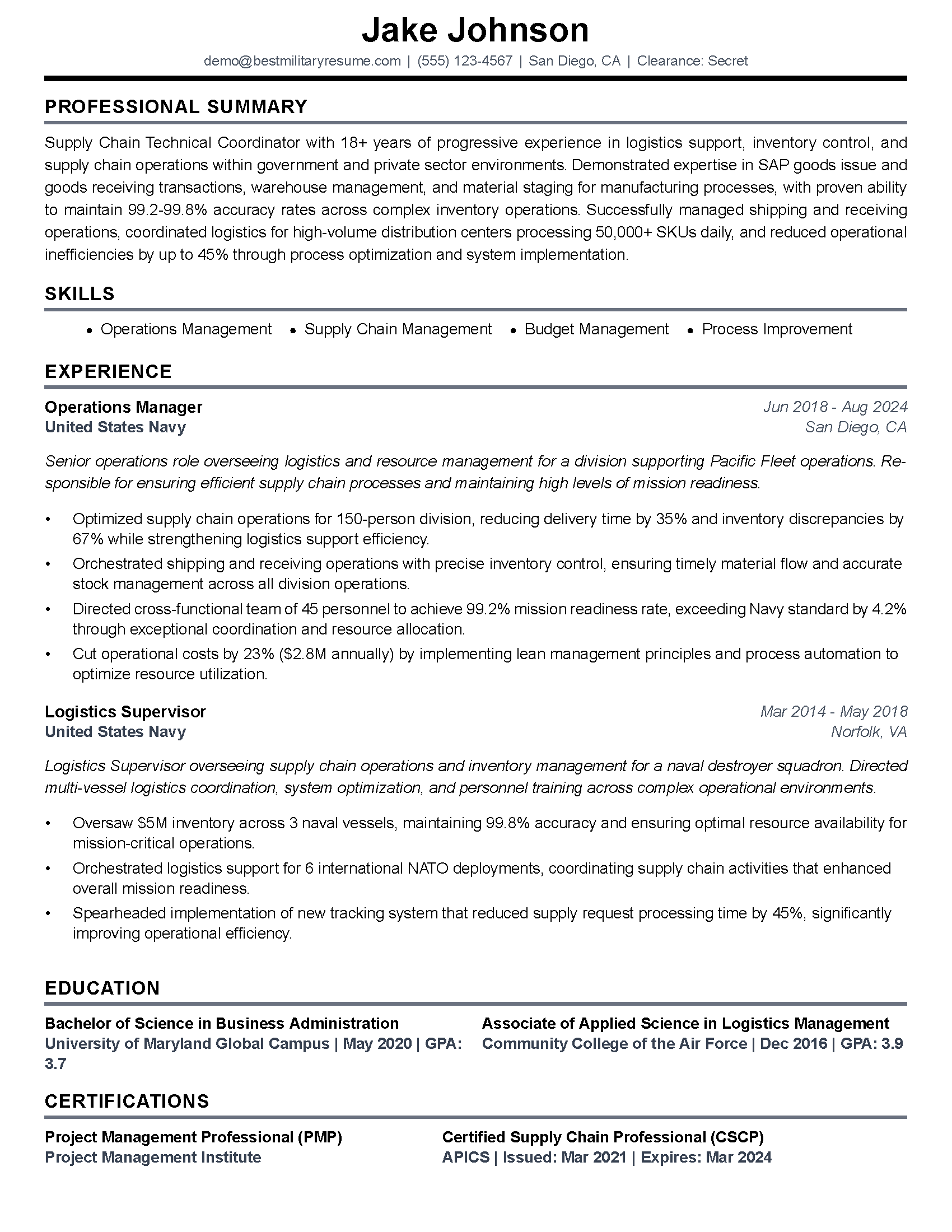
- Managed a $2.1 million supply budget and 1,200 inventory lines with zero errors on a formal inspection.
- Trained 6 new team members on the ship's inventory software.
Notice the second bullet. "Trained 6 junior Sailors" is a fact with no result. If you know what changed, like fewer order mistakes, add it with the number. If you don't, keep the fact and the number and stop there. Don't invent a result. Were you an LS? The Logistics Specialist civilian career guide shows job titles this bullet fits.
Example 2: Aviation Machinist's Mate (AD1)
Eval line (example): "Led 8-man power plants work center through 14 engine changes during 6-month deployment. Squadron sustained 98% MC rate."
The resume version.
- Led an 8-person jet engine team through 14 engine replacements while 98% of aircraft stayed ready to fly.
"MC rate" is mission capable rate. A civilian maintenance manager knows "ready to fly" or "uptime" right away. "Power plants" is the Navy name for the engine shop, so call it what it is. The Aviation Machinist's Mate career guide lists civilian roles that use these words.
Example 3: Hospital Corpsman (HM2)
Eval line (example): "Directed sick call for 450 personnel. Processed 1,100 PHAs, raising command IMR from 81% to 96%."
The resume version.
- Ran clinic care for 450 people and finished 1,100 health screenings, raising readiness from 81% to 96%.
PHA is a periodic health assessment. IMR is individual medical readiness. A clinic manager reading this sees patient volume and a compliance rate that went up 15 points. That's a business result in any clinic.
Example 4: Information Systems Technician (IT2)
Eval line (example): "Command's go-to IT! Single-handedly migrated 320 users to new network with zero downtime. Hand-picked over 9 peers as work center supervisor."
The resume version.
- Moved 320 users to a new network in 3 weeks with zero lost work time.
- Chosen over 9 peers to supervise a 12-person IT support team.
The "3 weeks" and "12-person" details came from the Sailor's memory, not the eval. That's fine and often needed. The eval gives you the frame. You fill in what you know is true. The Information Systems Technician career guide covers where this work fits in civilian IT.
What do you do with "1 of 12," EP marks and trait grades?
This is where people either overdo it or throw away real proof. Ranking language can help you, but only once it's translated.
Ranking lines
The manual allows a numerical ranking among peers in the comments. Many comment blocks open with something like "#1 of 12 Second Class Petty Officers." Keep the fact. Change the words.
- Eval: "#1 of 12 Second Class Petty Officers."
- Resume: "Ranked first of 12 peers at the same level by senior leadership."
Use your best ranking once, usually under the job where you earned it. Don't repeat it on every job.
Early Promote and Must Promote
Block 45 holds your promotion recommendation. A civilian won't know what EP means. But they'll understand a cap. Under 1610.10H, Early Promote is limited to 20 percent of each summary group, rounded up. So an EP can turn into a line like the one below.
- Resume: "Received Early Promote, the Navy's top promotion recommendation, given to 2 of 14 peers."
Use the real numbers from your own block 46.
Must Promote is harder to translate cleanly. For E-5 and E-6, the combined cap on Early Promote and Must Promote is 60 percent. That's a wide band. So it often works better to leave an MP off and let the bullets do the work.
Trait grades and averages
A "4.86 trait average" doesn't mean a lot outside the Navy. Leave the numbers off. The trait names can still guide you, though. Block 33 is Professional Knowledge. Block 39 is Leadership. If you scored high on Leadership, make sure a bullet shows you leading people, with a team size.
What should you leave off the resume?
Some parts of the eval shouldn't leave your folder. Others just don't help.
- Personal data: Your SSN sits in block 4 of every EVAL. Don't attach the form to an application unless the posting asks for it. Remove your SSN before uploading it anywhere.
- Counseling blocks: Blocks 30 to 32 record mid-term counseling. They don't belong on a resume.
- Fitness results: The PFA entry in block 29 stays off.
- Career recommendations: Block 41 is a Navy detailing note.
- Hull numbers and unit codes: "DDG-XX" or a UIC adds nothing. Use "a 300-person Navy destroyer" if the size matters.
- Classified or sensitive detail: Keep it general. "During a 6-month overseas deployment" is enough.
- Praise words: "Superb," "phenomenal" and "my #1 Sailor" tell a board how the rater felt. Your numbers say it better.
Some Navy terms are worth keeping because civilians in that field know them. A ship's 3-M maintenance system won't mean much in retail. But a shipyard or plant maintenance reader may know scheduled preventive maintenance well. Match the words to the posting.
How is the CHIEFEVAL different?
If you made Chief, your later reports are on NAVPERS 1616/27. The 1610.10H revision updated that form. The method stays the same, but the blocks move around.
- Comments sit in block 40: On the EVAL they're in block 43.
- No separate quals block: For E-7 to E-9, the manual puts quals and achievements in the comments block. So your certs and awards are mixed into the narrative. Pull them out into their own list.
- A hard ranking is required: Block 42 must show your ranking in your group. That gives you a clean "ranked X of Y" fact for every Chief report.
- Each trait gets remarks: The CHIEFEVAL gives each trait three short bullets that explain the grade. These are often more specific than EVAL comments, so read them for bullets too.
- Trait names differ: Military Bearing reads "Professionalism," and the climate trait reads "Accountability."
Chief reports also tend to describe results through your Sailors. "Mentored 4 Sailors to advancement" is a strong civilian line. A recruiter hears "developed people" and "kept them," and that's what a manager job needs. Write it as your result, with the number.
How does this change for a federal resume?
Everything above works for a private-sector resume. For USAJOBS, you use the same facts in a longer shape.
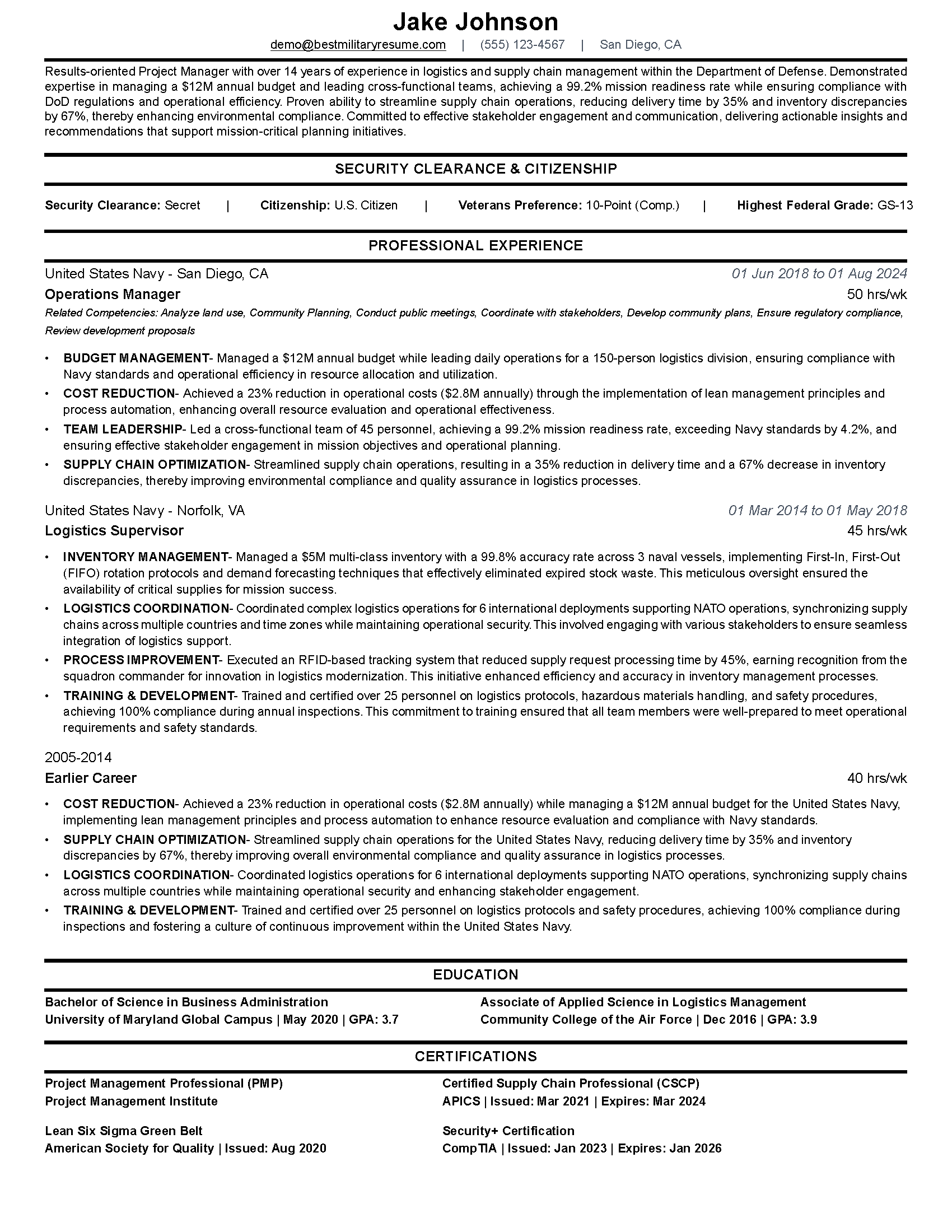
A federal resume is two pages for most federal jobs. Always check the announcement, because some are exceptions. Federal also has rules a private resume doesn't. You need month and year on every job and hours per week. Each duty needs more detail than a private bullet, written in the announcement's own words.
That's where blocks 28 and 29 earn their keep. The job scope line in block 29 often lists people supervised and budget. Those numbers help prove specialized experience at a grade level. A private bullet might be one line. The federal version may run two or three lines. Put the posting's own words up front.
This is Example 1 written for a federal supply job.
- Federal: "Managed a $2.1 million annual supply budget and 1,200 inventory line items for a 300-person organization. Reconciled accounts monthly and kept records audit-ready. Passed a formal supply management inspection with zero discrepancies."
For page layout, section order and before-and-after formatting, see the guide to the OPM two-page federal resume format.
What to Do Next
Pick one eval tonight. Use your most recent one, or the one from your busiest tour.
- Pull it from OMPF - My Record, milConnect or your own folder.
- Read block 43 line by line. Circle every number.
- For each line, write the action, scope, result and plain word.
- Turn each into one bullet. Check it against the four examples above.
- Add your best ranking or EP once, translated.
- Repeat for your other evals, newest first.
If you'd rather skip the manual work, BMR's Military Resume Builder reads Navy evals. Remove your SSN from each eval, upload them, and paste a job posting. It rewrites your experience in that posting's language. Then check every bullet against what you know is true. If you want to see the finished shape first, these military resume templates show where the bullets land.
Frequently Asked Questions
Can I attach my Navy eval to a job application?
Which block of the Navy EVAL holds the comments?
How do I get copies of my Navy evals after I separate?
Should I put Early Promote on my resume?
Should I list my trait average?
Can I add numbers that aren't in my eval?
Is a federal resume built from evals different?
About the author
Brad Tachi is the CEO and founder of Best Military Resume and a 2025 Military Friendly Vetrepreneur of the Year award recipient for overseas excellence. A former U.S. Navy Diver with over 20 years of combined military, private sector, and federal government experience, Brad brings unparalleled expertise to help veterans and military service members successfully transition to rewarding civilian careers. Having personally navigated the military-to-civilian transition, Brad deeply understands the challenges veterans face and specializes in translating military experience into compelling resumes that capture the attention of civilian employers. Through Best Military Resume, Brad has helped thousands of service members land their dream jobs by providing expert resume writing, career coaching, and job search strategies tailored specifically for the veteran community.