SkillBridge for E-4s and Below: Can Junior Enlisted Actually Qualify?
Justin was hired during terminal leave. "The best resume I have ever seen."
Justin, E-7, Air Force, network engineering, named his number and got it
You are 22 years old, an E-3, and your EAOS is eight months out. Someone in your shop mentions SkillBridge and you start Googling. Everything you find talks about senior NCOs and officers doing internships at Microsoft or Amazon. Within five minutes you are wondering whether the program even exists for someone at your pay grade.
It does. SkillBridge eligibility has nothing to do with rank. Zero. The DoD Instruction (1322.29) sets two requirements that matter: you need at least 180 continuous days of active-duty service, and the program must fall within your last 180 days before separation. E-1 through E-4 meet those criteria just as easily as an E-7 or an O-4. The paperwork is identical.
So why do so few junior enlisted actually use SkillBridge? Because there are real, practical barriers between policy eligibility and command approval. This article breaks down exactly what those barriers are, how to handle each one, and what your timeline should look like if you are an E-4 or below trying to make SkillBridge happen.
What Are the Actual SkillBridge Eligibility Requirements?
The official requirements are simple and rank-blind. Per DoD SkillBridge requirements, you need:
- 180 days of active-duty service (any branch, any MOS/rating/AFSC)
- The internship or training falls within your last 180 days before separation
- Commanding officer approval
- Separation must be under honorable conditions
That is it. No minimum rank. No minimum time in grade. No requirement to be an NCO. An E-2 with two years of service qualifies on paper the same way a Master Sergeant with 18 years does.
Each branch has its own implementation guidance layered on top of the DoD instruction. The Army uses AR 600-81, the Navy has NAVADMIN messages, the Air Force publishes AFIs, and the Marine Corps has MARADMIN guidance. The differences between branches are significant — our breakdown of how Navy SkillBridge compares to the Army, Air Force, and Marines covers what that means for your approval timeline. But none of these add a rank floor. They add process steps, approval routing, and sometimes timeline restrictions, but they do not say "E-4 and below need not apply."
"I spent 1.5 years after separating trying to figure out the civilian job market. If SkillBridge had been on my radar as a junior Diver, that entire gap could have been different. The program is there for E-3s just as much as E-7s."
Why Do So Few Junior Enlisted Use SkillBridge?
If rank does not disqualify you, why is the program dominated by E-6 and above? Four reasons keep coming up in conversations with veterans who went through it.
Command Culture and Manning Priorities
A First Sergeant or Department Head losing an E-7 to SkillBridge is an inconvenience. Losing an E-3 who stands watch, turns wrenches, or fills a billet on the watch bill is a manning problem that falls directly on the division. Junior enlisted are the labor force. Commands know that approving SkillBridge means losing a body for up to six months, and at the E-3/E-4 level, that body is often doing work no one else wants to pick up.
This is the single biggest barrier, and it has nothing to do with policy. It is a resource decision made by your chain of command, and it varies wildly from unit to unit. Some commands approve every SkillBridge request. Others have never approved one.
Awareness Gap
Senior NCOs hear about SkillBridge from peers, mentoring programs, and career counselors who assume they already know the basics. Junior enlisted hear about it from TikTok, Reddit, and word of mouth in the smoke pit. The quality of information is completely different. Many E-3s and E-4s do not know the program exists until they are already six months from separation, which is barely enough time to get through the approval process.
Shorter Enlistment Contracts Create Tighter Windows
A typical first-term enlistment is four years. Subtract initial training (boot camp, A-school, MOS school), which can eat 6-12 months depending on the pipeline. By the time you hit your unit and start learning your job, you might have 2.5 to 3 years left. SkillBridge requires you to apply well before your last 180 days. For someone on a four-year contract, the window to build a case, find a program, and get command approval is tighter than it looks on paper.
The Confidence Factor
An E-7 walking into their CO's office to request SkillBridge approval carries different weight than an E-3 doing the same thing. Senior enlisted have years of evaluations, relationships with leadership, and institutional credibility. Junior enlisted sometimes feel like they are asking for a favor they have not earned. That feeling is wrong, but it is real, and it stops people from even starting the process.
Common Misconception
Some commands informally tell junior enlisted that SkillBridge is "for senior guys." This is not DoD policy. If you are told this, ask for the specific instruction or regulation that restricts eligibility by rank. It does not exist.

How to Get Command Approval as an E-4 or Below
Command approval is the gate, and your approach determines whether it opens or stays shut. Here is what actually moves the needle for junior enlisted.
Start the Conversation 12 Months Out
Do not wait until your last six months. The earlier you plant the seed with your chain of command, the more time they have to plan around your absence. Bring it up at your 12-month mark. Frame it as a heads-up, not a request. "I am looking into SkillBridge for when I separate. I wanted to give you as much lead time as possible so we can plan around manning." That one sentence changes the dynamic from "surprise request" to "responsible planning."
Know Your Branch-Specific Process Cold
Every branch has specific forms, routing, and approval authorities. For the Army, you are going through your Career Counselor and submitting a DA-4187. Navy has command-specific routing that typically goes through your CMC or XO. Air Force routes through the Military Personnel Flight. Marine Corps goes through your Career Planner. Know your process before you bring it up. Walking in prepared signals that you are serious, not just floating an idea.
Solve the Manning Problem Before They Raise It
This is the move that separates approvals from denials. Your leadership is thinking about one thing: who fills your role when you leave? If you have an answer, you remove their biggest objection. Talk to your LPO, team leader, or section chief. Find out when new check-ins are expected. Identify who could cross-train into your responsibilities. Present a rough coverage plan alongside your SkillBridge request.
Pick a SkillBridge Program That Makes Sense
Commands are more likely to approve a program that looks like professional development, not a vacation. A diesel mechanic requesting a SkillBridge with a Caterpillar dealership makes immediate sense. An infantry Marine requesting a coding bootcamp still qualifies, but you may need to explain the connection more clearly. Check the full list of SkillBridge programs by industry to find options that align with your background or your target career field.
12 Months Out: Plant the Seed
Mention SkillBridge to your immediate supervisor. Frame it as early planning, not a formal request. Start researching programs.
9 Months Out: Build Your Case
Select a specific program. Draft your manning coverage plan. Gather any supporting documents your branch requires.
7 Months Out: Submit Formally
Route the official paperwork through your chain. Follow up weekly. Build in buffer time for delays and rewrites.
6 Months Out: Secure Final Approval
CO signs off. Begin coordinating start date with the SkillBridge host company. Start building your resume for the employer.
180 Days Out: Start the Program
Report to your SkillBridge host. You are still active duty, still collecting pay and benefits, while gaining civilian work experience.
What If Your Command Says No?
It happens. And for junior enlisted, it happens more often than it should. But a "no" does not always mean the conversation is over.
First, ask why. A specific reason gives you something to address. "We cannot afford to lose you during deployment workup" is a timing issue, not a permanent rejection. "We have never done that for someone at your rank" is a culture issue you can push back on with the actual regulation. "I do not know what SkillBridge is" is an education gap you can fill with a one-page summary and a link to the DoD SkillBridge website.
Second, get your Career Counselor or Transition Assistance advisor involved. They can explain the program to your chain of command in terms leadership understands. Some commands are more receptive when the information comes through official channels rather than from the junior person requesting it.
Third, if your command has a pattern of denying SkillBridge requests, check whether there is an Inspector General complaint process or an appeal route in your branch. This is a last resort, not a first move. But it exists because the program is supposed to be available to everyone who meets the eligibility criteria.
If the timing truly does not work with your current unit's operational schedule, explore whether you can adjust your separation date. Extending by even a few months might open a window that your command can approve. Talk to your career counselor about the trade-offs.
Can You Do SkillBridge Remotely as Junior Enlisted?
Yes, and remote SkillBridge programs can actually make the approval easier. Commands that worry about losing a body from the physical workspace are sometimes more flexible when the service member is doing the program remotely and can still be partially available for unit needs during the transition.
Remote programs also solve a geographic problem. If you are stationed at a small base in the middle of nowhere, your local SkillBridge options might be limited. Remote programs with companies like Amazon, Salesforce, or Booz Allen Hamilton open up possibilities that are not tied to your duty station.
A few things to know about remote SkillBridge as junior enlisted. You still need the same command approval. The approval process is identical regardless of whether the program is in-person or remote. Some commands view remote programs more favorably because the disruption to the unit feels smaller. Others see it as the same absence regardless of format. Know your command's perspective before you pitch it.
- •Work on-site with the host company daily
- •Stronger relationship-building with employer
- •Limited to companies near your duty station (or you relocate)
- •Full absence from your unit
- •Work from your current location
- •Access to programs nationwide
- •Easier command approval in some units
- •Requires strong self-discipline and time management
How SkillBridge Compares to Other Transition Programs for Junior Enlisted
SkillBridge is the most well-known option, but it is not the only one. If your command shuts down SkillBridge or the timing does not work, you should know what else is available. The full comparison of SkillBridge, CSP, and apprenticeships covers this in depth, but here is the short version for junior enlisted.
Career Skills Programs (CSPs) are similar to SkillBridge but run through your installation rather than directly with a civilian employer. Some bases offer CSPs in trades like HVAC, welding, commercial driving, and IT certifications. The approval process can be simpler because the program is already coordinated with the installation. For an E-3 whose command is nervous about losing them to an outside company, a base-run CSP might be an easier sell.
DoD apprenticeship programs through the United Services Military Apprenticeship Program (USMAP) let you document your military training as civilian apprenticeship hours. This does not require the same command approval as SkillBridge because you are not leaving your unit. You are just getting your existing work documented in civilian terms. For junior enlisted who cannot get SkillBridge approved, USMAP is a way to build credentials without fighting the approval battle.
The comprehensive SkillBridge program guide walks through how all of these programs fit together in your overall transition plan.
Building Your Resume for SkillBridge Employers
Once you have command approval, you need a resume that gets you accepted by the host company. This is where many junior enlisted hit their second wall. You have two or three years of military experience, which can feel thin on paper compared to an E-7 with 15 years of evaluations to pull from.
Your SkillBridge resume targets the employer only. Command approval uses military forms, not resumes. So your resume needs to speak civilian. That means translating your military job titles into civilian terms and writing accomplishment bullets that a hiring manager outside the military can understand and value.
As an E-3 or E-4, focus on what you have actually done. Did you maintain equipment worth six figures? Write that with the dollar amount. Did you lead a team of four on a watch section? That is team leadership. Did you complete a technical school with a 90%+ average? That shows trainability, which is exactly what SkillBridge employers are looking for in junior candidates. They know you do not have 15 years of experience. They are betting on your ability to learn fast and execute.
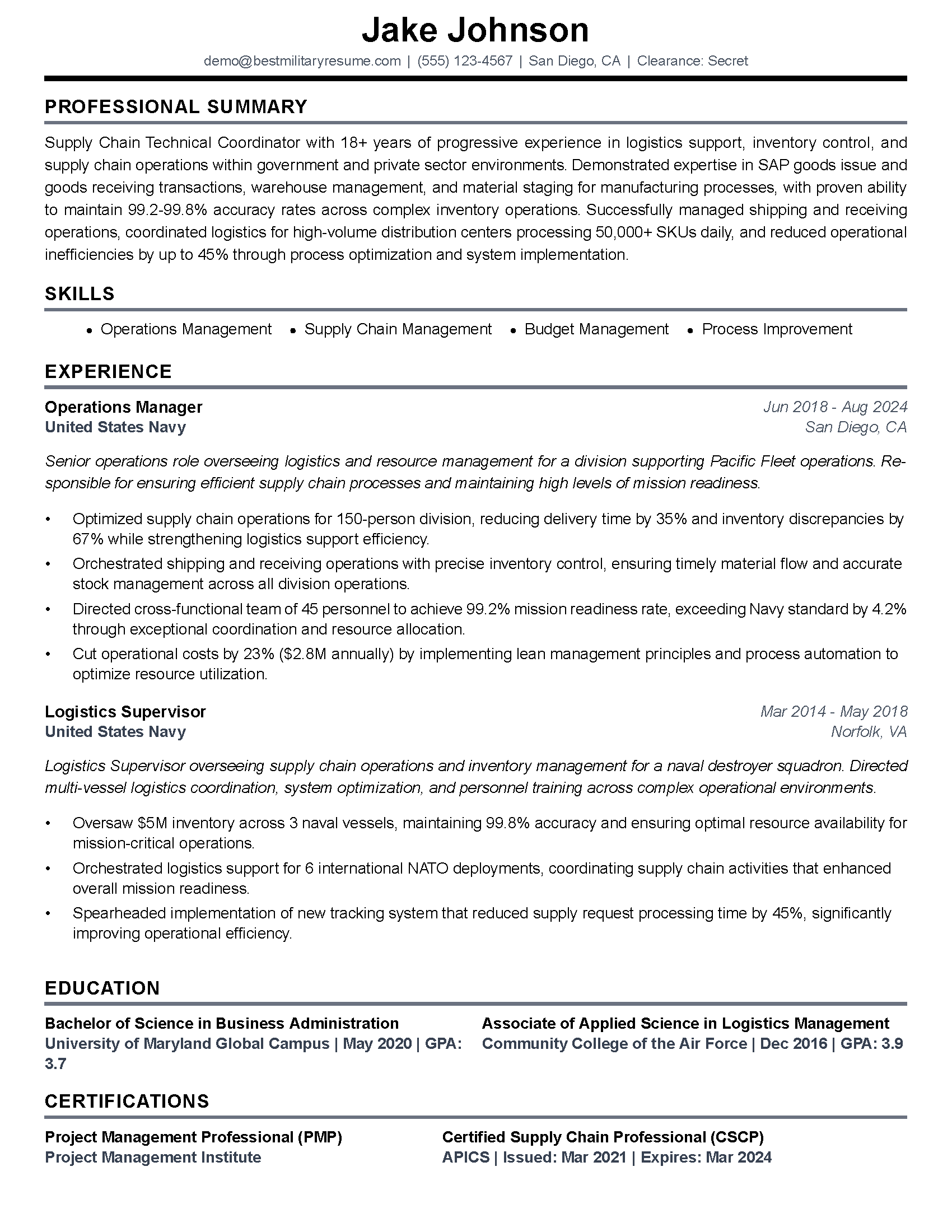
BMR's Resume Builder handles the military-to-civilian translation automatically. You paste the SkillBridge program description or job posting, and it tailors your resume to match. For junior enlisted with shorter service records, this is especially useful because it pulls the right language from your experience without you having to guess what civilian employers want to see.
Performed maintenance on military vehicles and equipment as assigned by supervisors in accordance with standard operating procedures.
Maintained fleet of 12 diesel vehicles valued at $2.4M. Reduced downtime 18% by implementing a preventive maintenance tracking system adopted by the entire motor pool.
What Happens After SkillBridge Ends?
SkillBridge is not a guaranteed job offer. It is an extended interview. Some companies hire their SkillBridge interns directly. Others do not. Your goal during the program is to make it impossible for them not to bring you on.
For junior enlisted, this means showing up with the same intensity you brought to your military job. Show up on time, ask questions, take notes, and deliver results. Many SkillBridge employers are specifically looking for young veterans they can develop over the long term. Your age and rank can actually be an advantage here. You are moldable. You have decades of career ahead of you. And you already know how to operate in structured environments and follow through on tasks.
If the SkillBridge host does not offer you a position, you still walk away with civilian work experience on your resume, professional references, and a clearer picture of what civilian workplaces actually look like. That is a massive head start compared to separating cold. Understanding the differences between military and civilian workplace culture before your first real civilian job gives you an edge that takes other veterans months to figure out on their own.
Your overall job search timeline should account for the possibility that SkillBridge does not convert to a direct hire. Have a backup plan. Keep your resume updated throughout the program and make sure your LinkedIn experience section is translated into civilian language. Apply to other positions during your final weeks if a full-time offer has not materialized.
What to Do Next
If you are an E-4 or below thinking about SkillBridge, stop wondering whether you qualify. You do. The question is whether you are willing to start the process early enough and push through the practical barriers.
Start with these four moves. First, check the 2026 SkillBridge eligibility requirements to confirm your timeline works. Second, browse the SkillBridge programs list by industry and pick two or three that match your interests. Third, have an informal conversation with your supervisor at least 12 months before your separation date. Fourth, build a resume that speaks to SkillBridge employers — with the right fonts, margins, and formatting — using BMR's Resume Builder. It is free and built specifically for this translation.
Your rank does not determine whether you qualify for SkillBridge. Your preparation determines whether your command approves it.
Frequently Asked Questions
Can E-1 through E-4 service members apply for SkillBridge?
Why do so few junior enlisted use SkillBridge?
What is the biggest obstacle to SkillBridge approval for E-3s and E-4s?
How far in advance should junior enlisted start the SkillBridge process?
Can you do SkillBridge remotely as junior enlisted?
What if my command denies my SkillBridge request?
Does SkillBridge guarantee a job after the program?
What alternatives exist if SkillBridge does not work out?
About the Author
Brad Tachi is the CEO and founder of Best Military Resume and a 2025 Military Friendly Vetrepreneur of the Year award recipient for overseas excellence. A former U.S. Navy Diver with over 20 years of combined military, private sector, and federal government experience, Brad brings unparalleled expertise to help veterans and military service members successfully transition to rewarding civilian careers. Having personally navigated the military-to-civilian transition, Brad deeply understands the challenges veterans face and specializes in translating military experience into compelling resumes that capture the attention of civilian employers. Through Best Military Resume, Brad has helped thousands of service members land their dream jobs by providing expert resume writing, career coaching, and job search strategies tailored specifically for the veteran community.
