A Army story from the same road
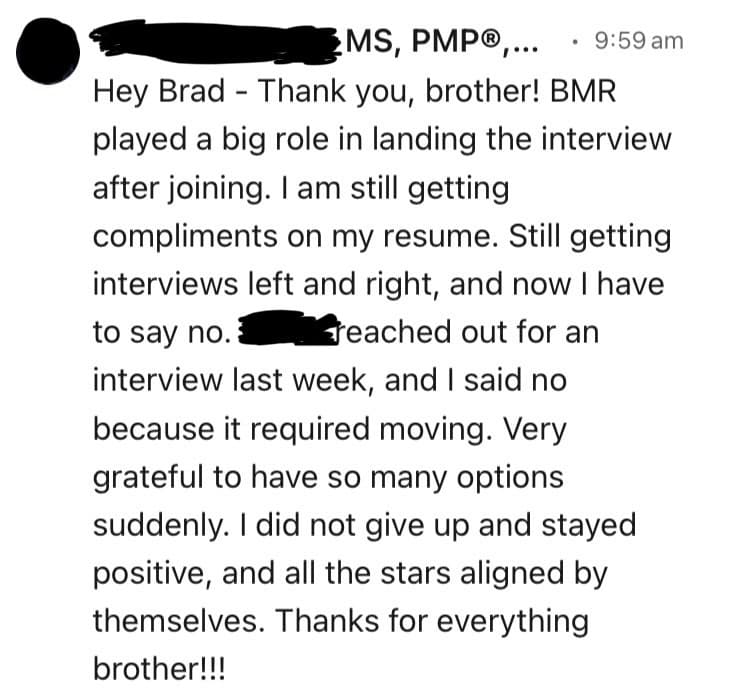
“I am still getting compliments on my resume. Still getting interviews left and right, and now I have to say no. Very grateful to have so many options suddenly.”
Taranjeet · Sergeant (E-5) · Army · Program Management
Home / Military to civilian jobs / Army / 68L
That is Army MOS 68L. Civilian jobs, federal paths, and how the work reads on a resume.
What is in this guide
What the translation looks like
How it reads in service
Performed activity analysis to grade therapeutic tasks for each patient
How a hiring manager reads it
Analyzed complex tasks and broke them into structured, measurable steps to build repeatable training plans
Roles this background maps to
Median pay, BLS OEWS May 2024
Build a resume for a real jobYou pick the job. We write it from your 68L experience. Free to start.
Brad TachiNavy Diver · BMR founder
After the Navy he was hired into six federal career fields and tech sales, and sat on federal hiring panels along the way. The last two years went into rebuilding all of it into BMR, tuned for how resumes get screened today. 71,892 resumes built so far.
As a 68L Occupational Therapy Specialist, you worked under a licensed occupational therapist to help soldiers and beneficiaries rebuild the ability to do everyday tasks after injury, illness, or surgery. That meant running treatment plans, leading therapeutic exercise, fabricating and fitting custom splints, teaching patients how to dress, write, cook, and work again, and documenting every session so the supervising OT and the next provider knew exactly where the patient stood.
The training pipeline is real clinical education, not a weekend course. Phase 1 runs 18 weeks and Phase 2 runs 16 weeks, both at Fort Sam Houston in San Antonio. Soldiers who complete the course earn an accredited associate degree through the College of Allied Health Sciences in coordination with the Uniformed Services University, and many sit for the national exam administered by the National Board for Certification in Occupational Therapy (NBCOT) during Phase 2. That is the same credential pathway civilian Occupational Therapy Assistants follow.
Employers value 68L experience because you did the hands-on clinical work that staffing-strapped rehab clinics need on day one. You charted in an electronic health record, handled a daily caseload, communicated with patients in pain or fear, and worked inside a treatment team. You can explore how your background maps to specific roles on our military-to-civilian career crosswalk, and if you served alongside 68X Behavioral Health Technicians or 68W Combat Medics, those backgrounds share many of the same civilian healthcare doors.
When I separated from the Navy I spent 18 months applying with no callbacks, and the reason was how I described my own experience, not the experience itself. A 68L has the opposite of a translation problem in clinical settings and the exact problem I had everywhere else. To a rehab clinic, COTA-eligible reads as hire today. To an HR screener at a company outside healthcare, splint fabrication and ADL retraining read as nothing unless you spell out the skill underneath. The work is on the page. The wording is what gets the callback. — Brad Tachi, Navy Diver veteran & BMR founder
The number that decides most of this: how does civilian pay compare to what the paycheck looks like now?
Army mid-career
$58K to $82K
E-5 to E-7 total comp: base plus BAH, BAS and the tax advantage.
Civilian Occupational Therapy Specialist
$51K to $68K
BLS median across the direct-match civilian roles on this page.
Federal, GS-9 to GS-13
$58K to $120K
6 matching GS series, plus locality pay and step increases.
About 14% lower on average
Civilian base pay for Occupational Therapy Specialists runs about $10K below mid-career enlisted total comp, though housing comes out of that number on the military side too.
Military comp is approximate and moves with location and dependents. Civilian is the BLS median. Federal includes locality pay. The real number depends on duty station, family status, GS step and overtime.
The most direct civilian path is Occupational Therapy Assistant (OTA), the role 68L training was built around. Per BLS OEWS May 2024, occupational therapy assistants earned a median of $68,340, and the Occupational Outlook Handbook projects 18 percent growth from 2024 to 2034, much faster than average, with about 7,900 openings a year across assistants and aides. To work as a COTA in most states you need an accredited associate degree (which the 68L course awards) plus the NBCOT certification and a state license, so confirm your specific state board requirements early.
Adjacent rehab roles hire the same skill set. Physical Therapist Assistants (BLS median $65,510, May 2024) do parallel hands-on treatment work and many states let you bridge with additional coursework. Recreational Therapists (BLS median $60,280) use activity-based intervention that mirrors the occupation-as-therapy model you already practiced. If you want patient contact without a clinical license, Health Education Specialists (BLS median $63,000) and Community Health Workers (BLS median $51,030) draw on the patient-teaching and behavior-change side of the job. Rehabilitation Counselors (BLS median $51,820) lean on the goal-setting and functional-assessment work you did with every patient.
Be honest with yourself about geography and setting. Rehab jobs cluster around hospital systems, skilled nursing facilities, outpatient clinics, schools, and home-health agencies, and pay and demand vary widely by region. Skilled nursing and home health tend to have the most openings; pediatric and hand-therapy specialties are competitive. Veterans coming from medical and clinical backgrounds, including Navy Hospital Corpsmen, compete for many of these same roles, so a resume that quantifies your caseload and outcomes matters. Our guide to translating military medical experience walks through how to present clinical hours, and you can draft the document itself in the military resume builder.
| Civilian job title | Industry | BLS median salary | Outlook | Match |
|---|---|---|---|---|
| Occupational Therapy AssistantO*NET 31-2011.00 | Healthcare | $68,340 | 18% (Much faster than average) | strong |
| Physical Therapist AssistantO*NET 31-2021.00 | Healthcare | $65,510 | 19% (Much faster than average) | strong |
| Recreational TherapistO*NET 29-1125.00 | Healthcare | $60,280 | 4% (As fast as average) | moderate |
| Rehabilitation CounselorO*NET 21-1015.00 | Healthcare | $51,820 | 2% (Slower than average) | moderate |
| Health Education SpecialistO*NET 21-1091.00 | Healthcare | $63,000 | 7% (Faster than average) | moderate |
| Community Health WorkerO*NET 21-1094.00 | Healthcare | $51,030 | 13% (Much faster than average) | emerging |
Largest U.S. employer of rehabilitation staff; hires OT and PT assistants and technicians across its medical centers.
National inpatient rehabilitation hospital network with steady demand for OT and PT assistants.
Operates rehab hospitals and outpatient clinics nationwide hiring rehab therapy staff.
Skilled nursing and post-acute network; high volume of OTA and PTA openings.
Senior living operator employing therapy staff for resident rehabilitation programs.
Contract therapy provider staffing OTAs and PTAs in skilled nursing and home settings.
Home health and pediatric therapy provider with field-based therapy assistant roles.
Long-term acute care and rehab hospitals hiring therapy support staff.
One of the largest hospital operators; runs a dedicated military hiring program for clinical roles.
Disability and rehabilitation nonprofit hiring therapy staff and program coordinators.
Orthotic and prosthetic provider; natural fit for veterans with splint and device-fabrication experience.
K-12 districts employ OTAs and rehab staff for school-based therapy and special education support.
BMR rewrites your 68L experience for any of the roles above, in the language the people reading actually scan for.
Free to start. 2 tailored resumes included.
Upload it and get a number in about a minute, plus the 68L lines a civilian hiring manager will not follow. No account. Sign up and BMR writes the fix.
Free. Your file is never stored.
“I am still getting compliments on my resume. Still getting interviews left and right, and now I have to say no. Very grateful to have so many options suddenly.”
Taranjeet · Sergeant (E-5) · Army · Program Management
Federal healthcare hiring is one of the strongest landing spots for a 68L, and the Department of Veterans Affairs is the largest single employer of rehabilitation staff in the country. The cleanest match is the GS-0640 Health Aid and Technician series, which covers occupational and physical therapy assistant and technician positions; VA medical centers and DoD treatment facilities hire into it directly, typically at the GS-5 through GS-8 range depending on credentials and experience.
Look past the obvious series too. GS-0601 General Health Science fits hybrid clinical and program roles. GS-0620 Practical Nurse and GS-0644 Medical Technologist sit nearby for veterans who cross-trained or want to build toward licensure. GS-0188 Recreation Specialist covers the activity-therapy and adaptive-recreation programs VA runs for rehabilitation, and GS-0101 Social Science supports the functional-assessment and case-coordination side. For administrative or program-management tracks, GS-0301 Miscellaneous Administration and Program is the common entry point.
Veterans preference applies to these openings, and your service connection can add 5 or 10 points to your rating. Read the 5 vs 10 point veterans preference breakdown before you apply so you claim what you are owed. A federal resume is a different document than a civilian one; it needs hours per week, supervisor details, and KSAs spelled out. The 15 federal resume tips that get veterans referred covers the format, and you can build the file in the federal resume builder. When you are ready to apply, you can start your federal resume now.
| Series | Federal job title | Typical grades | Match | Explore |
|---|---|---|---|---|
| GS-0640 | Health Aid and Technician | GS-5, GS-6, GS-7, GS-8 | 5 of 5 | View details |
| GS-0601 | General Health Science | GS-7, GS-9, GS-11 | 4 of 5 | View details |
| GS-0101 | Social Science | GS-7, GS-9 | 3 of 5 | View details |
| GS-0188 | Recreation Specialist | GS-5, GS-7, GS-9 | 3 of 5 | View details |
| GS-0301 | Miscellaneous Administration and Program | GS-5, GS-7, GS-9 | 3 of 5 | View details |
| GS-0620 | Practical Nurse | GS-4, GS-5, GS-6 | 3 of 5 | View details |
Federal raters match your record against the announcement's specialized experience statement. BMR writes the federal format for any GS series above, with the hours per week and supervisor detail a rater looks for.
Free to start. Federal and private sector formats included.
Not everyone stays in a related field. These paths run on the transferable half of the job: leadership, risk, logistics, planning.
You already designed and fit custom devices to individual human bodies and needs, which is the core of product and assistive-device design. Your clinical understanding of how people actually use objects is rare among designers.
Transfers: Custom assistive-device design and fitting, Activity analysis applied to product usability, User-centered iteration from direct feedback, Anthropometric and functional fit assessment.
How to get there: Build a portfolio of your device and fixture work. A certificate or associate in industrial design plus CAD skills (SolidWorks or Fusion 360) opens junior design roles, especially in medical and assistive products.
BLS OEWS May 2024 · 2% (Slower than average)
Accessibility is a fast-growing UX specialty and you understand disability and function at a depth most designers never reach. Your task-analysis habit is exactly how UX professionals map user flows.
Transfers: Task analysis and step-by-step breakdown, Designing for users with physical and cognitive limits, Empathy-driven usability evaluation, Accessibility and adaptive-equipment knowledge.
How to get there: Complete a UX or accessibility bootcamp (some GI Bill approved), learn WCAG standards and a design tool like Figma, and build a portfolio focused on accessible interfaces.
BLS OEWS May 2024 · 8% (Faster than average)
You used the equipment, fit it to patients, and can speak the clinical language buyers trust. Manufacturers of orthotics, mobility, and rehab equipment specifically want reps who have worked in the clinic.
Transfers: Clinical credibility with rehab and OT buyers, Hands-on knowledge of assistive and therapy equipment, Patient and provider communication, Functional outcome explanation.
How to get there: Target rehab, mobility, and orthotic device manufacturers. Sales experience helps but clinical background is the differentiator; many reps start in associate or territory-support roles.
BLS OEWS May 2024 · 6% (Faster than average)
School-based OT and special education overlap heavily; you already adapt tasks and environments for kids and adults with physical and cognitive challenges. The IEP process mirrors clinical goal documentation.
Transfers: Sensory and motor accommodation design, Individualized goal-setting and progress tracking, Breaking tasks into teachable steps, Working with families and care teams.
How to get there: Most states offer alternative teacher certification routes for career changers. A bachelor degree plus a special-education credential program (GI Bill eligible) gets you in the classroom.
BLS OEWS May 2024 · 1% (Little or no change)
OT is built on helping people rebuild function and routine, which is the heart of recovery counseling. Your experience guiding patients through difficult, slow progress transfers directly.
Transfers: Behavior-change coaching, Functional goal-setting with resistant clients, Patience under emotional pressure, Documentation of measurable progress.
How to get there: A bachelor degree plus a state-approved counseling certificate or associate program qualifies you in many states; some allow entry while you complete supervised hours.
BLS OEWS May 2024 · 19% (Much faster than average)
You taught skills to people under stress every day and adjusted your approach to each learner. Corporate training is the same teaching discipline applied to a workforce instead of a caseload.
Transfers: Curriculum and task instruction design, Adapting teaching to different learners, Measuring learning outcomes, Patient and clear communication.
How to get there: A certificate like ATD CPTD plus a portfolio of training materials moves you into corporate L and D roles. No clinical license required.
BLS OEWS May 2024 · 11% (Much faster than average)
The skills behind the specialty carry further than the specialty. BMR rewrites your bullets for any of the paths above without making it sound like you have never done the work.
Free to start. Try as many angles as you want.
If you are staying in rehabilitation, your terminology translates directly. Clinics and VA hiring managers already know what a COTA does, what ADL retraining means, and what NBCOT certification signals. This section is for veterans targeting careers OUTSIDE occupational therapy, where a hiring manager has never seen your job title and will skim past it unless you name the underlying skill.
The trick is to lead with the civilian-recognizable competency, then show the clinical proof underneath. Activity analysis becomes task and process analysis. Splint fabrication becomes custom device design and fitting. Patient teaching becomes training and behavior change. Treatment documentation becomes outcome tracking and reporting.
For the full vocabulary swap, our glossary of 50 military terms translated to civilian language is a fast reference, and the military resume builder rewrites bullets like these for whatever field you are targeting.
Before, in service
Performed activity analysis to grade therapeutic tasks for each patient
After, on the resume
Analyzed complex tasks and broke them into structured, measurable steps to build repeatable training plans
Before, in service
Fabricated custom thermoplastic splints to clinical specifications
After, on the resume
Designed and fitted custom assistive devices to individual user requirements, iterating on fit based on direct feedback
Before, in service
Retrained patients in activities of daily living after injury
After, on the resume
Trained clients to perform complex tasks independently, adjusting instruction to each learner
Before, in service
Documented treatment sessions and progress in the electronic health record
After, on the resume
Tracked client outcomes against defined goals and reported progress in a digital records system
Before, in service
Managed a daily occupational therapy caseload under OT supervision
After, on the resume
Managed a daily portfolio of 12 to 15 clients, balancing competing priorities against a fixed schedule
Before, in service
Led therapeutic exercise sessions to restore patient function
After, on the resume
Delivered structured improvement programs and coached participants to measurable performance gains
Before, in service
Assessed patients home and work environments for safe function
After, on the resume
Evaluated work environments and recommended changes that improved safety and reduced injury risk
Before, in service
Coordinated patient care with OTs, physicians, and nursing staff
After, on the resume
Collaborated across functions to align stakeholders and deliver a shared result on schedule
BMR turns your 68L duties and accomplishments into civilian bullets aimed at the job you are applying for. No manual translation.
Free to start. Tailored to each posting.
Which ones you need depends on where you are headed.
RecommendedCost FreeTime Self-pacedNot a certification but the skill that lands GS-0640 and VA rehab roles; format differs from civilian resumes.
EssentialCost Check current pricingTime Exam after accredited associate degreeGI Bill eligibleThe core civilian credential; 68L training is built around it. Many earn it during Phase 2. Verify current status with NBCOT.
EssentialCost Varies by stateTime Weeks after applicationRequired to practice as an OTA in most states. Requirements vary; confirm with your target state board.
RecommendedCost Check current pricingTime 1 dayStandard requirement for clinical roles in hospitals and rehab settings.
RecommendedCost Check current pricingTime Self-paced plus examValuable for veterans targeting neuro and TBI rehabilitation caseloads.
RecommendedCost Check current pricingTime 1-2 days plus experienceUseful for skilled nursing and senior-care therapy roles, a high-volume hiring segment.
RecommendedCost GI Bill may cover tuitionTime 18-24 monthsGI Bill eligibleBridge path for veterans who want to cross into physical therapy assisting.
RecommendedCost Check current pricingTime Exam plus eligibilityFor veterans moving into health education and patient-teaching roles outside direct clinical care.
RecommendedCost Membership plus course feesTime OngoingContinuing education to maintain certification and specialize (hand therapy, pediatrics, ergonomics).
RecommendedCost Check current pricingTime Self-study plus examRecognizes the adaptive-equipment and device-fitting work central to 68L; opens assistive-tech roles.
OptionalCost Check current pricingTime 3-6 months prepGI Bill eligibleFor veterans moving into healthcare program or clinic operations management.
OptionalCost Check current pricingTime 30 hoursSupports a pivot into ergonomics and workplace-safety roles that use functional assessment skills.
Placement decides whether a screener ever sees it. BMR knows where each one ranks, what to call it, and how to frame it.
Free to start. Built around your real certs and clearance.
Staying in occupational therapy and rehab. Your fastest route is converting the credential you already hold. Confirm your NBCOT certification status and your target state's licensing rules for occupational therapy assistants, since requirements vary by state. The military medical to civilian healthcare guide covers how to present clinical hours, and for the EMS-adjacent crowd the medic-to-EMT bridge programs article shows how military clinical training maps to civilian licensure. Professional associations like AOTA (the American Occupational Therapy Association) maintain state-by-state licensing references worth bookmarking.
Careers outside the field. If you are done with clinical work, your transferable strengths are task analysis, teaching, device design, and documentation. Use your GI Bill strategically, lean on veteran networking through American Corporate Partners (ACP) for mentorship, and target one field at a time. The best certifications by career field guide helps you pick the credential that opens your target door, and the interview prep library covers how to talk about a career change without sounding lost.
See also: 68W Combat Medic Specialist, 68X Behavioral Health Technician, and Air Force Physical Medicine (4J0X2) career paths.
When you are ready to put it together, build your resume now or explore more roles on the career crosswalk.
Most people do this backwards: wait for terminal leave, then panic. This is the sequence that works. Already out? Same plan, day one is today.
Days 0 to 30
Days 30 to 60
Days 60 to 90
Occupational Therapy Assistant (OTA). The 68L course was built around the same credential pathway, including an accredited associate degree and the NBCOT certification. Per BLS OEWS May 2024, occupational therapy assistants earned a median of $68,340. To practice in most states you also need a state license, so check your state board's requirements early.
BLS OEWS May 2024 reports a median annual wage of $68,340 for occupational therapy assistants (SOC 31-2011). Pay varies by setting and region, with skilled nursing and home health often paying more than school-based roles. The BLS Occupational Outlook Handbook projects 18 percent employment growth for assistants and aides from 2024 to 2034.
No. Many 68Ls leave clinical work entirely. The job builds task analysis, custom device design, patient teaching, and outcome documentation skills that transfer to fields like industrial and product design, accessibility and UX design, medical device sales, special education, and behavioral counseling. See the Want to Change Careers Entirely section above for specific paths with salary data.
The GS-0640 Health Aid and Technician series is the closest match and the VA hires into it directly, often at GS-5 through GS-8. Related series include GS-0601 General Health Science, GS-0188 Recreation Specialist for adaptive-therapy programs, and GS-0301 for administrative tracks. The VA is the largest employer of rehabilitation staff in the country. You can build the application in our <a href='/federal-resume-builder' class='text-blue-600 dark:text-blue-400 font-medium no-underline hover:underline'>federal resume builder</a>.
If you passed the NBCOT exam and hold current certification, yes, it is the same national credential civilian COTAs hold. You still need a state license to practice in most states, and certification must be kept current. Confirm your status with NBCOT and your target state's occupational therapy board before applying.
Veterans preference can add 5 or 10 points to your federal application rating depending on your service and any service-connected disability. It does not guarantee a job, but it improves your placement in the candidate pool. Our <a href='/blog/federal-resumes/veterans-preference-explained-5-10-points' class='text-blue-600 dark:text-blue-400 font-medium no-underline hover:underline'>5 vs 10 point veterans preference guide</a> explains who qualifies.
Many veterans use the GI Bill to bridge from COTA to a master's-level Occupational Therapist, which BLS lists at a much higher median wage. Programs vary, so verify GI Bill approval for your specific school and degree, and check whether your associate credits transfer. A career counselor at your target school can confirm what applies.
Lead with the civilian skill, not the military title. Splint fabrication is custom device design. ADL retraining is structured task training. Treatment documentation is outcome tracking. Our <a href='/blog/career-transition/explain-military-experience-civilian-interview-no-jargon' class='text-blue-600 dark:text-blue-400 font-medium no-underline hover:underline'>guide to explaining military experience without jargon</a> covers how to do this in an interview.
BLS publishes state and metro employment data, and demand generally tracks population and the density of skilled nursing and outpatient facilities. Large states like Texas, Florida, California, and New York report high employment levels. Because licensing is state-specific, check both the job market and the license requirements of any state you are considering.
Start before you separate. Verify your NBCOT status, identify your target state's license steps, and build a resume that quantifies your caseload, clinical hours, and patient outcomes. You can <a href='/' class='text-blue-600 dark:text-blue-400 font-medium no-underline hover:underline'>get started here</a> and have a clinical-ready resume done in an afternoon.
Salary data from the U.S. Bureau of Labor Statistics, Occupational Employment and Wage Statistics (OEWS), May 2024. Career data from O*NET OnLine.
Stop rewriting from scratch every time you apply. BMR turns your military experience into civilian and federal resumes, tailored to each job.
Tailored resumes
Rewritten for each job posting
Cover letters
Matched to the role
LinkedIn optimization
Profile rewrite for civilian recruiters
Elevator pitch generator
For interviews and networking
Company research reports
Know who you are applying to
Job tracker
Every application in one place