Loading...
Loading...
The civilian and federal jobs that hire Air Force Physical Medicines — with real salaries and the resume that gets callbacks.
Every 4J0X2 has more options than a Google search will tell you. Below: career paths, BLS salary data, federal GS series, certifications by target career, and how to translate your experience without losing what made you valuable to the Air Force in the first place.
Free · No credit card · Tailored resume in under 5 minutes
After the Navy I got hired into 6 federal career fields and tech sales, and sat on federal hiring panels along the way. I spent the last 2 years rebuilding everything I learned into BMR, tuned for how AI actually screens resumes today. This is the system I wish I'd had on day one.
You ran the rehab clinic floor. You set patients up on the ultrasound and electrical-stimulation units, walked post-surgical Airmen through therapeutic exercise progressions, fit them for orthotics, and coached people through the exact moment recovery hurts and they want to quit. As a 4J0X2 Physical Medicine specialist you supported both physical therapy and occupational therapy, ran modalities like ultrasound, e-stim, traction, and hot/cold therapy, assisted with gait and mobility training, and kept treatment documentation clean enough for a credentialed PT or OT to sign off on. Some of you also earned the Occupational Therapy Technician path (SEI 464) and carried college credit toward a Physical Therapist Assistant credential straight out of the pipeline.
Training ran through the Medical Education and Training Campus (METC) at Fort Sam Houston, where the curriculum covers anatomy and physiology, therapeutic modalities, orthotic lab equipment, therapeutic exercise, and patient instruction methods. Entry required college-level coursework in anatomy, physiology, biology, English composition, oral communication, and intermediate algebra. That academic load is the part most civilians never realize you carried.
Here is what employers in the rehab world actually value: you already know how to apply a modality safely, progress an exercise plan without re-injuring someone, read how a body moves, and keep a patient motivated through pain. Those are billable clinical skills, not soft skills. If you want to see how your skill set maps across the rehab industry and into completely different fields, the military-to-civilian career explorer is a good starting point, and the related 4H0X1 Respiratory Care Practitioner and 4N0X1 Aerospace Medical Technician pages cover adjacent Air Force medical paths.
Across the 60,000 resumes BMR has built, Physical Medicine techs are one of the cleaner translations we see, and most people miss why. A clinic hiring manager scanning for a Physical Therapist Assistant does not know what "4J0X2" means, but they understand "ran therapeutic-exercise progressions and modality treatments on a busy rehab floor." Name the work in clinic language and the same experience that read as a mystery starts reading as a hire. That naming is the whole job. — Brad Tachi, Navy Diver veteran & BMR founder
The number that matters when you're deciding what's next: how does civilian pay compare to what you make now?
Military comp is approximate (varies by location/dependents). Civilian is BLS median. Federal includes locality pay. Your real number depends on duty station, family status, GS step, and overtime.
The rehabilitation field is one of the cleaner translations out of the Air Force, because the clinical work you did has a direct civilian license track. Be honest with yourself about one thing first: most civilian rehab roles are credential-gated. Knowing the work is not the same as holding the state license, so the realistic move for many 4J0X2 veterans is to convert military experience and credit into the civilian credential.
Physical Therapist Assistant (PTA) is the closest match. BLS OEWS (May 2024) reports a median wage of $65,510 for PTAs, with the field projected to grow much faster than average through 2034 as the population ages. PTAs work under a licensed physical therapist, which is the exact supervisory structure you already operated in. The catch is the credential: PTA roles require graduation from a CAPTE-accredited associate program and a state license, though the credit some of you earned in the pipeline can shorten that path.
Occupational Therapy Assistant (OTA) pays a median of $68,340 (BLS OEWS, May 2024). If you ran the OT side and carried SEI 464, this is your lane. OTAs help patients rebuild the functional movements of daily living, which is the work you already did with recovering Airmen.
Physical Therapist and Occupational Therapy Aide roles are the no-additional-license entry points. Aides handle setup, modalities, equipment, and patient flow. BLS OEWS (May 2024) medians are $34,520 for PT aides and $37,370 for OT aides. Pay is lower, but it is an immediate way back into a clinic while you finish a PTA or OTA credential.
Orthotic and Prosthetic Technician uses the orthotic lab side of your training. The broader Orthotists and Prosthetists occupation has a BLS OEWS (May 2024) median of $78,310, and the technician roles that fabricate and fit devices are a strong fit for anyone who ran the orthotic bench.
Athletic Trainer and Recreational Therapist round out the adjacent clinical options, at BLS medians of $60,250 and $60,280 respectively (May 2024). Geography matters in this field: outpatient clinics, hospital systems, and skilled-nursing facilities cluster around metro areas and aging-population regions, so the densest job markets are not always where the bases are. When you are ready to put this on paper, the military resume builder is built to translate clinical military roles into civilian language, and you can build your resume now to get started. Veterans coming from the Army 68W Combat Medic and Navy Hospital Corpsman paths share many of these same civilian rehab targets.
| Civilian Job Title | Industry | BLS Median Salary | Outlook | Match |
|---|---|---|---|---|
Physical Therapist Assistant O*NET: 31-2021.00 | Healthcare | $65,510 | Much faster than average (2024-34) | strong |
Occupational Therapy Assistant O*NET: 31-2011.00 | Healthcare | $68,340 | Much faster than average (2024-34) | strong |
Physical Therapist Aide O*NET: 31-2022.00 | Healthcare | $34,520 | Faster than average (2024-34) | strong |
Occupational Therapy Aide O*NET: 31-2012.00 | Healthcare | $37,370 | Faster than average (2024-34) | strong |
Orthotic and Prosthetic Technician O*NET: 29-2091.00 | Healthcare | $78,310 | Faster than average (2024-34) | moderate |
Athletic Trainer O*NET: 29-9091.00 | Healthcare | $60,250 | Faster than average (2024-34) | moderate |
Recreational Therapist O*NET: 29-1125.00 | Healthcare | $60,280 | Faster than average (2024-34) | moderate |
Massage Therapist O*NET: 31-9011.00 | Healthcare | $57,950 | Much faster than average (2024-34) | moderate |
BMR rewrites your 4J0X2 experience for any of the civilian roles above — keywords, achievements, and language hiring managers actually scan for.
Free · No credit card · 2 tailored resumes included
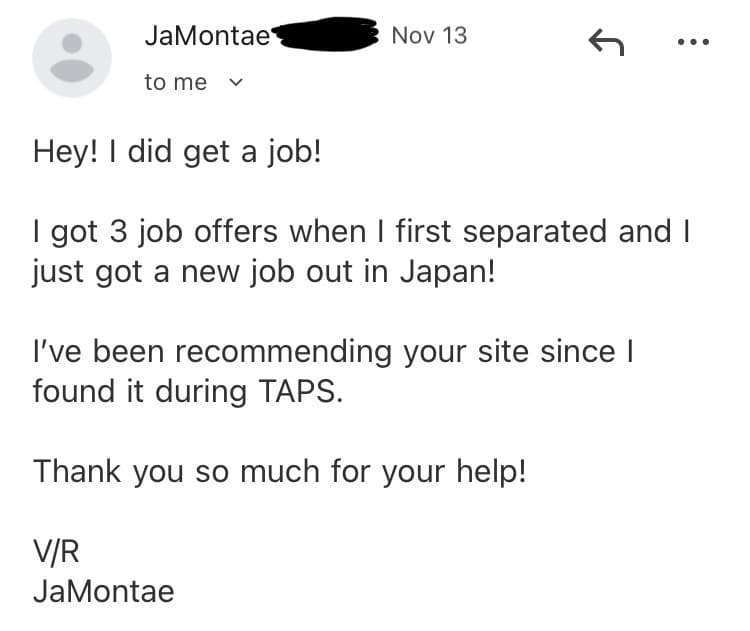
“Hey! I did get a job! I got 3 job offers when I first separated and I just got a new job out in Japan! I’ve been recommending your site since I found it during TAPS. Thank you so much for your help! V/R JaMontae ”
Federal rehab and health-technician work is one of the most under-applied paths for 4J0X2 veterans, and the VA is the single largest employer of rehabilitation staff in the country. Veterans' Preference can add 5 or 10 points to your rated score on a federal application, and the VA actively staffs the kind of physical-medicine clinics you already worked in.
The most direct match is the GS-0640 Health Aid and Technician series, which covers therapy and rehabilitation technician roles in VA and DoD treatment facilities. With your pipeline training and clinic floor time, GS-7 through GS-11 is a realistic target band. GS-0601 General Health Science is the broader clinical-program series for roles that blend patient care with program work, commonly at GS-7 through GS-11.
GS-1715 Vocational Rehabilitation is worth a serious look. The VA runs a large Veteran Readiness and Employment program, and your background coaching people back to function through injury maps cleanly onto helping veterans return to work after disability. GS-0620 Practical Nurse is an adjacent option if you cross-trained on patient care, and GS-0301 Miscellaneous Administration and Program and GS-0303 Miscellaneous Clerk and Assistant cover the clinic-coordination and treatment-scheduling roles that medical facilities hire constantly. If injury prevention interests you, GS-0018 Safety and Occupational Health Management ties your functional-movement knowledge to workplace ergonomics across federal agencies.
Federal resumes do not work like civilian one-pagers. They are longer, keyword-matched to the announcement, and graded against the qualification standard. Our federal resume builder is built for that format, and the guide to decoding a USAJOBS announcement and the OPM qualification standards walkthrough explain how your grade gets set. Air Force 4T0X1 Medical Laboratory Specialist veterans target several of these same health-science series.
| GS Series | Federal Job Title | Typical Grades | Match | Explore |
|---|---|---|---|---|
| GS-0640 | Health Aid and Technician | GS-5, GS-6, GS-7, GS-9 | View Details → | |
| GS-0601 | General Health Science | GS-7, GS-9, GS-11 | View Details → | |
| GS-1715 | Vocational Rehabilitation | GS-9, GS-11, GS-12 | View Details → | |
| GS-0018 | Safety and Occupational Health Management | GS-7, GS-9, GS-11 | View Details → | |
| GS-0620 | Practical Nurse | GS-5, GS-6, GS-7 | View Details → | |
| GS-0301 | Miscellaneous Administration and Program | GS-7, GS-9 | View Details → | |
| GS-0303 | Miscellaneous Clerk and Assistant | GS-4, GS-5, GS-6 | View Details → |
Federal hiring uses keyword-matching and structured experience. BMR builds federal-format resumes (USAJobs-ready) with the right keywords, hours/week, and supervisor info — for any GS series above.
Free · No credit card · Federal + civilian resume formats included
Not everyone wants to stay in a related field. These career paths leverage your transferable skills — leadership, risk management, logistics, project planning — in completely different industries.
Companies selling e-stim, traction, bracing, and rehab equipment need reps who can speak to clinicians as a peer. You ran that equipment daily, so you sell from real clinical authority instead of a script.
Exercise physiologists build and supervise conditioning programs for cardiac, athletic, and wellness clients. Your therapeutic-exercise and assessment experience maps directly to designing safe, progressive programs.
Coaching athletes and general clients through structured progressions is the same loop you ran in rehab, minus the post-injury constraint. Your eye for movement quality is an immediate edge.
You spent your career teaching patients how to manage their own recovery. Health education specialists do that at scale for employers, hospitals, and public-health programs.
You already helped people recover physical capability. Vocational rehab counselors help people, often fellow veterans, return to work after disability, which is the same mission in a different setting.
You spent your days assessing how people move, preventing re-injury, and coaching better mechanics. Occupational safety applies that same eye to the workplace: ergonomic assessment, injury prevention, and behavior change on the production floor or office.
The skills that made you a good Marine, Sailor, Airman, or Soldier transfer further than you think. BMR rewrites your bullets for any of the pivot careers above — without making you sound like you've never done the work.
Free · No credit card · Try unlimited career angles
If you are staying in rehab and applying to a clinic, hospital, or PTA program, your terminology already translates. Recruiters in that world use the same words you do. This section is for 4J0X2 veterans targeting careers OUTSIDE direct patient care, where a hiring manager has never seen an Air Force training record and does not know what a modality is.
The skill underneath your job is not "ran the PT clinic." It is the ability to assess how a body moves, apply a treatment plan safely, operate clinical equipment, document to a regulated standard, and keep a person motivated through discomfort. Name those skills in civilian terms and doors open in wellness, medical-device sales, ergonomics, and coaching.
Before and after, for a corporate wellness or ergonomics role:
Before and after, for a medical-device clinical sales role:
The 50 military terms translated to civilian language glossary and the military skills translation list go deeper on this. When you are ready, the military resume builder handles the translation for you, or you can start building free.
BMR turns your 4J0X2 duties and accomplishments into civilian bullets that match the job you're applying for — no manual translation, no rewriting.
Free · No credit card · Tailored to each job posting
Which certifications you need depends on where you're headed. Find your target career path below.
The wrong placement can sink an otherwise strong application. BMR knows where each cert ranks, what to call it, and how to frame it for ATS keyword matching and hiring manager attention.
Free · No credit card · Built around your real certs and clearance
If you are staying on the clinical side, your fastest route is converting military credit and experience into a civilian credential. Some 4J0X2 veterans separate with college credit toward a Physical Therapist Assistant degree, so contact CAPTE-accredited PTA and ACOTE-accredited OTA programs early and ask how they evaluate military transcripts and the Community College of the Air Force record. The American Physical Therapy Association (apta.org) and the American Occupational Therapy Association (aota.org) publish licensure and program directories. SkillBridge can place you in a clinic or hospital system during your final months of service. Our SkillBridge guide and list of SkillBridge companies hiring cover how to line that up.
If you are done with patient care, your clinical and coaching background still travels. Medical-device companies hire clinically fluent reps. Corporate wellness and ergonomics programs hire people who understand functional movement and injury prevention. The VA's Veteran Readiness and Employment program hires vocational rehabilitation staff. American Corporate Partners (acp-usa.org) offers free veteran mentorship to map any of these moves. Use the GI Bill strategically: a vocational certificate or associate degree often unlocks a credential faster than a full bachelor's.
Start your transition here: build your resume now, explore paths with the career explorer, build a government-format resume with the federal resume builder, and review transition steps through SFL-TAP resources. See also: 4N0X1 Aerospace Medical Technician, Army 68W Combat Medic, and Coast Guard Health Services Technician. For deeper reading, the guide to translating military experience is a strong next step.
Most veterans do this backwards — they wait until terminal leave to start, then panic. Here's the actual sequence that works.
Print this. Tape it to your monitor. Veterans who treat the transition like a 90-day op get hired faster than the ones who treat it like an emergency.
Stop rewriting from scratch every time you apply. BMR turns your military experience into civilian and federal resumes — tailored to each job.