Home / Military to civilian jobs / Marines / 0321

MarinesMOS 0321

Reconnaissance Marine

That is Marines MOS 0321. Civilian jobs, federal paths, and how the work reads on a resume.

What is in this guide

Salary range
$52K to $125K
Career paths
14
Federal GS series
10
Companies hiring
12
Resume examples
8
Certification paths
7
Questions answered
10

What the translation looks like

How it reads in service

Developed and executed R&S plans for deep reconnaissance operations in support of battalion-level objectives

How a hiring manager reads it

Designed and executed intelligence collection strategies to support senior leadership decision-making across a 200+ person organization


Roles this background maps to

  • Intelligence Analyst$99,710
  • Private Detective / Investigator$52,370
  • Police Officer$76,290

Median pay, BLS OEWS May 2024

Build a resume for a real job

You pick the job. We write it from your 0321 experience. Free to start.

Brad TachiNavy Diver · BMR founder

After the Navy he was hired into six federal career fields and tech sales, and sat on federal hiring panels along the way. The last two years went into rebuilding all of it into BMR, tuned for how resumes get screened today. 71,892 resumes built so far.

Get a free 0321 Reconnaissance Marine sample resume

One page, built in our template, with the military experience translated into the civilian terms hiring managers and screening software read. Use it as a reference for your own. Leave an email and the download link comes to you.

Free. Occasional job-search tips come with it. Unsubscribe anytime.

What the job actually is

Reconnaissance Marines (0321) are the Marine Corps' eyes and ears beyond the front lines. They operate in small teams — typically 4 to 6 Marines — conducting deep reconnaissance, surveillance, and intelligence collection in hostile territory, often for days without resupply or reinforcement. Recon Marines attend the Basic Reconnaissance Course (BRC) at the School of Infantry West (Camp Pendleton, CA), one of the highest-attrition training pipelines in the Marine Corps.

0321s are trained in amphibious reconnaissance, demolitions, communications, close-quarters battle, combat diving (some earn the Combatant Diver Qualification Course), military free-fall parachuting, and advanced patrolling techniques. They operate with both Marine Division Reconnaissance Battalions (1st, 2nd, 3rd, 4th Recon Bn) and may screen for Marine Forces Special Operations Command (MARSOC). The MOS requires ASVAB GT score of 105+.

What separates Recon Marines in the civilian workforce is not just physical toughness — it is the ability to plan complex missions under incomplete information, operate with minimal supervision in ambiguous environments, and deliver precise reporting under pressure. These skills are difficult to teach and rare outside the military.

Recon Marines carry one of the rarest skill stacks in the cleared workforce — but civilian recruiters routinely can't read the resume. After 18 months of no callbacks myself, I learned the resume problem dominates these specialty backgrounds. 0321s land in federal LE, defense contracting, and corporate security when the resume translates direct-action reconnaissance into industry-recognizable operations work. — Brad Tachi, Navy Diver veteran & BMR founder

Security clearance
Secret (minimum), TS/SCI common
ASVAB requirement
GT 105+
Training
Basic Reconnaissance Course (BRC) at School of Infantry West, Camp Pendleton, CA — approximately 12 weeks with high attrition. Follow-on schools may include Combatant Diver Qualification Course (CDQC), Military Free-Fall (MFF), and SERE.
Certs earned in service
Combatant Diver Qualification (some), Military Free-Fall Parachutist (some), SERE Level C, First Aid/CPR/AED, Tactical Combat Casualty Care (TCCC)

Pay reality check

The number that decides most of this: how does civilian pay compare to what the paycheck looks like now?

Marines mid-career

$58K to $82K

E-5 to E-7 total comp: base plus BAH, BAS and the tax advantage.

Civilian Reconnaissance Marine

$52K to $125K

BLS median across the direct-match civilian roles on this page.

Federal, GS-9 to GS-13

$58K to $120K

10 matching GS series, plus locality pay and step increases.

About 23% higher on average

Civilian roles for Reconnaissance Marines pay about $16K more than mid-career enlisted total comp.

Military comp is approximate and moves with location and dependents. Civilian is the BLS median. Federal includes locality pay. The real number depends on duty station, family status, GS step and overtime.

Private sector career paths

Reconnaissance Marines bring a skill set built around intelligence collection, surveillance technology, threat assessment, and autonomous small-team operations. The private sector demand for these capabilities has grown steadily, driven by corporate security departments, defense contractors, and government consulting firms.

According to BLS May 2024 data, the protective services and intelligence-adjacent fields offer competitive salaries: private detectives and investigators earn a median of $52,370 (O*NET 33-9021.00), while information security analysts — a growing field that values the analytical and threat-assessment mindset — earn a median of $124,910 (O*NET 15-1212.00). Police and detectives earn medians of $76,290 and $77,270 respectively.

For Recon Marines with SIGINT, HUMINT, or technical surveillance experience, the defense intelligence contractor space is particularly accessible. Companies with active DOD contracts frequently seek candidates who already hold TS/SCI clearances and understand collection management cycles.

Civilian job title translations

Civilian job titleIndustryBLS median salaryOutlookMatch
Intelligence AnalystO*NET 33-3021.06Government / Defense$99,710Much faster than averagestrong
Private Detective / InvestigatorO*NET 33-9021.00Professional Services / Legal$52,370About as fast as averagestrong
Police OfficerO*NET 33-3051.00Government / Law Enforcement$76,290About as fast as averagestrong
Detective / Criminal InvestigatorO*NET 33-3021.00Government / Law Enforcement$77,270About as fast as averagestrong
Information Security AnalystO*NET 15-1212.00Information Technology / Cybersecurity$124,910Much faster than average (32%)moderate
Protective Service SupervisorO*NET 33-1099.00Government / Corporate Security$74,960About as fast as averagestrong
Security ManagerO*NET 11-1021.00Corporate / Government$102,950About as fast as averagemoderate
Compliance OfficerO*NET 13-1041.00Finance / Healthcare / Government$78,420About as fast as averagemoderate

Companies that hire this background

Booz Allen HamiltonMilitary Hiring Program

Major intelligence and defense consulting firm. Actively recruits cleared veterans for intelligence analysis, cyber operations, and strategic consulting roles.

CACI InternationalMilitary Veteran Careers

Intelligence, surveillance, and reconnaissance (ISR) contract work. Employs former recon and intelligence professionals across DOD programs.

LeidosMilitary and Veterans

Defense intelligence, cybersecurity, and IT solutions. One of the largest employers of cleared veterans in the DC Metro area.

L3Harris TechnologiesVeteran Careers

ISR platforms, tactical communications, and electronic warfare systems. Values operators who understand the equipment from the user perspective.

Northrop GrummanMilitary Skills Translator

ISR systems, cybersecurity, and mission support. Large cleared workforce with veteran-friendly hiring practices.

Raytheon (RTX)Military Veterans

Intelligence solutions, cyber defense, and surveillance systems. Hires former reconnaissance and intelligence professionals for program management and operations roles.

Pinkerton (Securitas)

Global corporate security and risk management. Corporate investigations, executive protection, and threat intelligence positions.

Constellis

Global protective services, risk consulting, and training. Known for hiring former SOF and reconnaissance personnel.

U.S. Customs and Border ProtectionVeterans Portal

Border Patrol Agent, CBP Officer, and Air and Marine Operations. Strong hiring pipeline for Recon Marines — fieldcraft, navigation, and physical fitness are core requirements.

Federal Bureau of Investigation (FBI)Military Transition

Special Agent, Intelligence Analyst, and Surveillance Specialist positions. Values cleared veterans with tactical and analytical backgrounds.

AmazonMilitary Hiring

Operations management, logistics, and corporate security roles. Military Leadership Development Program specifically targets transitioning service members.

DeloitteMilitary Veteran Network

Management consulting, risk advisory, and government consulting. Recruits veterans for analytical and client-facing roles.

See a salary you want? Build a resume aimed at it.

BMR rewrites your 0321 experience for any of the roles above, in the language the people reading actually scan for.

Free to start. 2 tailored resumes included.

Build My Resume Free

Already have a resume? Get it graded straight.

Upload it and get a number in about a minute, plus the 0321 lines a civilian hiring manager will not follow and what to write instead. No account.

Free. Your file is never stored.

Score my resume free

A Marines story from the same road

Eli, success story
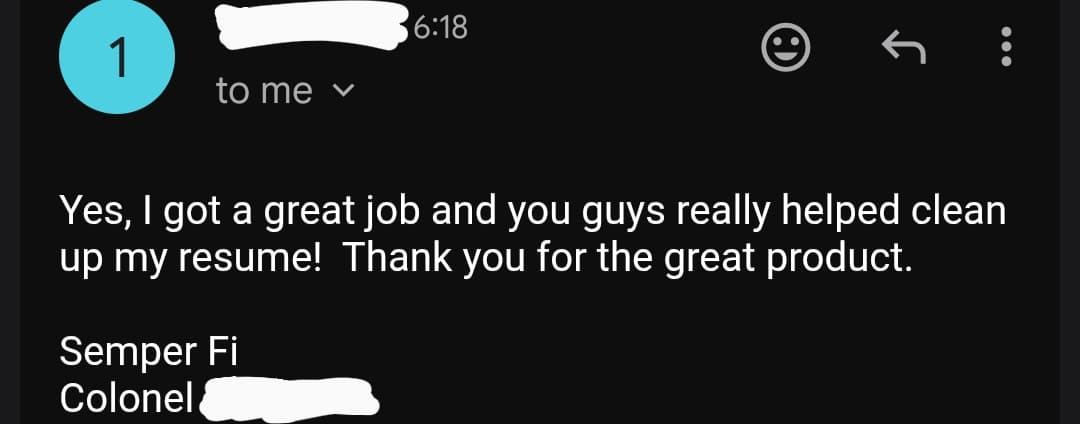
I used the resume program to transition a very government centric resume into one that could be easily understood and appreciated in the civilian sector. I applied to several government and corporate jobs using the resume builder to adjust my details according to the job I was applying for. I…

Eli · Colonel (O-6) · Marines · Operations and Intelligence

Read the full story

Federal career paths

Federal agencies across the intelligence, law enforcement, and security spectrum actively recruit from the reconnaissance community. Recon Marines with active clearances and documented intelligence collection experience are competitive candidates for positions at DIA, NGA, FBI, CBP, and the various DOD intelligence centers.

The GS-0132 Intelligence series is the most direct match — your reconnaissance reports, surveillance logs, and ISR coordination experience are essentially intelligence analysis performed in the field. GS-0083 Police and GS-1896 Border Patrol Agent positions leverage your fieldcraft, physical conditioning, and tactical judgment. Veterans' Preference applies to all of these, and many agencies use Direct Hire Authority for veteran candidates in security-critical roles.

Federal series and position matches

SeriesFederal job titleTypical gradesMatchExplore
GS-1811Criminal InvestigatorGS-7, GS-9, GS-11, GS-135 of 5View details
GS-0132IntelligenceGS-9, GS-11, GS-125 of 5View details
GS-0080Security AdministrationGS-7, GS-9, GS-114 of 5View details
GS-0083PoliceGS-5, GS-7, GS-94 of 5View details
GS-1896Border Patrol AgentGL-7, GL-9, GS-114 of 5View details
GS-0340Program ManagementGS-11, GS-12, GS-133 of 5View details
GS-0343Management and Program AnalystGS-9, GS-11, GS-123 of 5View details
GS-1712Training InstructionGS-7, GS-9, GS-113 of 5View details
GS-0089Emergency ManagementGS-9, GS-11, GS-123 of 5View details
GS-0301Miscellaneous Administration and ProgramGS-7, GS-9, GS-113 of 5View details

Federal resumes follow different rules. We know them.

Federal raters match your record against the announcement's specialized experience statement. BMR writes the federal format for any GS series above, with the hours per week and supervisor detail a rater looks for.

Free to start. Federal and private sector formats included.

Build My Federal Resume Free

Want to change careers entirely?

Not everyone stays in a related field. These paths run on the transferable half of the job: leadership, risk, logistics, planning.

Surveyor$72,740 median · Surveying / Construction · O*NET 17-1022.00

Recon is built on reading terrain precisely and reporting exactly what is there. Land surveying is the civilian version: precise field observation, remote work, and accuracy that others depend on.

Transfers: Sustained terrain observation and precision, Working long hours in remote field conditions, Reading and producing accurate field measurements, Self-directed work with minimal oversight.

How to get there: Most surveyors hold a bachelor's in surveying or geomatics, but many start as a survey technician and earn licensure (FS then PS exams) through on-the-job experience.

BLS OEWS May 2024 · 6% (Faster than average)

Cartographer and Photogrammetrist$78,380 median · Geospatial / Mapping · O*NET 17-1021.00

Recon Marines turn imagery and ground truth into usable terrain intelligence. Cartography and photogrammetry are the same craft in the civilian GIS world: turning aerial and sensor data into precise maps.

Transfers: Imagery and terrain analysis, Translating observation into accurate maps, Attention to fine geographic detail, Geospatial reasoning and route planning.

How to get there: A bachelor's in geography, GIS, or geomatics is typical; GIS certificate programs plus software skills (ArcGIS, photogrammetry suites) can open the door.

BLS OEWS May 2024 · 3% (As fast as average)

Forest and Conservation Technician$60,130 median · Environment / Forestry · O*NET 19-4071.00

Few civilian jobs match the remote, self-reliant fieldwork of recon. Conservation technicians live in the backcountry, navigate rough terrain, and gather field data alone or in tiny teams, exactly the recon rhythm.

Transfers: Extended self-reliant field operations, Observation and data collection in the wilderness, Navigation across rough terrain, Endurance in harsh conditions.

How to get there: An associate degree in forestry or natural resources is common; seasonal technician roles with the Forest Service or state agencies are a frequent entry point.

BLS OEWS May 2024 · -3% (Decline)

Commercial Pilot$122,670 median · Aviation · O*NET 53-2012.00

Recon work is planning-heavy: routes, contingencies, and reading a wide operating picture. Commercial flying rewards that same disciplined mission planning and calm, high-stakes decision-making.

Transfers: Detailed mission and route planning, Decision-making under pressure and risk, Situational awareness over wide areas, Disciplined contingency planning.

How to get there: Earn FAA Commercial Pilot certification (about 250 flight hours) at a flight school; the Post-9/11 GI Bill can fund a portion of flight training.

BLS OEWS May 2024 · 5% (Faster than average)

Electrical Power-Line Installer and Repairer$92,560 median · Utilities / Energy · O*NET 49-9051.00

Linework recreates the recon team dynamic: a small crew, real danger, and complete reliance on each other, where physical resilience and disciplined risk management decide the outcome.

Transfers: Operating in high-hazard environments, Total trust within a small autonomous team, Physical and mental endurance, Disciplined risk management.

How to get there: Enter through a utility apprenticeship or a community-college line-worker program (often under a year), followed by paid on-the-job training.

BLS OEWS May 2024 · 8% (Faster than average)

Logistician$80,880 median · Supply Chain / Logistics · O*NET 13-1081.00

The recon planning cycle, mapping routes, sequencing movement, and building branches for when things go wrong, is the same discipline civilian logisticians use to keep complex supply chains moving.

Transfers: Mission and contingency planning, Coordinating movement and resources, Anticipating failure points, Operating under shifting conditions.

How to get there: A bachelor's in supply chain, business, or logistics is typical; APICS or Six Sigma certifications speed advancement, and many enter as a logistics analyst or coordinator.

BLS OEWS May 2024 · 19% (Much faster than average)

Pivoting industries does not mean starting from scratch.

The skills behind the specialty carry further than the specialty. BMR rewrites your bullets for any of the paths above without making it sound like you have never done the work.

Free to start. Try as many angles as you want.

Tailor My Resume to a New Career

Skills translation guide

If you are applying to a defense contractor or intelligence agency, your reconnaissance terminology likely needs no translation — they speak the language. But if you are targeting operations management, project management, corporate security, or any role outside the defense and law enforcement space, the hiring manager has never heard of an R&S plan or a SALUTE report.

The translations below are designed for non-defense, non-law-enforcement roles. They reframe Recon Marine experience into business language that resonates with corporate hiring managers who have zero military context.

Resume bullet examples

Before, in service

Developed and executed R&S plans for deep reconnaissance operations in support of battalion-level objectives

After, on the resume

Designed and executed intelligence collection strategies to support senior leadership decision-making across a 200+ person organization

Before, in service

Authored and briefed patrol orders for 6-man reconnaissance teams conducting 72-hour operations

After, on the resume

Developed comprehensive operations plans for 6-person field teams, including objectives, timelines, risk mitigation, and contingency procedures for multi-day projects

Before, in service

Led a 6-man recon team through 14 combat deployments and 200+ operational missions with zero preventable casualties

After, on the resume

Led a high-performance field team through 14 deployment cycles and 200+ complex operations, maintaining 100% personnel safety record through rigorous risk management

Before, in service

Produced over 150 SALUTE reports during deployment providing critical intelligence for battalion-level operations

After, on the resume

Authored 150+ field intelligence assessments that directly informed organizational decision-making and resource allocation for a 1,000-person operation

Before, in service

Conducted pre-mission planning and full-scale rehearsals for all team operations, identifying and mitigating risks before execution

After, on the resume

Led comprehensive pre-execution risk assessments and team rehearsals for high-stakes field operations, reducing operational incidents through proactive hazard identification

Before, in service

Authored after action reports following all major operations, identifying areas for improvement and updating SOPs accordingly

After, on the resume

Conducted structured post-project performance reviews after each engagement, documenting lessons learned and updating standard operating procedures to improve future outcomes

Before, in service

Planned and coordinated helicopter and waterborne insert/extract for reconnaissance operations across multiple operational areas

After, on the resume

Coordinated multi-modal transportation logistics for remote field teams, managing scheduling, routing, and contingency planning across multiple geographic zones

Before, in service

Developed and maintained communications plans including primary, alternate, contingency, and emergency (PACE) procedures for all operations

After, on the resume

Designed redundant stakeholder communication protocols with primary, backup, and emergency notification procedures to ensure continuous information flow during critical operations

Get bullets like these written from your own record.

BMR turns your 0321 duties and accomplishments into civilian bullets aimed at the job you are applying for. No manual translation.

Free to start. Tailored to each posting.

Generate My Resume Bullets

Certifications by career path

Which ones you need depends on where you are headed.

Cybersecurity

CompTIA Security+CompTIA

Required for many DOD IT and cybersecurity positions. Baseline certification for information security roles.Cost $404 exam feeTime 2-4 months studyGI Bill eligibleDOD 8570 compliant. Opens doors to both government and private sector cybersecurity positions. Many prep courses covered by GI Bill.

CISSP (Certified Information Systems Security Professional)ISC2

Gold standard for senior information security roles. Requires 5 years experience (4 with degree).Cost $749 exam feeTime 3-6 months studyGI Bill eligibleHigh-value credential for cybersecurity careers. Associates of ISC2 option available if you do not yet meet experience requirements.

Emergency Management

CEM (Certified Emergency Manager)International Association of Emergency Managers (IAEM)

Standard credential for emergency management professionals. Demonstrates competency across all EM phases.Cost $375-475 application + examTime 3-6 months prepRequires combination of education, experience, and training. FEMA Independent Study courses (free) count toward requirements. Your contingency planning experience is directly relevant.

Emergency Medical Services

Tactical Combat Casualty Care (TCCC)National Association of EMTs / DOD

Some Recon Marines may have earned TCCC certification during service. Transfers to civilian EMT pathway and demonstrates medical competency under stress.Cost Earned in serviceTime Earned in serviceIf earned, document it. Can be a stepping stone to civilian EMT-B or Paramedic certification. Demonstrates composure and medical competency in emergency situations.

Investigations

Private Investigator LicenseState licensing boards (varies by state)

Required to work as a PI in most states. Requirements vary — some states accept military experience toward eligibility.Cost $100-500 (varies by state)Time 1-6 months (varies)Requirements differ significantly by state. Some states require a specific number of investigative experience hours — your reconnaissance and surveillance work may qualify. Check your state licensing board.

Project Management

PMP (Project Management Professional)Project Management Institute (PMI)

Gold standard for project management across all industries. Your mission planning hours count toward experience requirements.Cost $555 exam (PMI member)Time 2-4 months studyGI Bill eligibleMany employers reimburse exam costs. PMI membership ($139/year) reduces exam fee. Document your operational planning hours before applying.

CAPM (Certified Associate in Project Management)Project Management Institute (PMI)

Entry-level project management credential. Good stepping stone if you do not yet meet PMP experience requirements.Cost $300 exam (PMI member)Time 1-3 months studyGI Bill eligibleNo experience requirement — only 23 hours of PM education needed. Can upgrade to PMP once you accumulate required project hours.

Safety & EHS

OSHA 30-Hour General Industry or ConstructionOSHA (via authorized trainers)

Baseline safety certification. Required or preferred for many safety, construction, and operations roles.Cost $150-300 (online)Time 30 hoursAvailable online through OSHA-authorized providers. Construction version for construction careers, General Industry for manufacturing and corporate safety.

CSP (Certified Safety Professional)Board of Certified Safety Professionals (BCSP)

Most respected credential in occupational safety. Requires degree + experience or extensive experience alone.Cost $300-520 exam feeTime 3-6 months studyGI Bill eligibleYour military safety program management experience counts toward eligibility. BCSP offers a military-to-safety career pathway.

Security Management

CPP (Certified Protection Professional)ASIS International

Premier certification for corporate security management. Covers security management, investigations, and physical security.Cost $450-650 exam feeTime 3-6 months studyRequires experience in security management. Your reconnaissance and threat assessment background counts toward eligibility. Strong for corporate security director roles.

Got a cert? Do not bury it.

Placement decides whether a screener ever sees it. BMR knows where each one ranks, what to call it, and how to frame it.

Free to start. Built around your real certs and clearance.

Build My Resume the Right Way

Transition resources

For Staying in Intelligence, Security, or Law Enforcement

SkillBridge Programs: Several defense intelligence contractors and federal agencies participate in DOD SkillBridge, allowing Recon Marines to work in intelligence or security roles during their last 180 days of service. Check the SkillBridge database for current openings. Booz Allen Hamilton, CACI, and Leidos have historically participated.

Federal Law Enforcement Training: CBP, FBI, and Secret Service have dedicated veteran hiring pipelines. Many Recon Marines qualify for GS-1811 Criminal Investigator positions based on military experience alone. Check USAJobs for current openings and start applying 6 months before separation — federal hiring moves slowly.

Intelligence Community Careers: IntelligenceCareers.gov is the portal for IC positions across all agencies. Your TS/SCI clearance is a major asset — do not let it lapse during transition.

For Careers Outside Defense and Law Enforcement

Project Management: The PMP certification (PMI) is the gold standard. Your mission planning and execution experience counts toward the project hours requirement. Cost: ~$555 (PMI member). GI Bill covers some prep courses.

Information Security: Start with CompTIA Security+, then target CISSP for senior roles. Your threat assessment and risk analysis background gives you a foundation that many IT professionals lack. The field is growing and pays well — BLS median $124,910.

Federal Employment (USAJobs): Create your USAJobs profile immediately. Federal resumes are 2 pages max. Key agencies for Recon Marines: DIA, NGA, FBI, CBP, USSS, DOE, and every DOD intelligence center. Build yours here.

Veteran Networking: American Corporate Partners (ACP) provides free mentorship from corporate executives. You get paired with someone in your target industry. ACP is legitimate and completely free for veterans.

Clearance Leverage: An active TS/SCI clearance can be worth $15,000-30,000+ to employers who need cleared personnel. ClearanceJobs.com lists positions requiring active clearances. This is one of your strongest transition assets — use it before it lapses (24 months post-separation).

Education Benefits: Use the GI Bill Comparison Tool to verify program approval before enrolling. Many certification prep courses and exam fees are covered.

BMR Career Resources

Marine Infantry Resume Guide | Complete Military Resume Guide | Top Companies Hiring Veterans | Build Your Resume Free

Your 30, 60, 90-day transition plan

Most people do this backwards: wait for terminal leave, then panic. This is the sequence that works. Already out? Same plan, day one is today.

Days 0 to 30

Set the foundation

  • Pull your DD-214 (request it from milConnect if you are already separated)
  • List your top three civilian roles and your top three GS series
  • Build your tailored 0321 resume, free
  • Write one strong LinkedIn headline, not "veteran seeking opportunities"
  • Gather your evals and performance reports for the accomplishments
Build my resume free

Days 30 to 60

Apply with intent

  • Apply to five to ten jobs a week, quality over volume
  • Tailor every resume to the announcement (BMR does this part for you)
  • Connect with five people a week on LinkedIn, not a spray
  • Set up a USAJOBS profile and a saved search for your GS series
  • Say your bullets out loud to a civilian friend and fix what they do not follow
Tailor my next resume

Days 60 to 90

Close the offer

  • Track every application: date, status, contact, notes
  • Follow up seven to ten days after each one
  • Prep behavioral interviews with the STAR method
  • Negotiate. The BLS median is your floor, not the offer
  • Keep applying after the first offer. Options are the leverage
Track my applications

Questions about 0321

What is the median salary for jobs that use Recon Marine skills?

It depends heavily on the career path. According to BLS May 2024 data: information security analysts earn a median of $124,910 (O*NET 15-1212.00), operations managers earn $102,950 (O*NET 11-1021.00), management analysts earn $101,190 (O*NET 13-1111.00), police officers earn $76,290 (O*NET 33-3051.00), and private investigators earn $52,370 (O*NET 33-9021.00). The defense intelligence contractor space often exceeds these medians for cleared personnel, but BLS does not track contractor salaries separately.

What if I want to leave the military and defense world entirely?

Many Recon Marines successfully transition into completely non-military fields. Operations management (BLS median $102,950), project management ($100,750), corporate training ($65,850), and management consulting ($101,190) all leverage your planning, leadership, and analytical skills without requiring any defense or law enforcement connection. See the Career Change Paths section above for specific entry strategies.

How valuable is my TS/SCI clearance after separation?

Extremely valuable. An active TS/SCI clearance saves employers months of processing time and tens of thousands of dollars in investigation costs. Defense contractors, intelligence agencies, and some financial services firms specifically seek cleared candidates. Your clearance stays active for up to 24 months after separation if not renewed — start your job search before it lapses. Sites like ClearanceJobs.com list positions that require active clearances.

Do I need a degree to get hired in the private sector?

For many roles, no. Corporate security, operations management, and project management positions frequently accept military experience in lieu of a degree, especially with professional certifications (PMP, CPP, Security+). Intelligence contractor roles prioritize clearance and experience over education. However, some employers and government positions require a bachelor's minimum. Use your GI Bill strategically — certifications often provide faster ROI than a 4-year degree.

How do I explain Recon Marine experience in a non-defense job interview?

Focus on the transferable skills, not the missions. Instead of describing a reconnaissance patrol, talk about leading a small team to gather critical information under tight deadlines with incomplete data and no direct supervision. Instead of surveillance operations, discuss monitoring, data collection, and analysis to inform decision-making. Quantify everything — team sizes, budgets managed, operational hours, equipment values. The tactical context is interesting background, but the skills are what get you hired.

How does Veterans' Preference work for federal jobs?

Veterans' Preference gives you 5 or 10 extra points on federal hiring assessments. Disabled veterans receive 10 points. You need your DD-214 (Member 4 copy) and SF-15 form. Some positions use Direct Hire Authority which can bypass normal competitive processes — DIA, CBP, and FBI frequently use this for veteran hires. Apply to positions at or below GS-11 initially where Veterans' Preference has the strongest impact. Federal resumes follow different rules than private sector — build yours at bestmilitaryresume.com.

What certifications should I get before separating?

Prioritize based on your target career. For intelligence/security: CompTIA Security+ ($404 exam, GI Bill may cover prep). For corporate security: CPP (Certified Protection Professional) from ASIS International. For project management: start PMP prep — your mission planning hours count toward the experience requirement. For federal law enforcement: focus on physical fitness and application timing rather than certs. Universal: keep First Aid/CPR current and get your USAJobs profile set up 6 months before your EAS.

Is federal law enforcement a good fit for Recon Marines?

Many Recon Marines transition well into federal law enforcement. CBP Border Patrol Agent (GS-1896), FBI Special Agent (GS-1811), and Secret Service all value the fieldcraft, physical conditioning, threat assessment, and autonomous decision-making that define the Recon community. The hiring processes are long (6-18 months), so apply early. Your military experience may qualify you at higher grade levels than civilian applicants.

Where are the best job markets for former Recon Marines?

For defense/intelligence work: the DC Metro area (Northern Virginia, Maryland) dominates with the highest concentration of defense contractors and IC agencies. San Diego, Tampa (SOCOM), and Fayetteville (Fort Liberty) are secondary hubs. For corporate security and operations management: any major metro works, but DC, New York, Houston, and Dallas have strong markets. For federal law enforcement: positions exist nationwide, but border-state assignments are common for CBP.

Can I start job searching while still on active duty?

Yes — and you should start 12 months before your EAS. At 180 days out, you may be eligible for DOD SkillBridge to work full-time at a civilian company while still receiving military pay. At minimum: have your resume ready 6 months out, start networking on LinkedIn 6 months out, apply to federal positions 6 months out (federal hiring is slow), and attend industry events if targeting a specific field. Use terminal leave strategically — it is your transition runway.
Turn your 0321 Reconnaissance Marine experience into a resume that gets callbacks

Stop rewriting from scratch every time you apply. BMR turns your military experience into civilian and federal resumes, tailored to each job.

2

Tailored resumes

Rewritten for each job posting

2

Cover letters

Matched to the role

LinkedIn optimization

Profile rewrite for civilian recruiters

Elevator pitch generator

For interviews and networking

2

Company research reports

Know who you are applying to

Job tracker

Every application in one place

Start My Free ResumeFree for every veteran. Built by a Navy Diver veteran, 71,892 resumes built for the military community.