Loading...
Loading...
The civilian and federal jobs that hire Navy Machinery Repairmans — with real salaries and the resume that gets callbacks.
Every MR has more options than a Google search will tell you. Below: career paths, BLS salary data, federal GS series, certifications by target career, and how to translate your experience without losing what made you valuable to the Navy in the first place.
Free · No credit card · Tailored resume in under 5 minutes
After the Navy I got hired into 6 federal career fields and tech sales, and sat on federal hiring panels along the way. I spent the last 2 years rebuilding everything I learned into BMR, tuned for how AI actually screens resumes today. This is the system I wish I'd had on day one.
A Machinery Repairman is the Navy's shipboard machinist. When a valve seat, a pump shaft, or a bearing journal fails at sea and the nearest supply depot is a thousand miles away, the MR walks into the machine shop and makes the part. You ran lathes, milling machines, boring mills, grinders, drill presses, and power saws to fabricate and repair components for main propulsion engines, auxiliary systems, deck machinery like winches and hoists, condensers, and heat exchangers. On modern platforms that work increasingly runs through Computer Numerically Controlled (CNC) machines and Computer-Aided Design (CAD), so many MRs leave service fluent in both manual and programmed metalworking.
The pipeline starts with "A" school, where you learned blueprint reading, precision measurement to the thousandth of an inch, metallurgy, and the safe operation of every machine tool in a shipboard shop. From there MRs split roughly half their careers between fleet units and shore repair facilities, including tenders, intermediate maintenance activities, and regional repair centers. It is a small rating, around 770 sailors, which means employers rarely see this exact background, and that scarcity is a selling point once the resume translates it correctly.
Civilian manufacturers value this background because you already work to tolerance, read engineering drawings without hand-holding, and troubleshoot a part failure back to its root cause. Machine shops spend months training a new hire to do what an MR did on a pitching deck with limited material and no second chances. If you are still mapping where this rating leads, start with the military career crosswalk tool, and compare your path to the closely related Machinist's Mate (MM) and Hull Maintenance Technician (HT) ratings, whose veterans compete for many of the same civilian shops.
In more than 60,000 resumes BMR has built, the MRs we see land precision-machining and manufacturing offers fast once the resume names the machines, the tolerances, and the materials instead of burying it under "performed maintenance." The work already speaks for itself. The translation is what gets you in the door. — Brad Tachi, Navy Diver veteran & BMR founder
The number that matters when you're deciding what's next: how does civilian pay compare to what you make now?
Military comp is approximate (varies by location/dependents). Civilian is BLS median. Federal includes locality pay. Your real number depends on duty station, family status, GS step, and overtime.
Machinists and CNC operators are in steady demand, and the precision-machining trades have an aging workforce that manufacturers are actively trying to replace. According to the Bureau of Labor Statistics (BLS OEWS, May 2024), machinists earn a median annual wage of $56,150, and tool and die makers, the higher-skilled tier you can grow into, earn a median of $63,180. CNC programming is where formal MR experience with CAD and programmed machines pays off, since shops pay a premium for someone who can write and prove out a toolpath rather than just run one.
Be realistic about geography. Machining jobs cluster around manufacturing corridors, the upper Midwest, the Southeast, Texas, and the Pacific Northwest aerospace belt, more than they cluster in coastal metros. Pay scales with the industry: medical-device and aerospace shops, which demand the tightest tolerances and the most documentation, pay more than general job shops. Your shipboard habit of working to a drawing and signing for your own quality is exactly what those regulated industries screen for.
Defense shipbuilders and ship-repair firms are the most natural landing spot because they already understand the rating. Beyond them, contract machine shops, industrial equipment manufacturers, and maintenance-heavy plants hire MRs into machinery and equipment repair roles that overlap with the Coast Guard's machinery rating. If you want a structured before-and-after on translating shop language for non-machining employers, the military terms glossary is a useful companion, and you can build your resume now when you are ready to put it to work.
| Civilian Job Title | Industry | BLS Median Salary | Outlook | Match |
|---|---|---|---|---|
Machinist O*NET: 51-4041.00 | Manufacturing | $56,150 | 2% (As fast as average) | strong |
CNC Machinist O*NET: 51-4041.00 | Manufacturing | $56,150 | 2% (As fast as average) | strong |
Tool and Die Maker O*NET: 51-4111.00 | Manufacturing | $63,180 | 0% (Little or no change) | strong |
Industrial Machinery Mechanic O*NET: 49-9041.00 | Industrial Maintenance | $63,510 | 15% (Much faster than average) | strong |
Welder, Cutter, Solderer, and Brazer O*NET: 51-4121.00 | Manufacturing | $51,000 | 2% (As fast as average) | moderate |
Sheet Metal Worker O*NET: 47-2211.00 | Manufacturing | $60,850 | 1% (Little or no change) | moderate |
Production Machinery Mechanic O*NET: 49-9041.00 | Manufacturing | $63,510 | 15% (Much faster than average) | moderate |
BMR rewrites your MR experience for any of the civilian roles above — keywords, achievements, and language hiring managers actually scan for.
Free · No credit card · 2 tailored resumes included
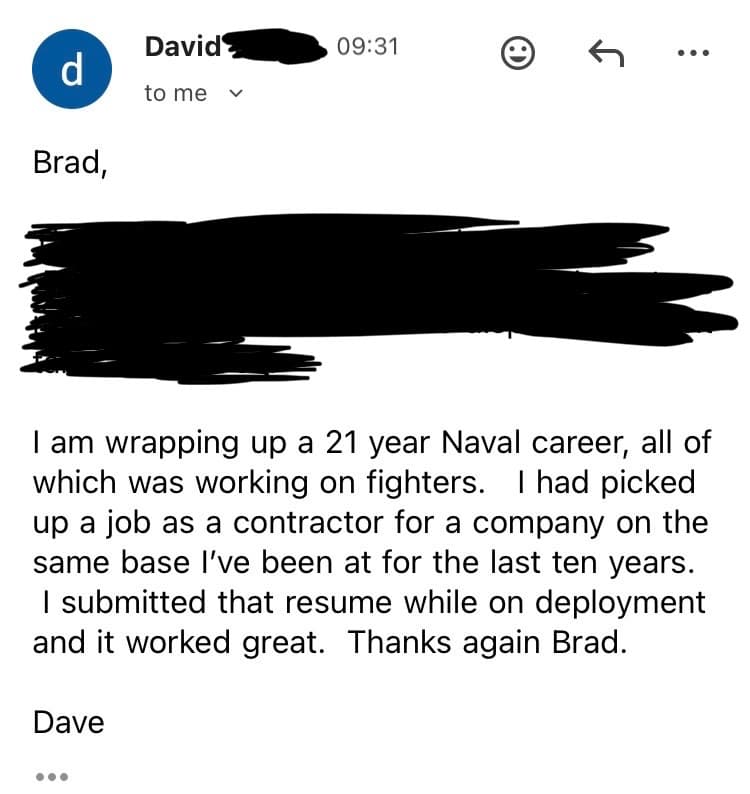
“I am wrapping up a 21 year Naval career, all of which was working on fighters. I had picked up a job as a contractor for a company on the same base I’ve been at for the last ten years. I submitted that resume while on deployment and it worked great. Thanks again Brad. Dave ”
Federal machining work is concentrated in the Wage Grade trades and the technical GS series that surround them, and veterans who held this rating qualify for several of them with little additional training. The most direct match is WG-3414 Machining, the federal classification for the exact work you did, found in Navy shipyards, Army depots, and Air Force logistics centers. Closely adjacent are WG-5350 Production Machinery Mechanic and WG-3806 Sheet Metal Mechanic, both common in depot-level overhaul shops.
On the General Schedule side, GS-0802 Engineering Technician rewards MRs who moved into work planning, inspection, or quality verification, while GS-0830 Mechanical Engineering and GS-0801 General Engineering become reachable for those who pair shop experience with a degree or completed coursework. MRs who gravitated toward shop scheduling, tooling control, and parts accountability also map to GS-1601 General Facilities and Equipment and GS-1670 Equipment Services.
Veterans' Preference adds 5 or 10 points to your rated score and, in many trades vacancies, lets you compete in a separate category that civilians cannot. Federal shipyard and depot jobs reward continuity, so naval shop experience reads as directly relevant rather than as a career change. For the mechanics of writing to a federal vacancy announcement, the guide on moving into federal employment walks through the format, and you can start your federal resume here. Veterans from the Hull Maintenance Technician rating compete for many of the same shipyard trade slots.
| GS Series | Federal Job Title | Typical Grades | Match | Explore |
|---|---|---|---|---|
| GS-5350 | Production Machinery Mechanic | WG-8, WG-10, WG-11 | View Details → | |
| GS-3414 | Machining | WG-10, WG-11, WG-12 | View Details → | |
| GS-5334 | Marine Machinery Mechanic | WG-10, WG-11, WG-12 | View Details → | |
| GS-0802 | Engineering Technician | GS-7, GS-9, GS-11 | View Details → | |
| GS-3806 | Sheet Metal Mechanic | WG-8, WG-10 | View Details → | |
| GS-1670 | Equipment Services | GS-7, GS-9 | View Details → | |
| GS-0830 | Mechanical Engineering | GS-7, GS-9, GS-11 | View Details → | |
| GS-1601 | General Facilities and Equipment | GS-7, GS-9 | View Details → |
Federal hiring uses keyword-matching and structured experience. BMR builds federal-format resumes (USAJobs-ready) with the right keywords, hours/week, and supervisor info — for any GS series above.
Free · No credit card · Federal + civilian resume formats included
Not everyone wants to stay in a related field. These career paths leverage your transferable skills — leadership, risk management, logistics, project planning — in completely different industries.
Building crowns, bridges, and dentures is precision part-making at small scale, the same hand-eye control and tolerance discipline a machinist uses on a lathe.
Aviation maintenance rewards the same drawing-driven precision and disciplined troubleshooting MRs use shipboard, in an industry that documents every repair.
Installing and servicing lift systems is mechanical work to exacting safety tolerances, a strong fit for someone who already aligns shafts and bearings to spec.
Operating and maintaining building boilers, chillers, and mechanical plant draws on the same auxiliary-machinery and heat-exchanger work MRs do at sea.
Crafting and repairing fine metal pieces is precision metalwork at miniature scale, a natural fit for the steady hands and tolerance focus a machinist develops.
Building custom orthotic and prosthetic devices is precision one-off fabrication to an exact spec, the same craft an MR runs at the lathe and mill, applied to a patient instead of a pump shaft.
The skills that made you a good Marine, Sailor, Airman, or Soldier transfer further than you think. BMR rewrites your bullets for any of the pivot careers above — without making you sound like you've never done the work.
Free · No credit card · Try unlimited career angles
If you are staying in machining, fabrication, or shipyard repair, your terminology already translates. Shop foremen know what a lathe operator and a CNC programmer do, so do not water down your jargon for them. This section is for MRs targeting careers outside the machine shop, where a hiring manager has never set foot on a tender and needs the work framed in business language.
The pattern that wins is to lead with the outcome and the standard, then name the skill. "Operated a lathe" tells a non-technical reader nothing. "Fabricated replacement components to drawing tolerances of plus or minus 0.001 inch, eliminating a 6-week supply lead time" tells them you deliver precision under deadline pressure.
For more before-and-after conversions across categories, the 50 military terms translated to civilian language guide is the fastest reference, and the walkthrough on converting evaluations into resume bullets shows where to mine the specifics. When you are ready to draft, the military resume builder handles the structure.
BMR turns your MR duties and accomplishments into civilian bullets that match the job you're applying for — no manual translation, no rewriting.
Free · No credit card · Tailored to each job posting
Which certifications you need depends on where you're headed. Find your target career path below.
The wrong placement can sink an otherwise strong application. BMR knows where each cert ranks, what to call it, and how to frame it for ATS keyword matching and hiring manager attention.
Free · No credit card · Built around your real certs and clearance
If you are continuing in the trade, your first move is matching civilian credentials to the work you already do. The National Institute for Metalworking Skills (NIMS) offers competency credentials that civilian shops recognize immediately, and a SkillBridge placement with a manufacturer or shipbuilder lets you start before your separation date. The SkillBridge guide and the list of SkillBridge companies hiring are the places to start. Related ratings worth comparing: Machinist's Mate and the Air Force Aircraft Metals Technology career field.
If you want a clean break from the shop floor, lean on the credentials that signal you can manage process and quality anywhere. NIMS, an OSHA 30 card, and a quality certification open manufacturing-adjacent roles, and American Corporate Partners (ACP) provides free one-on-one veteran mentorship to help you map a new field. For broad career exploration, the military-to-civilian career hub lets you scan paths by skill rather than by rating. Plan the timeline early using the SFL-TAP transition checklist.
Whichever direction you choose, the military resume builder and the federal resume builder are built for exactly this translation work. When you are ready to start, build your resume now. See also the related Engineman career path for veterans weighing engine-room versus machine-shop routes.
Most veterans do this backwards — they wait until terminal leave to start, then panic. Here's the actual sequence that works.
Print this. Tape it to your monitor. Veterans who treat the transition like a 90-day op get hired faster than the ones who treat it like an emergency.
Stop rewriting from scratch every time you apply. BMR turns your military experience into civilian and federal resumes — tailored to each job.