How to Interview for a Role Above Your Level (Veteran Guide)
Taylor sent 200+ applications for 5 interviews. With BMR, 20 resumes all hit.
Taylor, E-7, Army, defense industry
To interview above your level, claim only the scope you held. Size it in the new job's words. Then name the one part you haven't done yet and how you'd close it.
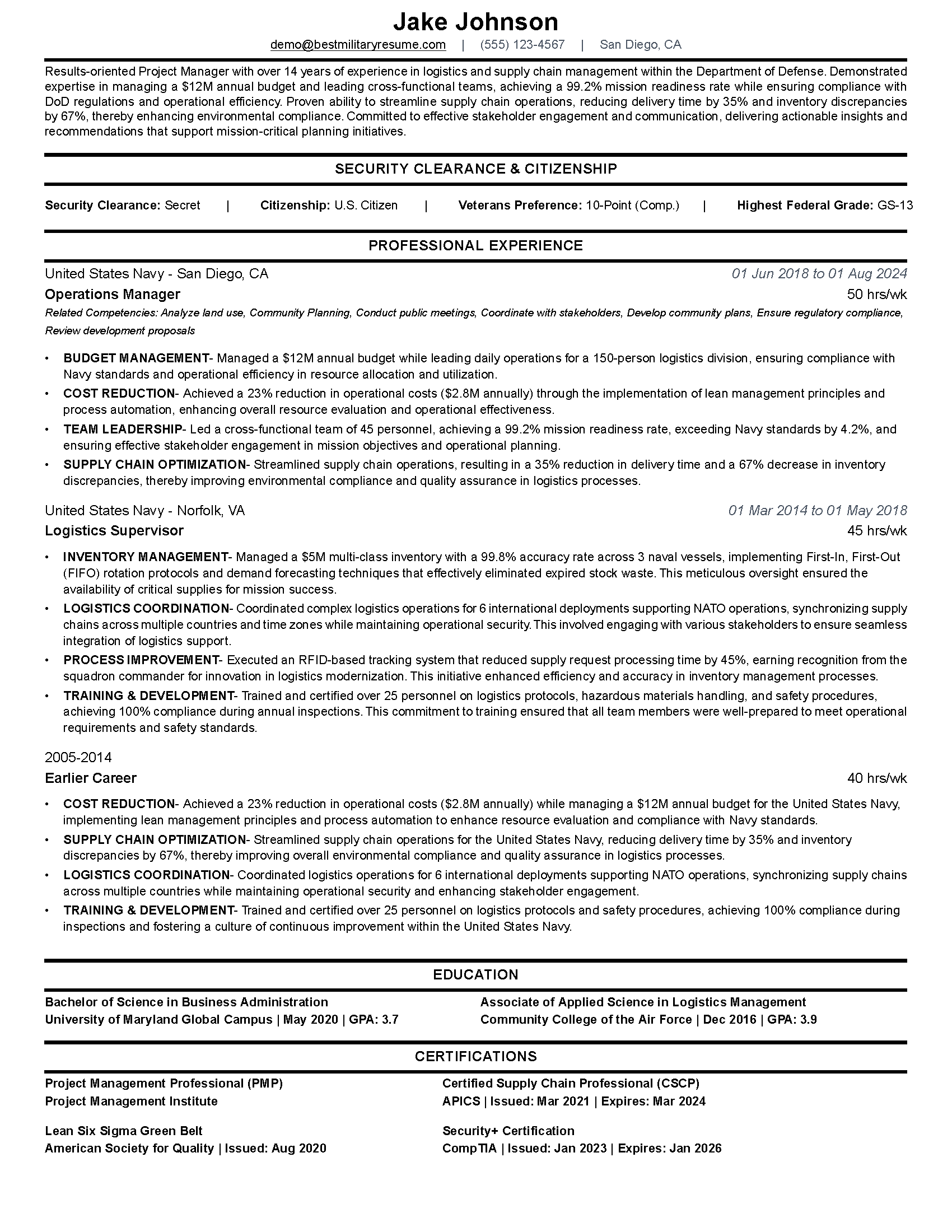
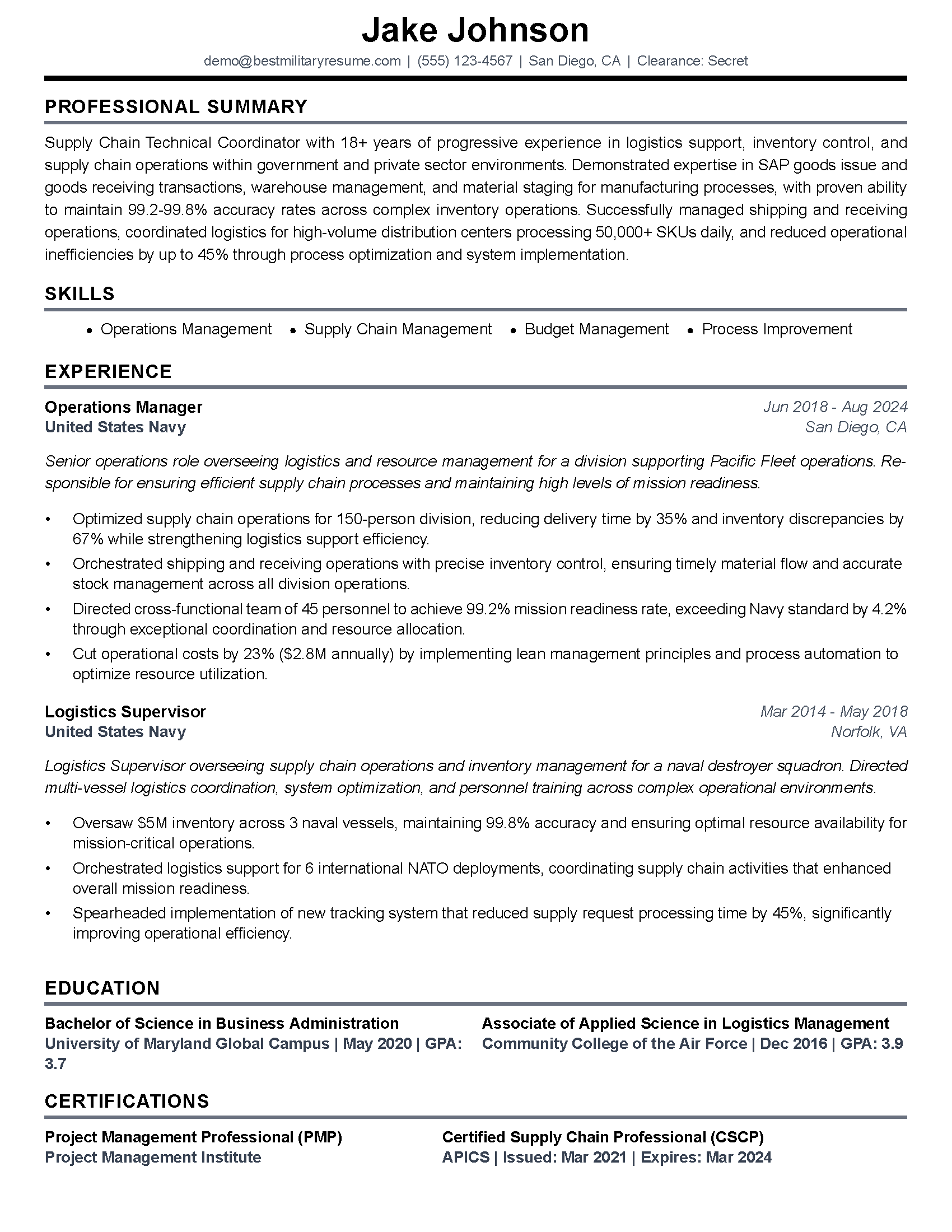
Say you were enlisted, and this job would be an officer's billet in the military. That gap can feel huge. It usually shrinks once you count what you truly ran. Your resume should carry the same true numbers you'll say out loud, so build both from one list. 79,689 resumes have been built on BMR, a resume builder for veterans.
What scope can you claim, and what counts as overselling?
The table and the three answers below use made-up samples to show the method. Every left-column line is true and sized. Every right-column line takes credit for something the person didn't own.
| Claim it (true scope) | Don't claim it (overselling) |
|---|---|
| I led 38 soldiers through 4 squad leaders. | I managed a 38-person department. |
| I tracked spending against a $4.2 million budget. | I owned the profit and loss on $4.2 million. |
| I built the plan. My commander approved it. | I made the call to move the whole unit. |
| My part was the parts tracker that sped up repairs. | I cut repair time for the whole shop. |
| I wrote yearly reviews for 4 supervisors. | I ran HR for 38 people. |
| I filled in for my manager for 6 weeks. | I've already been doing the manager's job. |
The left column is strong, and you can back every line of it. If you can't back a line on a follow-up question, cut it.
How do you answer "You haven't managed at this level. Why you?"
Our advice at BMR: answer the question they asked. They asked why you, at this level. So give one true scope claim with its size and tie it to this job's duties. Then name the gap and your plan. Tell it as a short story, not a briefing.
Sample 1: former Army platoon sergeant, first civilian manager job
Dana was an Army Sergeant First Class (E-7) and a platoon sergeant. She now works as a logistics analyst with no direct reports. She's interviewing for a warehouse operations supervisor role.
"Fair question. My current job has no direct reports. Before this, I led 38 soldiers through 4 squad leaders for two years. I set the daily work plan, checked the results and wrote reviews for those 4 leaders. That's the core of this role: plan the shift and hold leads to a standard. In my last inspection, my team accounted for every item on a $12 million equipment list. What I haven't done is hire. The Army assigned my people. So in month one, I'd sit in on interviews with your HR partner first."
Sample 2: retired Army major, director role that owns profit and loss
Marcus retired as an Army Major (O-4). His last job was brigade logistics officer on a staff. He's interviewing for Director of Operations at a distribution company that owns its own profit and loss.
"I've led at the director's scope, with one piece missing. As a logistics officer, I planned and tracked a $4.2 million yearly operations budget. I coordinated 6 supply teams that didn't report to me, so I had to lead by agreement. My commander made the final calls. I built the options and the plan behind them. The missing piece is revenue. I've managed spending, but I've never owned margin. So in my first 90 days, I'd meet weekly with your finance lead. I'd want to learn which lines move your margin before I change any of them."
Sample 3: Navy veteran, internal promotion one level up
Luis served in the Navy and now works as a senior analyst at the same company. He's interviewing for the team lead job above him.
"You've seen my work here for a few years. Here's the part you may not have seen. This year I trained our 5 new hires, and all 5 now close tickets on their own. When our manager was out for 6 weeks, I ran the weekly schedule and the client calls. In the Navy I led a work center of 9 sailors, so leading peers isn't new. What I haven't done is a pay decision or a formal performance plan. I'd ask to co-write the first round of reviews with you."
Each answer runs about 100 words. Each one claims a real size and ends on a plan.
How do you put a rank's scope into the bigger job's words?
A rank isn't a size. "Platoon sergeant" or "S4" doesn't say how big the job was. The size does the work. Count the people, the money, the teams you worked with and the calls that were yours.
Start from the target job's duties, not your old title. Pull the duties from the posting first, then check a job's task list for the plain words.
O*NET lists the tasks for general and operations managers. One is "Prepare staff work schedules and assign specific duties." That matches what Dana did every day, so she says "set the daily work plan."
- People: say how many, and how many levels. "38 soldiers through 4 squad leaders" shows a two-level team.
- Money: say what you did with it. Tracking a budget and owning profit and loss are different jobs.
- Reach: say who you worked with who didn't report to you. Marcus led 6 teams by agreement.
- Decisions: say which calls were yours and which you recommended.
- Jargon: swap each military term for its plain job. Hand receipt is equipment list. NCOER is a yearly review.
For more jargon swaps, read how to explain military experience in an interview without jargon.
How do you name what you haven't done without apologizing or bluffing?
A bigger job usually has at least one duty you haven't held. Four are common ones to check: hiring and firing, setting a budget, owning profit and loss and pay calls. O*NET's task list for first-line office supervisors includes "Recruit, interview, and select employees." If you haven't done that, say so.
Our advice at BMR is a three-part line. Name the gap in plain words. Name the closest thing you did. Then name the first step you'd take to close it.
"I'm sorry, I know I don't have budget experience." Or: "Budgets are budgets. I can handle any of them."
"I've tracked spending, but I've never set a budget. In month one, I'd build next year's draft with your finance lead."
Keep the gap to one. One gap with a plan is enough. Pick the biggest one the job needs, and say it before they find it. If they push on a second one, use the same three parts.
The gap line works like a weakness answer, so the same rules carry over. Our page on the biggest weakness question for veterans covers that one on its own.
Which lines sound like overselling?
These habits make a true record sound inflated. Read your practice answer out loud and listen for them.
- The unit's result as yours: "I cut repair time" when the shop did it. Say what your part was.
- The commander's call as yours: "I decided to move the unit." If you recommended it, say you built the plan.
- Title inflation: "I was basically the operations director." Use your real job and its real size.
- Rank as the proof: "As a Master Sergeant, I can lead anyone." The rank says you were trusted. The numbers say with what.
- "I can do anything": it skips the gap. Name the gap yourself, then show your plan.
- A briefing in place of a story: bottom line, situation, recommendation. Tell what happened and what you did about it.
Some veterans under-claim by saying "we" about work they led alone. Say "I" when you did it.
Does the answer change for a promotion at your company or a new employer?
The method stays the same. What changes is what they already know about you.
Internal promotion
They've seen your current job. They may not have seen your military scope or your fill-in work. So lead with the part they haven't seen, the way Luis did. Tie it to their own team and their own numbers. If it's a federal promotion panel, read our federal promotion panel interview guide too.
New employer
Make every number you say match a line on your resume. Be ready for the size questions: how many people, how many levels, how much money, whose decision. If you took a step down after the military, say why in one line. Then go straight to the scope you held before it.
Going for a bigger job is the opposite problem from being too senior for one. If you're stepping down, read how to handle the overqualified question. If the panel asks how you lead, see our leadership style answer for senior veterans.
If you want to build the missing duty before you apply, a stretch assignment can do that. Pay talk for the higher level lives in our salary negotiation scripts.
What to Do Next
Write your own "why you at this level" answer tonight. Use one sized claim, one tie to the job, one gap and one plan. Then say it out loud until it fits in about 100 to 150 words.
Matt, an Air Force Master Sergeant (E-7), made that kind of jump. In his words: "I was hired as a Director of Operations, and I used the resume that I built on BMR to get it."
Practice your answer in BMR's mock interview. Answer the question, and it writes a stronger version from your own background, at 100 to 150 words. It also flags each "we" that hides your part.
Sources: O*NET OnLine task lists for 11-1021.00 and 43-1011.00, and BMR's mock interview method. We checked them in November 2026.
Frequently Asked Questions
Should I apply for a bigger role if I meet only some of the requirements?
How do I answer a recruiter who asks what my current level is?
Should I accept a lower title to get in the door?
Should I bring up the gap if they don't ask about it?
About the author
Brad Tachi is the CEO and founder of Best Military Resume and a 2025 Military Friendly Vetrepreneur of the Year award recipient for overseas excellence. A former U.S. Navy Diver with over 20 years of combined military, private sector, and federal government experience, Brad brings unparalleled expertise to help veterans and military service members successfully transition to rewarding civilian careers. Having personally navigated the military-to-civilian transition, Brad deeply understands the challenges veterans face and specializes in translating military experience into compelling resumes that capture the attention of civilian employers. Through Best Military Resume, Brad has helped thousands of service members land their dream jobs by providing expert resume writing, career coaching, and job search strategies tailored specifically for the veteran community.