Arizona Veterans Preference: 5 or 10 Points, Only If You Pass
"Still getting interviews left and right. Now I have to say no."
Taranjeet, E-5, Army, optimized her LinkedIn and resume with BMR
Arizona veterans preference adds points to your state exam score, but only if you pass without them. Under A.R.S. 38-492, it's 5 points for an eligible veteran and 10 for the disability group.
The 5 points need two things. You left the service under honorable conditions, and you served more than six months of active duty. Miss either one and the first sentence of subsection (A) doesn't apply to you.
You'll get every condition, the promotion limit, a DD 214 check and the upload step.
Rules checked in November 2026. Sources: A.R.S. 38-491 to 38-494, the state's personnel rules and the state HR veterans page.
Arizona Preference Points at a Glance
Each point value below comes from the law. The letters match its parts.
- Veteran, subsection (A): 5 points. You separated under honorable conditions after more than six months of active duty.
- Disability group, subsection (E): 10 points. The exact wording is in the next section.
- Veteran who is also a person with a disability, subsection (C): 10 points. You qualify under (A) and under (B).
- Spouse or surviving spouse, subsection (D): 5 points, in three narrow cases.
- The cap, subsection (G): No one gets more than 10 points.
The pass rule changes the math. The law adds the points "only if the veteran earns a passing grade without preference." So the line reads like this:
- You pass on your own: [your passing score] + 5 is your final rating.
- You fall short on your own: No points get added. The points can't lift a failing score to a pass.
That's the big change from a percent system. Ohio adds a share of your grade instead. See the contrast in the Ohio exam credit guide. Arizona adds a flat number. Georgia also adds a flat 5 or 10, as the Georgia scored exam guide shows.
The Five Point and Ten Point Veteran Rules
Five points
Subsection (A) covers a veteran who is "separated from the armed forces under honorable conditions." The separation has to follow "more than six months of active duty." It applies to an exam for a state or local government job. The job has to be under a merit system, as set out in A.R.S. 38-491.
Six months is the line, and it means more than six. If you served exactly six months, you don't meet the words of the law.
Ten points
Subsection (E) is the disability group. It reads, word for word:
"An honorably separated veteran who served on active duty in the armed forces at any time and who has a service-connected disability or is receiving compensation or disability retirement benefits under laws administered by the United States department of veterans affairs, army, navy, air force, coast guard or United States public health service shall be given a ten point preference pursuant to this section."
Look at what (E) doesn't say. There's no six month test. "At any time" speaks to when you served, not how long. On the text alone, a short tour can still reach 10 points through (E). You must meet its other terms.
There's a second way to get 10. Subsection (B) gives 5 points to a "person with a disability." Subsection (C) says a person who qualifies under both (A) and (B) gets 10.
Spouse Points in Three Narrow Cases
Subsection (D) gives 5 points to a spouse or surviving spouse. The spouse has to be "otherwise qualified pursuant to subsection A." The points go to the spouse "as if the spouse or surviving spouse were an eligible veteran."
The service member has to fit one of these three cases:
- Death: "Any veteran who died of a service-connected disability."
- Missing or held: A member "serving on active duty" who is listed when you apply. The Secretary of Defense lists the member for "not less than ninety days" in one of these groups:
- "Missing in action."
- "Captured in the line of duty by a hostile force."
- "Forcibly detained or interned in the line of duty by a foreign government or power."
- Total disability: "A person who has a total, permanent disability resulting from a service-connected disability or any person who died while the disability was in existence."
If your spouse is living with a partial rating, you're not on this list. The statute names these three cases and no others.
Find Your Points on Your DD 214 and VA Letter
You don't need to guess. Pull out two papers and go through these steps.
- Find your character of service on the DD 214. Subsection (A) asks for a separation "under honorable conditions." Subsection (E) says "honorably separated." If yours is not honorable, read both lines with care before you claim.
- Add up your active duty time. For (A), it has to be more than six months.
- Check for a VA decision on a service-connected disability. Your VA letter shows if you have one. If you do, you're likely in the (E) group for 10 points.
- Check for compensation or disability retirement pay. Part (E) also covers pay under laws run by the VA or your branch. A retirement board letter fits here.
- Stop at 10. If two rules apply, you still get 10 at most.
Your answers sort out like this:
- Honorable, more than six months, no disability: 5 points.
- Honorable, any length, service-connected disability or disability pay: 10 points.
- Six months or less, no disability: No points under (A), unless the Guard and Reserve retiree line fits.
Federal jobs run on a different system. For that side, read how federal veterans preference works.
Send Your Proof Once Through azstatejobs.gov
State HR lists the papers on its Veterans' Hiring Preference page. You need one of these:
- Any veteran: "DD214 or certification from the Veteran's Administration Office."
- Disability group: "Form FL-802 or an equivalent letter from a service retirement board if you are a disabled veteran."
Upload the file to your online profile at azstatejobs.gov. The page says to "Submit your documentation only one time." You don't send it again for each job.
Do it before you apply. For more on the form itself, see our guide to using your DD 214 to claim preference.
Promotions, Current State Staff and Preference Codes
These points help you get in the door. In state covered service, they don't apply to promotional exams. A.A.C. R2-5A-302(C)(2) says, "Preference points shall not be applied to promotional examinations." That rule covers "positions in the covered service."
Some evaluations end with no numeric grade. The rule covers that too. "If an evaluation does not result in a numeric grade, preference shall be given by granting applicable preference codes to qualified applicants." Subsection (F) of the statute says the same thing. It covers jobs where applicants "are assessed and evaluated but scores are not given."
Neither text says what a code does after that. So don't expect a number on an unscored job. Expect a code tied to your claim.
Three Places the Official Texts Word It Differently
The law, the rule and the HR page don't match word for word. Read all three before you claim.
- Who counts as disabled. Statute (E) covers a service-connected disability "or" compensation or disability retirement pay. The R2-5A-101 definition says only "has a service-connected disability." The HR page asks for Form FL-802 or a retirement board letter.
- Who can use it. The HR page says preference "is available to external candidates who are not currently state employees." That's the HR page's line. The rule's words are "promotional examinations." The statute says nothing on either point.
- What the HR page leaves out. It asks for a DD214 but doesn't mention the six months or the honorable conditions. The statute has both. So a DD 214 alone may not settle it.
If your case falls in one of these gaps, ask state HR in writing before the job closes.
Counties, Cities and Guard or Reserve Retirees
A.R.S. 38-493 makes the law binding on the state. It also binds "a county, city, town or other political subdivision" with a merit system. That holds "regardless of any provision of the law, ordinance, rule, regulation or other enactment" for that system.
Guard and Reserve retirees get one extra line. Subsection (A) gives 5 points to a veteran entitled to non-regular retired pay under 10 U.S.C. chapter 1223. It also covers one who would be entitled "but for age."
That sentence names "any political subdivision of this state" only. It doesn't name state jobs. So the text gives you this route on county and city exams, not state exams. The same pass rule applies.
Two more rules apply. Under subsection (H), an office run under a federal merit system follows that system's preferences instead. An official who knowingly ignores this law when hiring or grading exams commits a crime. A.R.S. 38-494 makes it a class 3 misdemeanor.
Private companies sit outside this law. Our page on state preference laws for private employers covers that side.
Your Next Step Once You Pass
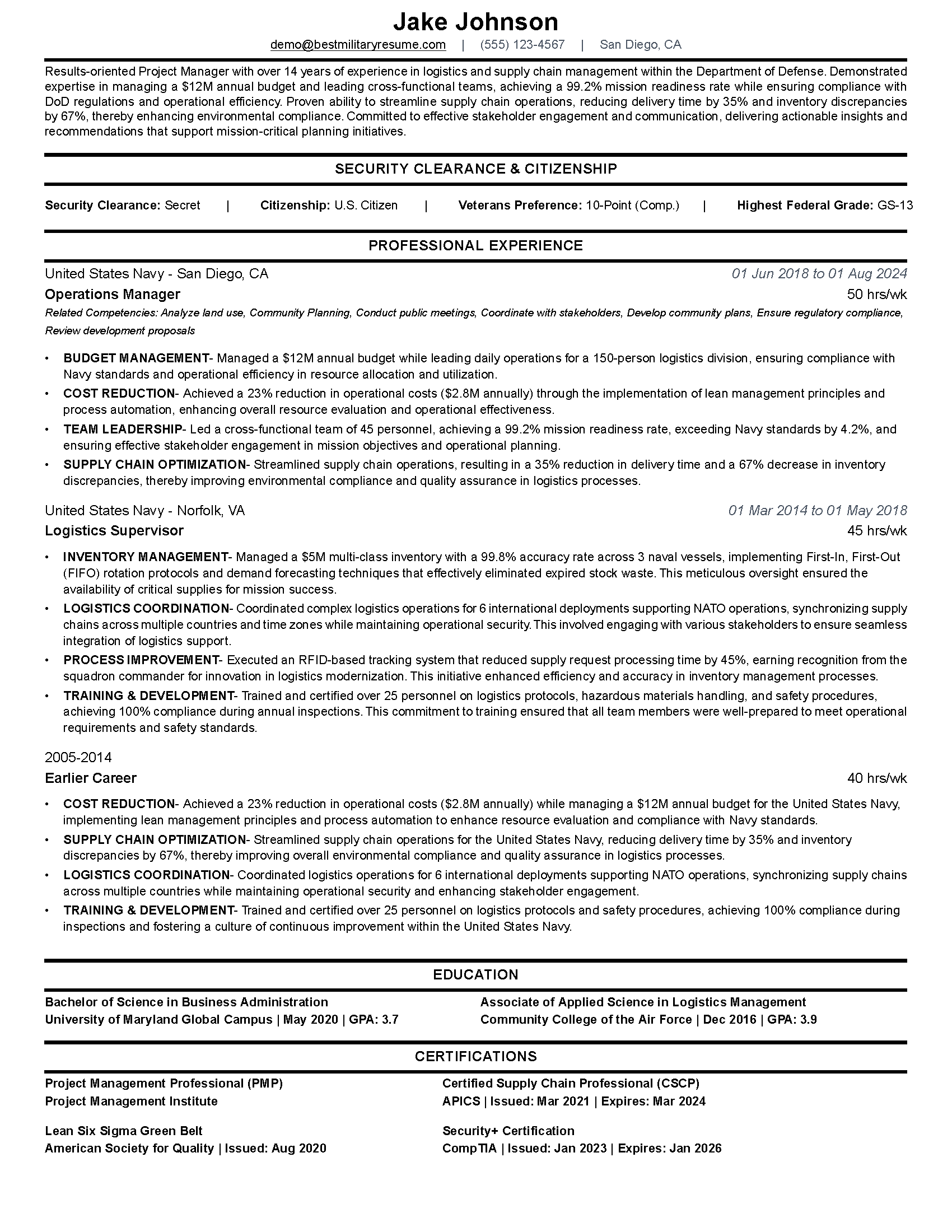
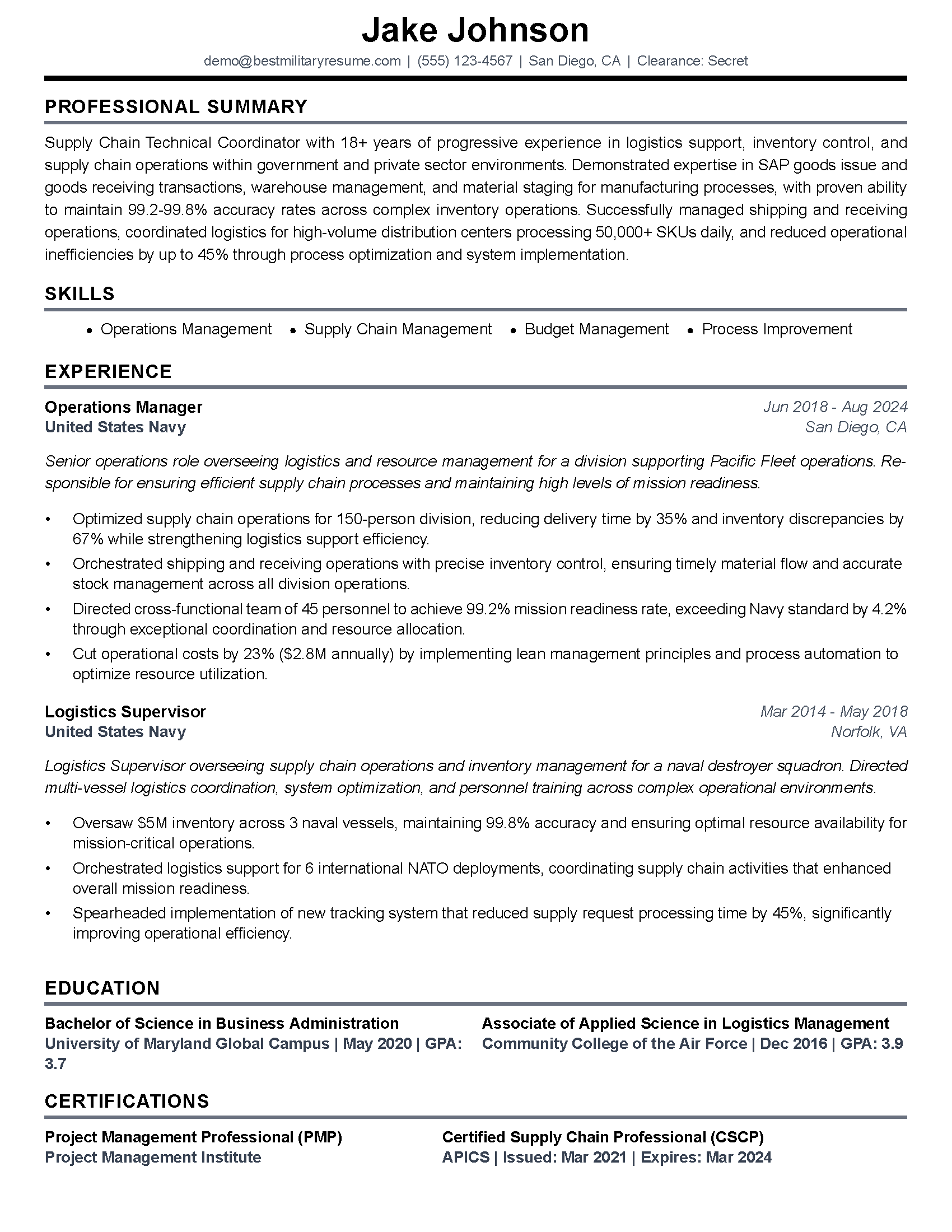
Your points only count once you pass. So the next step is the resume behind your Arizona application. Each duty you list should line up with a qualification in that posting.
Duvil, a Navy Petty Officer First Class, wrote to us after a federal job offer. "Thank you again for your assistance because I am one of those success stories. I have been offered a GS-9 position."
Open the military resume builder, sign in and paste the Arizona job posting. It rewrites your summary, bullets and skills in that posting's words. Confirm your DD 214 is on your azstatejobs.gov profile, then apply.
Frequently Asked Questions
Does Arizona veterans preference guarantee me an interview?
Is there an age limit for veterans applying to Arizona merit system jobs?
Who counts as a person with a disability under subsection (B)?
Does veterans preference protect me in an Arizona state layoff?
About the author
Brad Tachi is the CEO and founder of Best Military Resume and a 2025 Military Friendly Vetrepreneur of the Year award recipient for overseas excellence. A former U.S. Navy Diver with over 20 years of combined military, private sector, and federal government experience, Brad brings unparalleled expertise to help veterans and military service members successfully transition to rewarding civilian careers. Having personally navigated the military-to-civilian transition, Brad deeply understands the challenges veterans face and specializes in translating military experience into compelling resumes that capture the attention of civilian employers. Through Best Military Resume, Brad has helped thousands of service members land their dream jobs by providing expert resume writing, career coaching, and job search strategies tailored specifically for the veteran community.
