Georgia Veterans Preference: 5 or 10 Points Only on Scored Exams
"Still getting interviews left and right. Now I have to say no."
Taranjeet, E-5, Army, optimized her LinkedIn and resume with BMR
Georgia adds 5 points to an eligible veteran's passing score on a scored written state exam. It's 10 points with a VA service-connected disability rating of at least 10%. That's State Personnel Board Rule 478-1-.18, in effect since November 28, 2017.
No scored exam? Then preference applies only when your qualifications equal those of the most suitable non-veteran applicant. Hiring preference covers initial state employment only. It does not apply to promotion, demotion or transfer.
So I turned Georgia's own HR flowchart into six questions. You can answer them for one posting tonight.
Georgia's decision tree, in plain words
The state's Department of Administrative Services (DOAS) has a one-page Veterans Preference Decision Tree, dated 10/2017. Walk it in this order:
- First state job: Are you seeking your first job with the State of Georgia? If no, you're in the regular pool with no preference.
- Who you are: Are you a veteran or a disabled veteran's spouse? An unmarried widow or widower of a veteran also counts. If none fit, no preference.
- Discharge: Was the discharge under honorable conditions? Your DD 214 is the proof.
- Exam or no exam: Is a scored written exam part of hiring for this job?
- With an exam: Add 5 or 10 points to your earned passing score.
- With no exam: You get preference when your qualifications equal a non-veteran's for the same job.
Is this your first Georgia state job?
The rule is blunt on this. "Preference does not apply in cases of promotion, demotion, or transfer to a different job." So a state worker moving to a new job gets no service points.
That matters if you took a state job right after you got out. Your preference did its work on that first hire. The next move up is on merit alone.
This page covers jobs under the State Personnel Board rule.
Does your service count under the Georgia rule?
The rule's word "veteran" is narrower than you might think. You have to be honorably discharged and fit one of three lines:
- Active duty: You "served on active duty as a member of the Armed Forces of the United States during a time of armed conflict."
- Guard or Reserve, Iraq and Afghanistan era: You served on active duty during Operation Iraqi Freedom and Operation Enduring Freedom. The rule says "for any length of time."
- Guard or Reserve, Gulf War: You served on active duty during Desert Shield or Desert Storm. It had to be in an area of imminent danger.
The Gulf War line lists six areas. The first three are the Persian Gulf, the Red Sea and the Gulf of Oman. Next is the Gulf of Aden, plus part of the Arabian Sea. That part lies north of 10 degrees north and west of 68 degrees east.
Last is the land of Saudi Arabia, Kuwait, Iraq, Yemen, Oman, Bahrain, Qatar and the UAE.
The rule doesn't print dates for each armed conflict. If your service fell between operations, ask the agency HR office before you count on points.
Which discharges work?
A dishonorable discharge or one "under conditions other than honorable" makes you ineligible. The rule adds a note: "A general discharge does not disqualify a person for veterans' preferences."
Civilians don't qualify, "even if they accompanied military forces." So a contractor who deployed with a unit doesn't get preference.
The point floor comes from Article IV, Section III, Paragraph II of the Georgia Constitution. It requires at least 10 points for a 10% disability and at least 5 for other eligible veterans.
Do you get 5 points or 10?
Veterans who fit the three lines above get 5 points. Four groups get 10 points instead of the 5. They're not added together. Find your group:
| Group | Every condition the rule gives |
|---|---|
| Disabled veteran. | Official records show you have a service-connected disability now. It's rated at 10% or more and certified by the VA. |
| Veteran over 55. | You're over 55. Because of a disability, you're entitled to a pension or compensation under existing laws. The disability can be from service or not. |
| Spouse of a disabled veteran. | The veteran is in one of the two groups above. You're qualified for the job. The veteran is disqualified for the job because of the disability. |
| Unmarried widow or widower. | You're the unmarried widow or widower of a deceased veteran of any period of armed conflict. |
The points go "in addition to their earned passing ratings." So they add to a score that already passed. The rule doesn't say they lift a failing score.
Does your posting use a scored exam?
This is the big fork. With a scored exam, you get points. Without one, there are no points at all.
Look on the posting first for an exam or test step. If it doesn't say, ask the agency HR office listed on it. Ask one plain question: "Is a numerically scored written exam part of this hiring process?"
On a no-exam job, the rule says the agency "must give appropriate consideration" to eligible veterans. Then it sets the limit. "An agency is not required to hire a preference eligible veteran who is not the most suitable applicant for the position."
Georgia's rule also names no interview guarantee. Florida's law handles no-exam jobs another way, which our Florida veterans preference guide covers. Missouri also uses a tie rule, covered in our Missouri tie-breaker guide.
How do you prove you're equal to the best non-veteran?
Preference goes to veterans "whose qualifications for a job they have applied for are equivalent to the most suitable non-veteran applicant." So the tie has to be visible on paper first. A skill you left off can't help you reach that tie.
Build a match sheet before you start the application. List each skill line in the posting, top to bottom. Next to each one, write one line of proof from your service.
| Posting line (copy it word for word) | Your proof line |
|---|---|
| [First required qualification from the posting] | [Your job title], [branch], [years]: [the work that matches], [number] [people, items or dollars]. |
| [Second required qualification] | [What you did], using [the posting's term for it], for [time span]. |
| [Preferred qualification] | [Course, license or duty that matches], [date earned or held]. |
Use the posting's term, not the military one. Say the posting asks for "inventory control." Write inventory control, not "supply." If it says "supervision," name how many people you supervised.
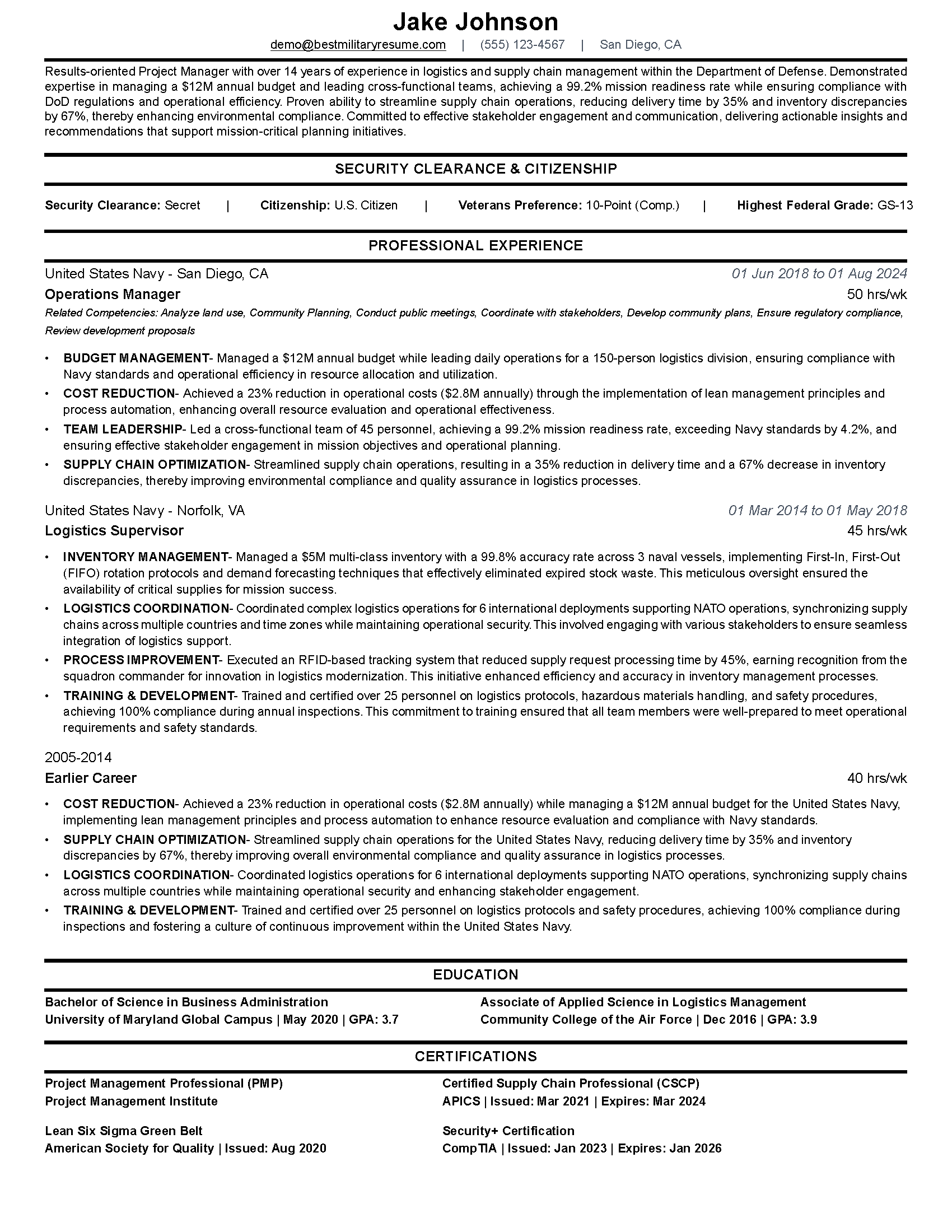
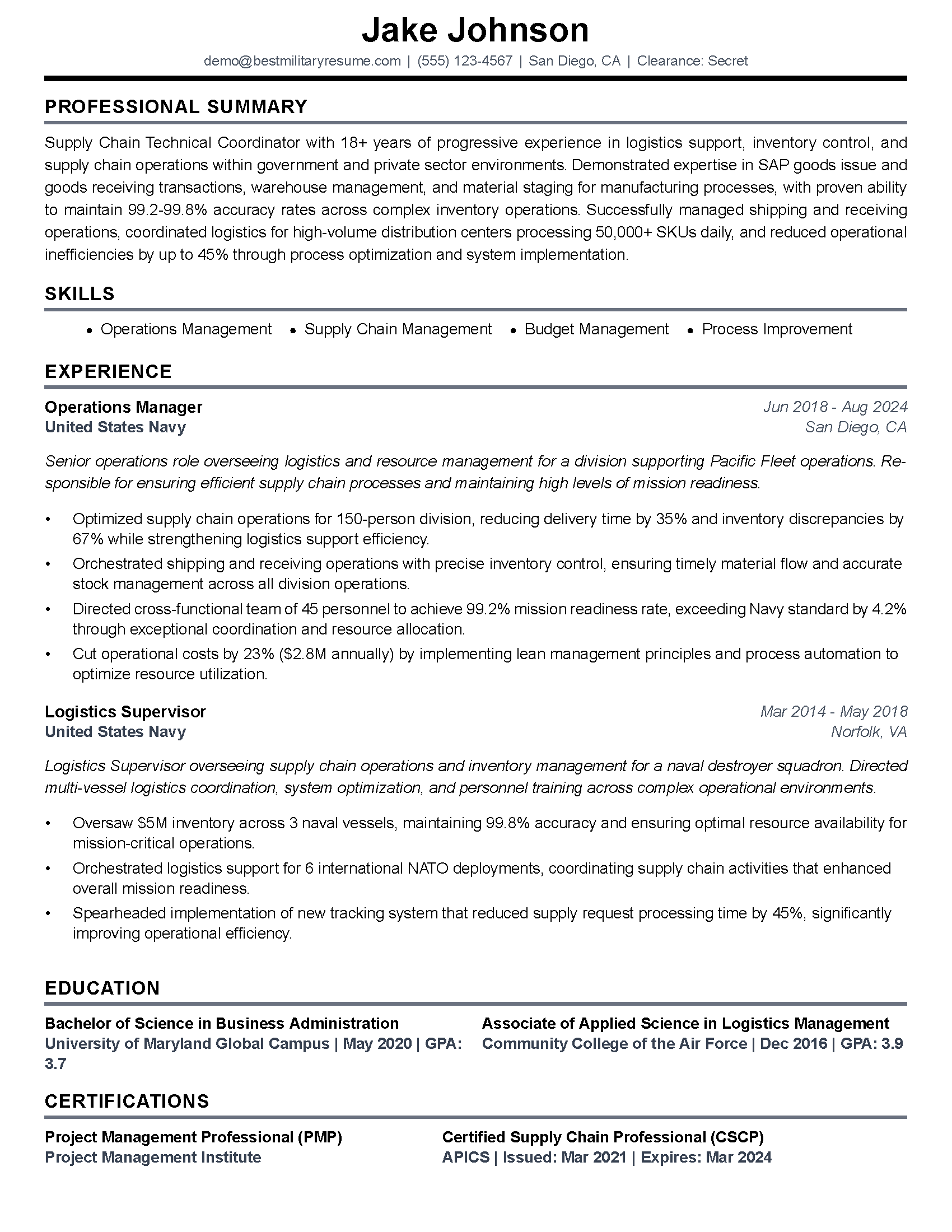
Then put each proof line in your resume and your answers. Our guide to checking your resume against a job's qualifications shows how to test each line.
A blank line is not a tie
Say the posting asks for budget work and you managed a unit budget. If your application never says so, you have no proof for that line. Fill every row of the sheet, even the short ones.
Did service interrupt a civilian career?
Georgia has one rule that's easy to miss. It sits in the exam part of the rule. It works when experience is part of your exam score.
Time "in the Armed Forces of the United States during a period of armed conflict will be credited." It counts in your ratings when service "temporarily interrupted" your work in "a similar vocation." You also must have gone back to that work after discharge.
Say you worked as a [civilian job] before you deployed. You came home and went back to it. Then you apply for a state job in that same line of work. Your service time can count as experience in that exam.
Tell the agency HR office if this fits you. On your resume, show the civilian job dates before and after your service.
How do you send your proof?
The state's careers FAQ spells out the step. "To receive Veteran's Preference, relevant documentation copies must be submitted to the Agency HR Department listed on the job posting."
It adds a hard limit. "Veteran's Preference won't be granted until the required documentation copies are received."
Send by group:
- Every veteran: Your DD 214. The rule says it's the proof of "honorable discharge and eligible service." Our DD-214 guide covers getting a copy.
- 10 points for disability: Add the VA's official record of your service-connected rating of at least 10%.
- Over 55, spouse or widow: The rule doesn't list papers for these groups. Ask the agency HR office what it needs before the posting closes.
Does preference protect you in staff cuts?
Yes. The rule covers a reduction in personnel, which means staff cuts.
A veteran of any period of armed conflict can be protected in those cuts. You must be entitled to preference in appointment. You also need an average summary evaluation rating of "successful performer."
Then the rule says you "will not be discharged or dropped or reduced in rank or salary before a nonveteran in competition with" you. So keep your ratings strong. The protection rides on them.
Georgia veterans preference is its own system, apart from the federal one. Our guide to how federal veterans preference works explains that side.
Checked against Rule 478-1-.18 (effective November 28, 2017) in November 2026. The DOAS decision tree (10/2017) and the state careers FAQ were checked then too.
Build the application for your Georgia posting
Your next step is the match sheet, filled in for one real posting. Then every proof line goes into your resume.
Jordan, an Army Staff Sergeant (E-6), used BMR on the way out. Jordan wrote: "You have been very helpful during my transition out of the army and I have gotten a very good job because of it."
Open the military resume builder, sign in and paste your Georgia posting. It builds your resume around that posting. Then send your DD 214 copy to the agency HR office named on the posting.
Frequently Asked Questions
Does Georgia veterans preference apply to city and county jobs?
Do I get Georgia points and federal points on the same exam?
Does Guard or Reserve drill time count?
Will the agency return my DD 214?
Is the DOAS decision tree newer than the rule?
About the author
Brad Tachi is the CEO and founder of Best Military Resume and a 2025 Military Friendly Vetrepreneur of the Year award recipient for overseas excellence. A former U.S. Navy Diver with over 20 years of combined military, private sector, and federal government experience, Brad brings unparalleled expertise to help veterans and military service members successfully transition to rewarding civilian careers. Having personally navigated the military-to-civilian transition, Brad deeply understands the challenges veterans face and specializes in translating military experience into compelling resumes that capture the attention of civilian employers. Through Best Military Resume, Brad has helped thousands of service members land their dream jobs by providing expert resume writing, career coaching, and job search strategies tailored specifically for the veteran community.