Missouri Veterans Preference: A Tie-Breaker, Not Points
"Still getting interviews left and right. Now I have to say no."
Taranjeet, E-5, Army, optimized her LinkedIn and resume with BMR
Missouri veterans preference is a tie-breaker for state merit jobs under RSMo 36.220 (effective August 28, 2018). The law gives you preference in appointment when all other relevant job-related factors are equal.
You may have read that Missouri adds 5 or 10 points to your score. The state's own paper application, form MO 300-0739 (revised 08-17), still says that too.
Here are the law's exact words, the old form's words, and how to close the gap.
Does Missouri add 5 or 10 points for veterans?
The current statute names no points. This is the first part of 36.220, word for word:
"In any competitive examination for the purpose of establishing a register of eligibles, veterans, disabled veterans, surviving spouses and spouses of disabled veterans shall be given preference. A veteran, or the surviving spouse of a veteran, a disabled veteran, or the spouse of a disabled veteran shall be given preference in appointment to a position subject to this chapter pursuant to subsection 1 of section 36.030 over other eligibles if all other relevant job-related factors are equal."
Read the last part slowly. You get picked first only when you and another applicant come out even.
The paper form tells a different story. This is what its veterans preference box says:
"Veterans' preference points are not cumulative and only 5 or 10 points total are allowed."
The form is dated 08-17. That's a year before the 2018 change to 36.220.
When the form and the law disagree.
Claim the preference anyway. Attach your proof. Then ask the hiring agency how it applies veterans preference today. Don't count on points showing up on your score.
Other states work differently. Florida adds 20, 15 or 10 points to a passing exam score. Missouri's statute does not. Texas adds 10 points on exam jobs and 15 for a disabled veteran. Federal jobs use their own system of 5 and 10 preference points. None of that carries over to a Missouri state job.
Which Missouri state jobs does the tie-breaker cover?
The tie-breaker in 36.220 points to positions under "subsection 1 of section 36.030." Those are the merit jobs. RSMo 36.030 says these jobs must be filled on merit:
- Institutions: jobs in the state's penal institutions and charitable care institutions (the law's old word is "eleemosynary").
- Grant programs: parts of an agency that federal grant rules require to hire on merit.
The same section lists jobs that stay out of the merit system. Some examples are department and division directors and their top assistants, chaplains and attorneys, and interns.
A posting may not say whether the job is merit. So ask the agency's HR office if the job is a merit position. The answer tells you which rules below apply. The 36.220 tie-breaker is written for merit jobs. For other agency jobs, the law we read gives only a Missouri National Guard interview rule.
Who counts as a veteran under Missouri law?
Missouri writes its own definitions in RSMo 36.020. They don't match the federal ones. Here they are in plain words.
Veteran
You must be a citizen of Missouri. You must be separated under honorable conditions. Then you need one of these:
- Active duty: at least six months in a row, in peacetime or wartime. Leaving early still counts if it was for a service-connected disability or a reduction in force.
- Guard or Reserve: at least six years of satisfactory service.
- Called up: as a Guard or Reserve member, you were ordered to active duty by the President. You also took part in a campaign or expedition with an authorized badge or service medal.
The Missouri citizen part matters if you're moving to Missouri after you get out. Ask HR what proof of residence they want.
Disabled veteran
You served on active duty at any time. You also get VA compensation for a service-connected disability. Disability retirement or pension from a federal agency for that disability counts too. So does a Missouri Guard veteran who was permanently disabled on state active service at the governor's call.
Surviving spouse
You're the unmarried surviving spouse of a disabled veteran or of a service member killed on active duty. The unmarried spouse of a Guard veteran killed on state active service at the governor's call also counts.
Spouse of a disabled veteran
36.220 names this group, but 36.020 gives it no definition. The 08-17 form limits it to one case. The veteran can't qualify for state work because of a service-related disability. Ask HR how the agency reads it now.
What papers prove your Missouri veterans preference?
The merit system rule, 1 CSR 20-3.010, sets the proof. You give your discharge papers, a copy of them, or "other satisfactory evidence of honorable service." A disability claim needs proof certified by the right federal agency, such as the VA. You can ask for your papers back.
The 08-17 form names the exact papers for each group. Use it as a packing list, even where the points are out of date.
| Who you are | What the 08-17 form says to attach |
|---|---|
| Veteran with six months of active duty, or called up for a campaign. | A copy of your DD-214 showing character of service, or your badge or medal. |
| Reserve member with six years. | Your Point Summary. |
| Guard member with six years. | Your NGB Form 22. |
| Disabled veteran. | A statement from Veterans Affairs. |
| Guard veteran disabled on state active service. | Documentation of that disability. |
| Spouse of a disabled veteran. | A VA statement with the percentage and general nature of the disability. |
| Surviving spouse. | Your spouse's DD-214 or casualty report, plus the death certificate. |
Gather these papers before you apply, so you can attach them with your application.
Do Missouri National Guard members get an interview?
Yes, if you are or were a member of the Missouri National Guard. One 2021 law, Senate Bill 120, added two sections. One covers merit jobs and one covers the rest.
- Merit jobs: RSMo 36.221 says the agency "shall offer an interview" to current and former Missouri Guard members. Your name has to be on the register of eligibles.
- Other state agency jobs: RSMo 105.1204 says the agency shall offer the same interview. Here you only have to meet the minimum qualifications.
Note the limits. It's the Missouri Guard only. Another state's Guard and Reserve members aren't named. "State agency" here leaves out the offices of elected officials, the General Assembly, the courts and colleges. And the law promises an interview. The hiring choice still comes after it.
For the non-merit rule, meeting the minimum qualifications is the whole test. So your application has to show each minimum on its face. Put "Missouri National Guard" and your years in plain view. Your unit can also be a source of job leads. This guide shows how to use your Guard unit to find work.
How do you write your application to reach the tie?
A tie-breaker only helps if you tie. The law says "all other relevant job-related factors are equal." So show every factor the posting names, in its words, with your proof beside it.
Work through the posting one line at a time:
- Copy every minimum qualification into a list, word for word.
- Copy every preferred qualification under it.
- Next to each line, write the job where you did that work.
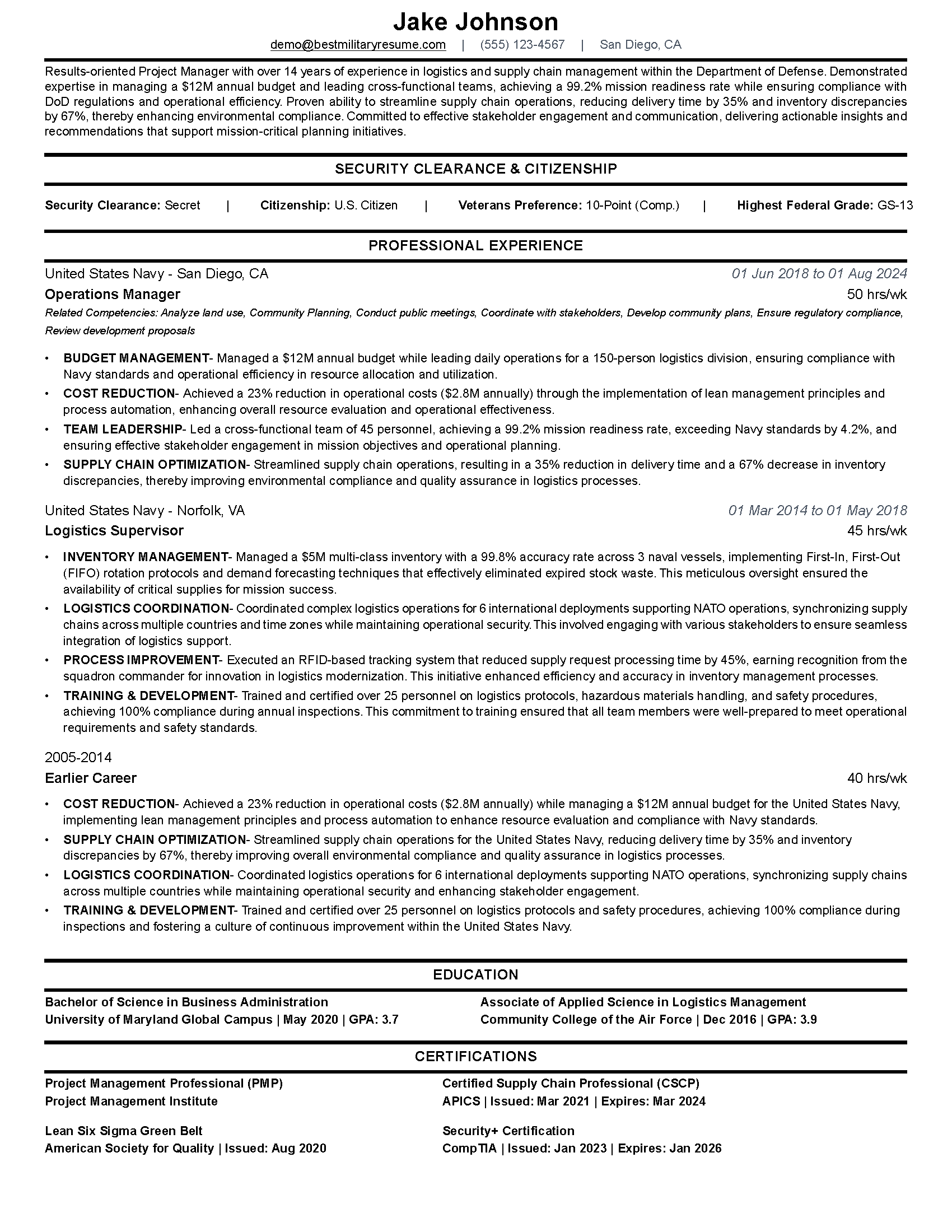
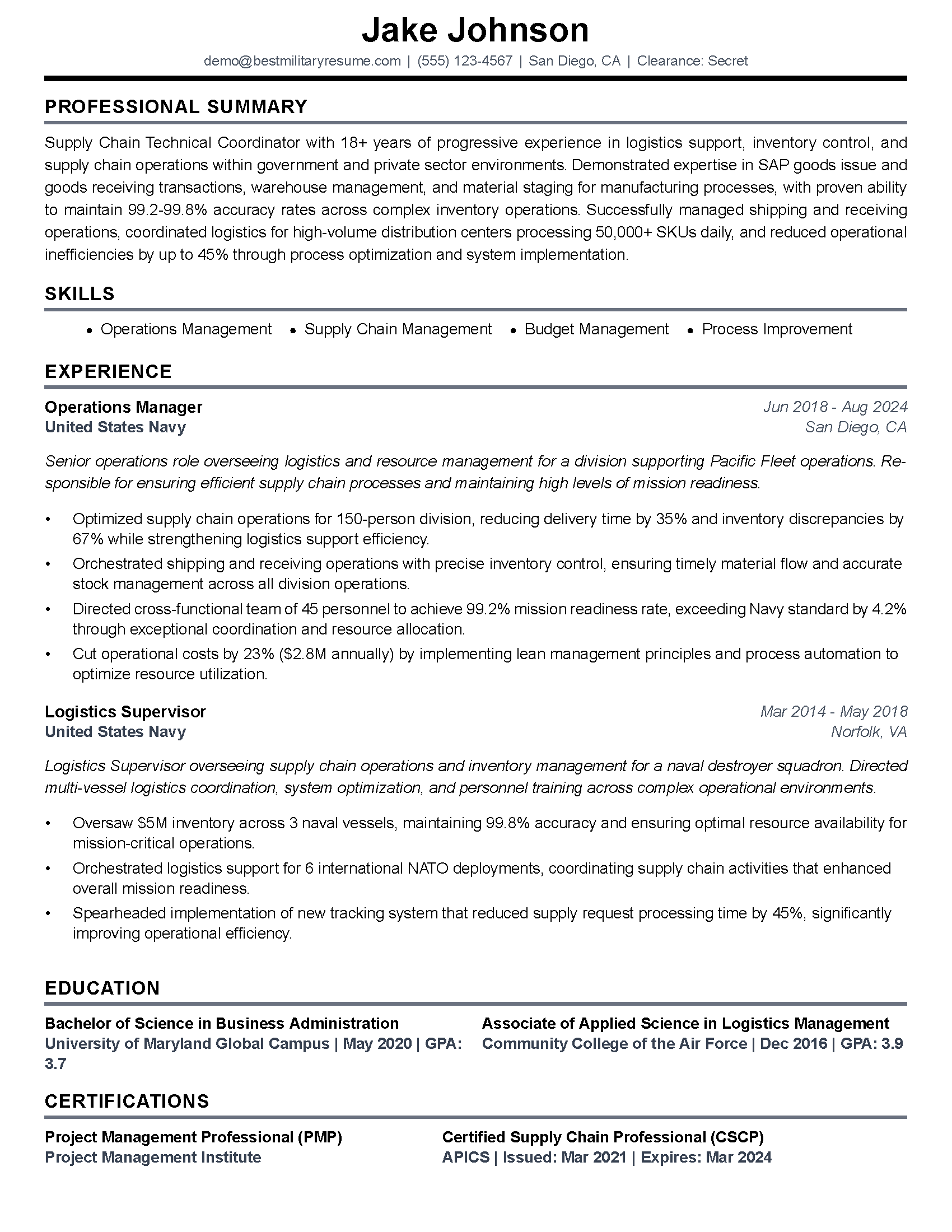
- Write a resume line that uses the posting's words and shows the size of the work.
- Check off each line. Anything still blank is a gap to fill or explain.
Use this shape for each line. Fill the brackets from your own record.
| The posting asks for | Your line answers with |
|---|---|
| [the qualification, copied word for word]. | [The posting's words] for [how many people, or how much gear or money]. Add [the result]. |
Say what you did in the words the posting uses. Leave the rank off and put the size of what you ran on the page instead.
Claim your military training too
36.220 has a second rule. If you were honorably discharged, you "shall receive appropriate credit" in any exam for military training or experience. The training has to relate to the duties of the job class. So list the schools and courses that match the posting. Give the course name, its length, and the duty it trained you for.
What should you ask the agency's HR office?
Some answers aren't in the law or rule we read. We couldn't find a state page with steps for claiming preference online. We also found no Missouri rule on veterans in layoffs. Don't guess on these. Call or email the HR contact on the posting and ask:
- Is this a merit position under 36.030?
- How does your agency apply veterans preference today? Points, or a tie-breaker?
- Where do I claim it in the online application?
- Which papers do you want, and when?
- Does your agency give veterans any preference in a layoff?
- I'm a Missouri Guard member. How do I make sure I get the interview?
Write down who answered and the date. If two offices tell you two things, you'll have a record.
Checked in November 2026 against archived copies of the Revisor of Missouri section pages. The rule text is 1 CSR 20-3.010 on Cornell's Legal Information Institute. The form quoted is MO 300-0739, revised 08-17.
Next: Write Every Qualification in the Posting's Words
Missouri's preference can't help an application that looks thinner than the next one. So your first job is to reach the tie.
BMR's builder helps with that step. Mikell, an Army Master Sergeant, wrote in after using it. He said, "Every job I applied for, I received calls and emails back to schedule interviews."
Open the military resume builder, sign in, and paste the Missouri posting. Build a version that answers each qualification line. Then attach your DD-214 and claim the preference.
Frequently Asked Questions
Does Missouri veterans preference apply to city and county jobs?
Does Missouri veterans preference count for promotions?
Do private employers in Missouri have to give veterans preference?
Which DD-214 copy should I send for Missouri veterans preference?
Is there a time limit to use Missouri veterans preference after I get out?
About the author
Brad Tachi is the CEO and founder of Best Military Resume and a 2025 Military Friendly Vetrepreneur of the Year award recipient for overseas excellence. A former U.S. Navy Diver with over 20 years of combined military, private sector, and federal government experience, Brad brings unparalleled expertise to help veterans and military service members successfully transition to rewarding civilian careers. Having personally navigated the military-to-civilian transition, Brad deeply understands the challenges veterans face and specializes in translating military experience into compelling resumes that capture the attention of civilian employers. Through Best Military Resume, Brad has helped thousands of service members land their dream jobs by providing expert resume writing, career coaching, and job search strategies tailored specifically for the veteran community.
