Oregon Veterans Preference: Points at Each Stage and Your Interview Right
Taylor sent 200+ applications for 5 interviews. With BMR, 20 resumes all hit.
Taylor, E-7, Army, defense industry
Oregon veterans preference adds 5 points at each scored stage of public hiring, 10 for disabled veterans. That's the rule in ORS 408.230. Since January 1, 2026, current Oregon National Guard members get the 5 points too. So do former members released under honorable conditions.
But an Oregon hiring process has several stages, and the law does something different at each one. It can add points, require special consideration, require an interview, or require the job offer.
By the end, you'll know which stage you're in and what the law does for you there.
Your stage and what the law does there
The DAS Veterans' Preference Guide for state agencies defines a stage simply. It's any point where two or more candidates are compared and one or more is cut. Find yours in the table.
| Stage you're at | What the law does | Where it says so |
|---|---|---|
| First screening of applications for the interview list | Adds 5 points (veteran, Guard) or 10 (disabled veteran) | ORS 408.230(2)(a) |
| A scored exam after screening | Adds 5 or 10 to the total score, not to one part | ORS 408.230(2)(b) |
| An unscored stage, like an interview or a rating of your experience | The employer must use a method that gives you special consideration | ORS 408.230(2)(c) |
| Deciding who gets interviewed | Veterans who meet the posted qualifications and show the skills get one | ORS 408.237 |
| The final pick | If you're otherwise qualified and your score plus points ties or beats a nonveteran's, they must appoint you | ORS 408.230(4) |
| After a no | Ask in writing and they must give their reasons in writing | ORS 408.230(5) |
Points only count once you pass. The law covers you after you complete the screening, exam or test. You also have to meet the minimum and any special qualifications for the job.
How the points land on a scored stage
The points are percentage points, not raw points. BOLI's veterans preference page gives this example. A veteran scores 86 out of 120 on an exam. That's 72%. Five more points makes it 77%. A disabled veteran gets 10 and lands at 82%.
The DAS Guide does the same math a different way for state agencies. Say the exam has 80 possible points. Five percent of 80 is 4, so a veteran gets 4 points added. Ten percent is 8, so a disabled veteran gets 8.
The law also says the points go on the total combined score. An employer can't tuck them into one small part of the exam. And the points come back at each scored stage, not just the first one.
Unscored stages still owe you special consideration
Some stages don't make a number. Think of an interview, a review of your training, or a supervisor's rating. The law still requires preference there. The employer has to "devise and apply methods" that give veterans special consideration in the hiring decision.
For state agencies, the DAS Guide spells out the method. Applicants get sorted into levels, like piles of more and less desirable. A veteran or Guard member moves up one level under DAS Policy 40.055.04. A disabled veteran moves up two.
Cities and counties pick their own method. BOLI's page names tiers or bands as one way to do it. So if a posting says interviews are ranked, ask the recruiter how the preference is applied.
The DAS Guide covers one more case. Reference checks count as a stage when they're used to choose between candidates. If they only check the top candidate, preference doesn't apply.
When a tie goes to you, and how to ask why
The points aren't a promise of a job, under ORS 408.230(3). The final pick has a hard rule.
Say you're otherwise qualified. Your exam result plus your preference ties or beats someone who isn't a veteran. Then ORS 408.230(4) says the employer must appoint you. For state agencies, DAS Policy 40.055.04 adds a tiebreak. A disabled veteran is picked over a veteran or Guard member when they're equal at the final stage.
If you don't get the job, send a written request for the reasons. The employer must answer in writing. The law lets them base the no only on your merits or qualifications for the job.
Breaking ORS 408.230 is an unlawful employment practice. You can file a verified written complaint with the BOLI Commissioner. The 2023 DAS Guide notes a deadline. It says you may file a BOLI complaint or lawsuit within one year of an alleged violation.
The interview rule and your transferable skills
When an interview is part of the process, ORS 408.237 says the employer "shall interview each veteran" who meets two conditions.
- Qualifications: The employer finds you meet the minimum and special qualifications for the job.
- Skills shown: Your application shows enough evidence of the transferable skills the employer required and requested.
The statute defines a transferable skill. It's a skill from military education or experience that "substantially relates, directly or indirectly," to the job.
BOLI adds two points that help you. The employer must list every skill it requires or requests in the first recruitment notice. And it can't use skills it never posted to decide who gets an interview.
The DAS Guide says a veteran who meets every posted requirement "must be interviewed regardless of the veteran's score or rank" against others. Your job is to make each posted skill plain in your own application.
The exception for ranked lists
The rule doesn't apply when the employer interviews only to pick from an eligibility list. That's a list of people ranked by a test or series of tests, then hired in rank order. BOLI names police and fire lists as examples. It also says an application form and its scoring don't count as a test.
Guard members who aren't veterans get points but not the interview
The interview rule names veterans only. It doesn't name state servicemembers. DAS Policy 40.055.04 says the same thing: the interview rule excludes Oregon National Guard servicemembers. If you count only as a Guard member, not as a veteran, the points still apply. The required interview doesn't.
Who counts under the Oregon definitions
Under ORS 408.225, you're a veteran if one of these fits. Each line needs a discharge or release under honorable conditions, except the pension line.
- Older service: Over 90 days in a row of active duty, starting by January 31, 1955.
- Standard service: More than 178 days in a row on active duty, starting after January 31, 1955.
- Short service, disability discharge: 178 days or less, released because of a service-connected disability.
- Short service, VA rating: 178 days or less, and you have a VA disability rating.
- Combat zone: At least one day in a combat zone set by presidential executive order.
- Medal: A combat or campaign ribbon, or an expeditionary medal.
- Pension: You get a VA pension that isn't service connected.
Active duty here doesn't include school under military orders. The exception is school that was part of an active enlistment or regular tour. It also doesn't include normal reserve or Guard training.
You're a disabled veteran if you're a veteran with a VA disability rating. You also count if a line of duty disability got you released. A Purple Heart for combat wounds counts too. The law adds anyone paid VA compensation under 38 U.S.C. 1110 or 38 U.S.C. 1131.
The Guard change came from Senate Bill 808 in 2025. BOLI says it took effect January 1, 2026. A current Oregon National Guard member counts. So does a former member released under honorable conditions. Both get 5 points.
Still in? You can claim it before you're out, if you meet the rest of the definition. File a certification that you expect an honorable discharge within 120 days. For the disabled veteran points, it's a medical separation within 120 days. Former Guard members get the same 120 day option.
There's no cap on uses. The rule text we read, OAR 839-006-0445, says there's no limit on the number of claims. That's not true in every state. Our Washington veterans preference guide shows a state where it ends at your first appointment.
Same rules for state, city and county jobs
The law binds every "public employer." That means any Oregon public body and anyone it authorizes to manage or supervise its employees. So a city, a county or a state agency all follow ORS 408.230 and 408.237.
It covers any "civil service position." The law defines that as a job filled by a merit based, competitive process. The job doesn't need the civil service label. And the points cover promotions too, when the new job has a higher top pay rate.
What changes is the paperwork. Each employer runs its own steps. Multnomah County's instructions ask you to submit your papers for each recruitment. The state works differently, covered next.
This is Oregon state law. Federal jobs in Oregon use federal rules. For those, read how federal veterans preference works.
Claiming it on a State of Oregon application
The State of Oregon job board and DAS Policy 40.055.04 lay out this path.
- Mark your status: The application asks if you're a veteran, a disabled veteran, or a Guard member.
- Do the Workday task: After you apply, a task shows up in your Workday account. Upload your military papers there.
- Send the right DD214 copy: It must show your character of service as honorable. The job board asks for service copy 2, 3 or member copy 4. Our guide to which DD214 copy to send also covers how to get a replacement.
- Add the VA letter for 10 points: Send a letter with your rating. Skip it if your DD214 or DD215 shows the rating.
- Beat the deadline: The policy says papers are due "normally at time of application but no later than at the time of interview."
Other papers can work too. For 5 points, the job board lists a VA pension letter or the 120 day certification. For 10, it lists a VA compensation letter or a DD214 showing a Purple Heart.
Guard members can send a DA Form 5016, a DD214 or 214-1, or an NGB Form 22. A VA benefits letter or other official document that shows your Guard service works too.
The policy covers repeat applications. Once an agency awards and records your preference in the state HR system, papers aren't needed again.
The DAS Guide covers a common miss. A manager's referred list shows no points despite service on the application. Then the applicant isn't eligible for preference. The likely cause is papers that never got in.
Sources checked November 2026: ORS chapter 408, 2025 edition, as archived July 9, 2026. Also the rule text we read for OAR 839-006-0450, the BOLI page and the state job board. And DAS Policy 40.055.04, effective August 1, 2026, plus the 2023 DAS Guide.
Write the skills into the Oregon application
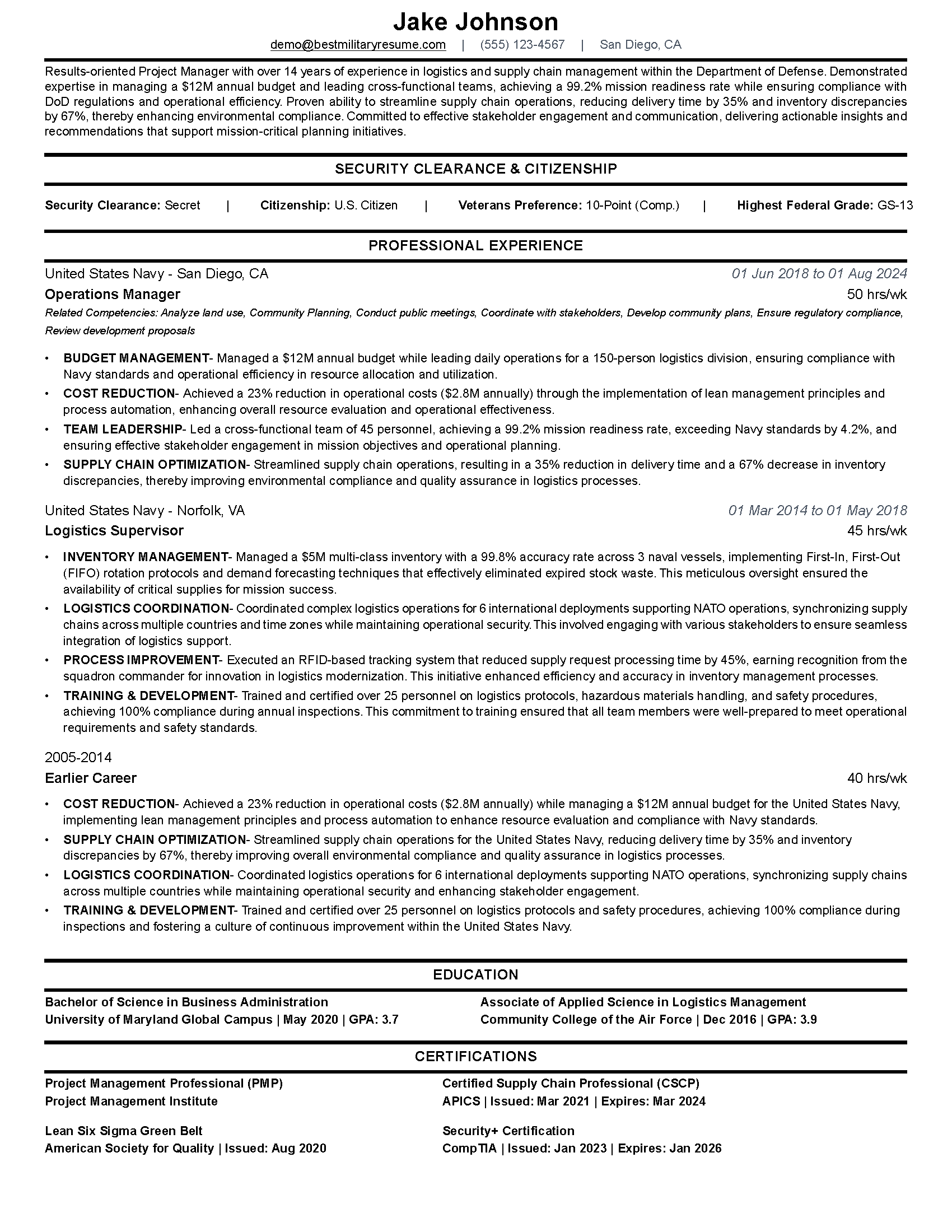
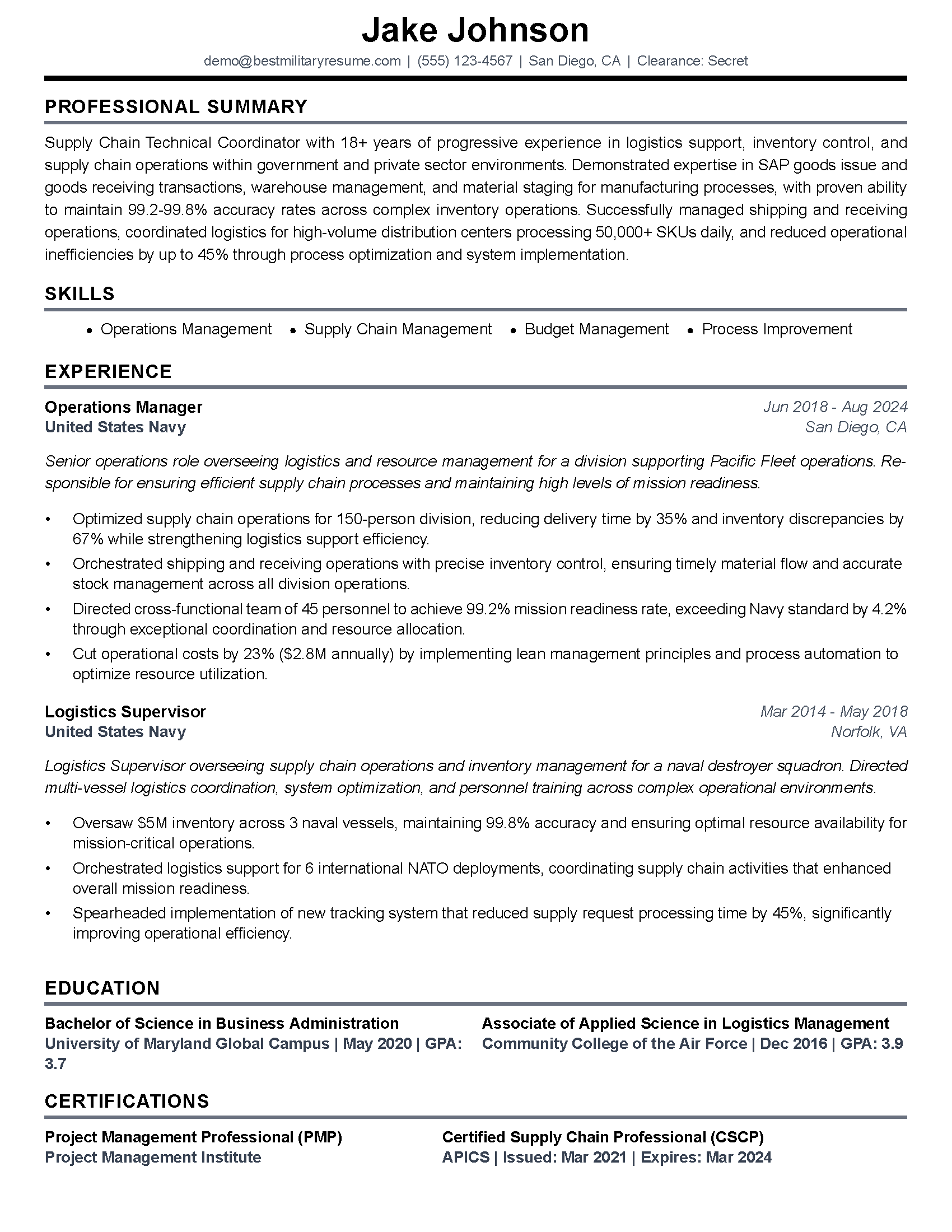
The interview rule turns on one thing you control. Your application has to show each skill the posting asks for. Use the job's words, and say where in the military you did the work.
Need help turning a job title into those words? Our guide to translating military experience for a civilian resume walks through it. Guard members can start with our National Guard resume guide.
Jason is a Gunnery Sergeant (E-7) in the Marines. He used BMR for a private contractor job on a base, not an Oregon public job.
In his words: "I had my interview this week and have been hired… they are offering me 77.9K/yr!"
Sign in to the military resume builder and paste the Oregon posting. It builds your resume to the skills that posting names.
Frequently Asked Questions
Do military spouses get Oregon veterans preference for public jobs?
Can a disabled veteran add both the 5 and the 10 points?
Does Oregon hold my public job while I serve?
Does Oregon veterans preference apply to private companies?
About the author
Brad Tachi is the CEO and founder of Best Military Resume and a 2025 Military Friendly Vetrepreneur of the Year award recipient for overseas excellence. A former U.S. Navy Diver with over 20 years of combined military, private sector, and federal government experience, Brad brings unparalleled expertise to help veterans and military service members successfully transition to rewarding civilian careers. Having personally navigated the military-to-civilian transition, Brad deeply understands the challenges veterans face and specializes in translating military experience into compelling resumes that capture the attention of civilian employers. Through Best Military Resume, Brad has helped thousands of service members land their dream jobs by providing expert resume writing, career coaching, and job search strategies tailored specifically for the veteran community.
