Washington State Veterans Preference: 10 or 5 Percent on Your Passing Score
"Still getting interviews left and right. Now I have to say no."
Taranjeet, E-5, Army, optimized her LinkedIn and resume with BMR
Washington adds a percent to your passing exam score, figured on a scale where 100 is perfect. Under RCW 41.04.010, as amended in 2026, war or conflict service with no military retirement earns 10 percent. Qualifying veterans without that service, and anyone receiving military retirement, earn 5 percent.
The credit counts on competitive exams only until your first appointment. It never counts on a promotional exam, with one narrow exception covered below.
The state page lists the rules. It does not tell you which number is yours, or when to use it. You'll leave knowing your percent and when to spend it.
Which percent you get: 10 or 5
Your Washington state veterans preference comes down to four checks. Pull out your DD 214 (or NGB 22) and your retirement papers first.
- Step 1, your discharge: Check that it is a qualifying discharge. The next section lists every type that counts. If it does not count, you get no percent.
- Step 2, your service dates and medals: Compare your dates and medals to the war list below. A match means war or conflict service.
- Step 3, your retirement: Ask one question. Do you receive military retirement right now?
- Step 4, your percent: War or conflict service and no military retirement gets 10 percent. No war or conflict service gets 5 percent. Receiving military retirement gets 5 percent, even with war service.
The law says "military retirement" and doesn't split it into types there. Not sure your pay counts? Ask the agency before you claim.
There's one more 5 percent. It goes to a veteran called to active service from a state or local government job. It counts on promotional exams, until your first promotion only.
How the percent lands on your score
Your score has to pass first. The credit is only added to a passing mark. The statute says the agency adds it "based upon a possible rating of one hundred points as perfect." The state guidance adds that the exam score must be equivalent to a 0 to 100 scale.
The law covers competitive exams given by the state and its local governments. It also covers private firms the state hires to give its exams.
Who counts as a veteran under Washington law
You need two things: a qualifying discharge and service that fits one of the listed capacities.
Qualifying discharge
RCW 73.04.005 lists four kinds:
- Honorable: Counts.
- General under honorable conditions: Counts.
- Other than honorable: Counts only if you give the agency "a letter, administrative decision, or other documentation from the United States department of veterans affairs showing eligibility for or receipt of monetary benefits, such as disability compensation or nonservice-connected pension."
- Any characterization: Counts if the listed reason was solely sexual orientation, gender identity or gender expression. Related statements, consensual conduct and disclosures count too, unless the UCMJ barred them on other grounds. You must also show the narrative reason.
Service that counts
RCW 41.04.007 needs at least one of these:
- Service in any branch, including the National Guard and the reserves, with your initial service obligation complete.
- Service as a Women's Air Forces Service Pilot.
- Reserve, Guard or Coast Guard members called up by a presidential select reserve call up. The federal service must total at least 180 days.
- Civil service crew on Army or Navy transport ships at sea. The window is December 7, 1941 through December 31, 1946.
- Philippine armed forces or scouts, December 7, 1941 through August 15, 1945.
- Documented merchant mariners on Defense Department ships at sea. They need Korean waters service from June 25, 1950 to July 27, 1953. They also need Vietnam waters service from August 5, 1964 to May 7, 1975, plus a military commendation.
The war and armed conflict list
This list decides 10 versus 5. RCW 41.04.005 names these periods:
- World War I, World War II and the Korean conflict.
- Vietnam era, if you served in the Republic of Vietnam: February 28, 1961 to May 7, 1975. Otherwise, August 5, 1964 to May 7, 1975.
- The Persian Gulf War: August 2, 1990 to February 28, 1991. It runs to November 30, 1995 if you earned a campaign badge or medal for it.
- Any future war Congress declares.
- Any armed conflict where you got, or would have got, the campaign or expeditionary badge or medal. A repeat deployment to a conflict where you already earned that medal does not count again.
- An Armed Forces Expeditionary Medal or a Marine Corps and Navy Expeditionary Medal. It must be for opposed action on foreign soil.
So check the medals on your DD 214. For service after November 30, 1995, look for a campaign or expeditionary medal.
The 2026 changes the state careers page leaves out
The careers.wa.gov veterans preference page has no date. It doesn't show two changes made in 2026.
Public Health Service and NOAA officers now count
The 2026 law added "members of the uniformed services." That means the U.S. Public Health Service Commissioned Corps and the NOAA Commissioned Officer Corps. You need a qualifying discharge, or you must be serving now with honor. You get the same 10 or 5 percent as a veteran.
The state HR rule filing gives the law's effective date as June 11, 2026.
You can claim before your DD 214 arrives
This fixes a real gap. Lawmakers found that agencies turned down service members who had no DD 214 yet. Now you can claim with a predischarge certification. Call it the predischarge letter. That's a written statement from your branch. It gives the discharge you expect, the date and how your service is rated.
The conditions:
- Age of the letter: It must be issued no more than 120 days before you submit it.
- Your deadline: Your DD 214 or NGB 22 is due to the agency within 30 days after discharge.
- Grace period: Miss it, and the agency must tell you. You then get at least 15 more days.
- Risk: If you still miss it, the agency "may rescind any appointment or benefit granted based solely on the predischarge certification."
- Limit: The letter can't count for layoffs until your final paper is in.
One protection helps you. Say the letter and your final DD 214 don't match. The agency must give you notice and a chance to be heard. Only then can it fire you or pull the offer.
Ask your command or separation office for this letter as soon as you start applying. Read our guide on when to start job hunting before separation to line up the timing.
Spend the preference on the job you plan to keep
The 10 or 5 percent lasts until your first appointment. After that it's gone for competitive exams.
The state guidance goes further. It says the credit "cannot be applied to a competitive service examination if the applicant has claimed it on a previous examination that resulted in a permanent appointment, even if the appointment was with a public employer that is outside state government." That line comes from the Department of Enterprise Services guidance, a Word file for state HR staff.
So a city or county job can use up your state credit. Before you claim, ask one question. Is this the public job I want to build on?
Near Joint Base Lewis McChord? Our JBLM and Seattle Tacoma job guide helps you sort your options first.
Federal jobs run on their own system. See how federal veterans preference works for that side.
Jobs with no exam: referral instead of a score
Many state jobs skip a scored exam. Then there's no score to add a percent to. A different rule takes over.
WAC 357-16-110, rewritten effective October 1, 2026, reads:
"If no examination is administered prior to certification, the employer must refer the following individuals to the employing official under the provisions of RCW 73.16.010 as long as the individual meets the competencies and other position requirements."
The rule then lists three groups:
- Eligible veterans with a qualifying discharge.
- Surviving spouses or registered domestic partners of those veterans.
- Spouses or registered domestic partners of active duty members. Spouses or partners of veterans with a service-connected permanent and total disability also count.
Read the condition twice. You must meet the job's skills and other needs. Referral gets your name to the person who decides. It's not a job offer.
Spouses of active duty members were added to this rule in 2026. RCW 73.16.010 adds one more group. It covers current Guard and reserve members deployed to serve in an armed conflict.
Spouses take note. The scoring law, RCW 41.04.010, names veterans and uniformed services members. It gives no percent to spouses. If your group is listed above, your preference is that referral path.
The paperwork, in order
The DES guidance says preference "should not be given automatically because an applicant is a veteran." You have to claim it and prove it.
- Register and build your profile: Per the careers.wa.gov veterans page, register first. Then build a profile with a resume and search.
- Answer the service questions: The state page says, "Be sure to answer the questions related to time serving in the Armed Forces when completing your profile and submitting applications." Answer them on every application.
- Attach your proof: DES accepts a DD 214, an NGB 22 or a signed VA service letter. The statute adds the predischarge letter.
- Add VA proof if needed: With an other than honorable discharge, attach the VA benefits letter or decision.
- Calendar the 30 days: Used a predischarge letter? Set a reminder to send your DD 214 within 30 days.
City fire and police entrance exams
Local fire and police civil service tie back to the same state credit. RCW 41.08.040 covers city and town fire departments. RCW 41.12.040 covers city police. Both require a credit "in accordance with RCW 41.04.010."
It goes to applicants who served in time of war or in an armed forces expedition. They also need a qualifying discharge. The statute's list names the army, navy, marine corps and the American Red Cross.
Both add the same limit: "These credits apply to entrance examinations only." Each city's board writes its own rules. So check the local exam notice. Our firefighter and EMS resume guide covers the resume for those jobs.
Checked against the Revised Code of Washington, WAC 357-16-110 and careers.wa.gov in November 2026.
Build the resume for your Washington posting
You know your percent. You know when to spend it. The last piece is a resume that proves each skill on that one posting.
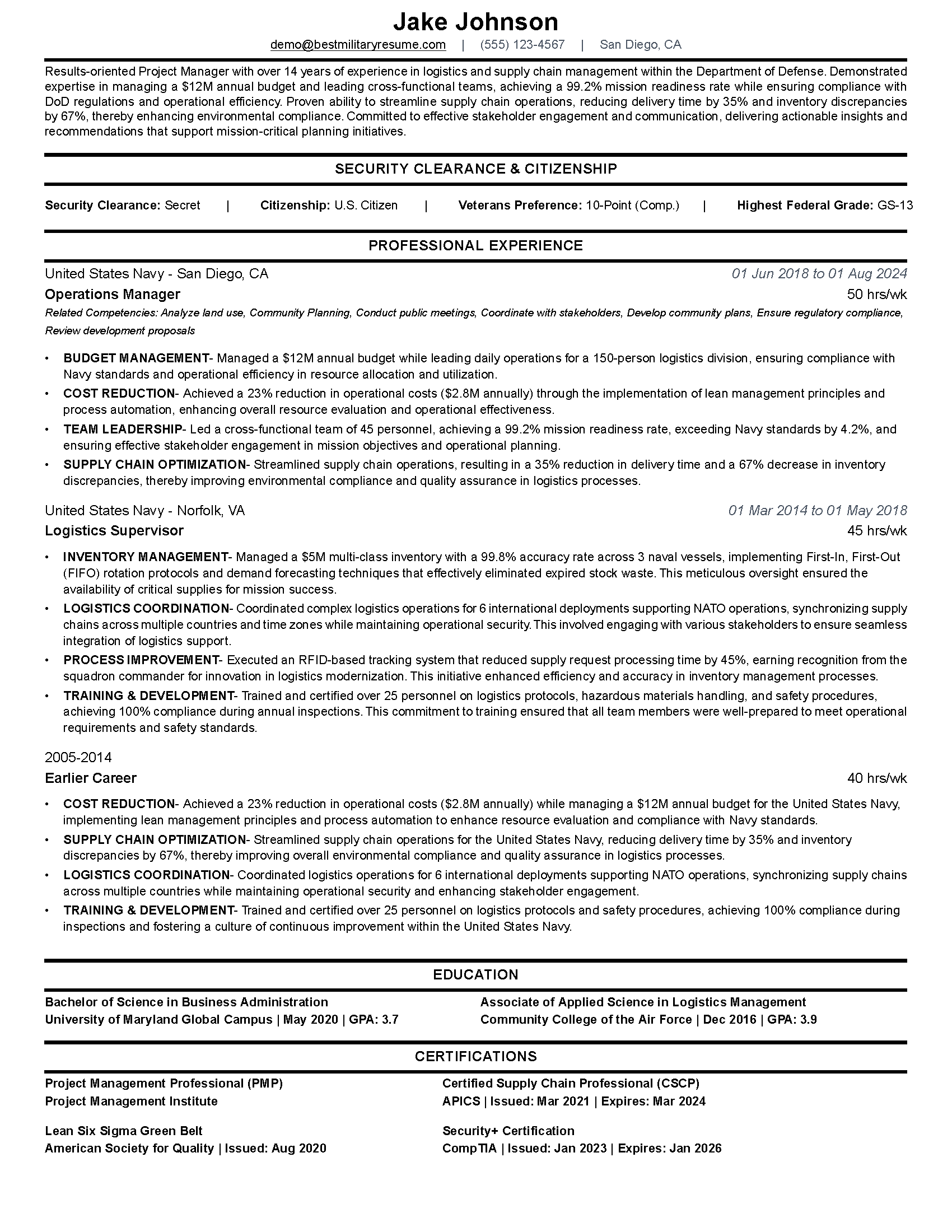
Jerod, a Navy Petty Officer Second Class (E-5), applied for a federal job with his first BMR resume. His words: "Not only did I get the job, but they let me become a GS 12 instead of an 11! It was the first resume I ever used from BMR and it came through!"
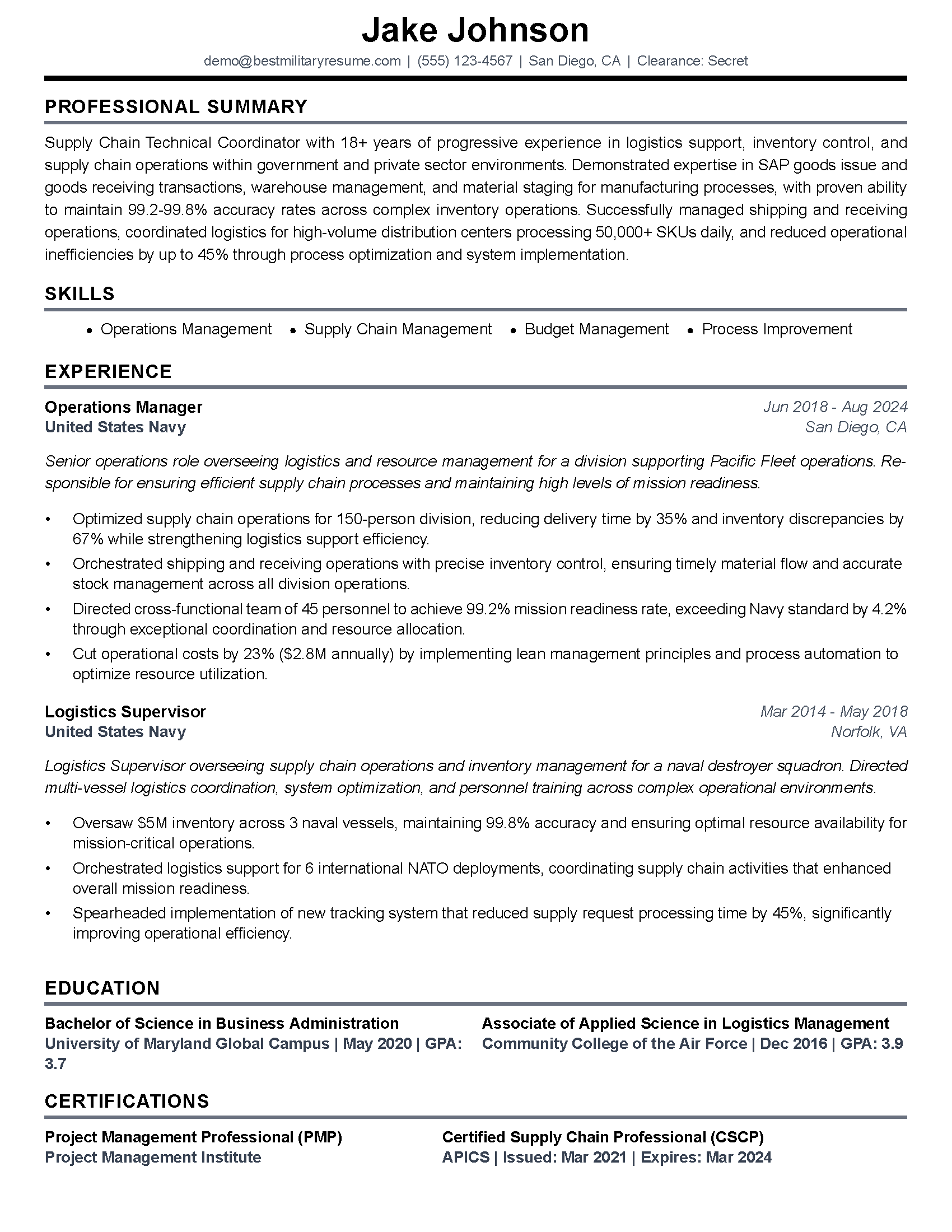
Sign in to the military resume builder and paste your Washington posting. It tailors your resume to that job's own words. Your skill lines are ready before you claim the preference.
Frequently Asked Questions
Does veterans preference protect me in a Washington state layoff?
Does Washington's preference apply to federal jobs at JBLM or other bases in the state?
Can I send a copy of my DD 214 instead of the original?
Who checks my predischarge letter after I am hired?
About the author
Brad Tachi is the CEO and founder of Best Military Resume and a 2025 Military Friendly Vetrepreneur of the Year award recipient for overseas excellence. A former U.S. Navy Diver with over 20 years of combined military, private sector, and federal government experience, Brad brings unparalleled expertise to help veterans and military service members successfully transition to rewarding civilian careers. Having personally navigated the military-to-civilian transition, Brad deeply understands the challenges veterans face and specializes in translating military experience into compelling resumes that capture the attention of civilian employers. Through Best Military Resume, Brad has helped thousands of service members land their dream jobs by providing expert resume writing, career coaching, and job search strategies tailored specifically for the veteran community.
