North Dakota Veterans Preference: Points, First Entitlement and the 15-Day Appeal
"Still getting interviews left and right. Now I have to say no."
Taranjeet, E-5, Army, optimized her LinkedIn and resume with BMR
North Dakota veterans preference adds 5 points, or 10 for a disabled veteran, on scored public jobs. That applies on a 100-point scale. On jobs with no score, the current law text puts a disabled veteran first, then a veteran. Both rules sit in NDCC chapter 37-19.1, the state's veterans preference law.
You get the exact papers for your case and the 15-day appeal clock.
Law text checked November 2026 against saved copies of the official state code pages.
The law covers state agencies and local governments
The law covers "all political subdivisions and the state." That means counties, cities and townships too. So a city job and a state job use the same law.
State HR rules point back to the same chapter. One rule is N.D. Admin. Code 4-07-05-07. It says preference "must be applied in the recruitment and selection of employees" under chapter 37-19.1.
A few jobs carry no preference at all. These are:
- Department heads: the head of a department the law requires.
- Close staff: the chief deputy or private secretary of an official.
- Picks from the top: temporary committees, and people the governor or the legislature names.
If one of these jobs is posted, the ad must say veterans' preference does not apply. Look for that line before you count on it.
Scored hires: points go on top of your grade
Some jobs are filled through a competitive personnel system. It rates each person against the skills and traits the job needs. On those jobs, the statute says:
"on a one hundred point scale, the examiner shall add five points for a veteran and ten points for a disabled veteran to the examination grade of the applicant."
Some jobs use a different scale. Then the examiner adds five percent of the scale for a veteran. A disabled veteran gets ten percent.
The points come after your proof arrives. Then the employer ranks everyone from highest to lowest final score. It picks a set number from the top to consider. It can interview, check backgrounds and test skills inside that group. The points can move you into that group. They don't hand you the job.
Unscored hires: a veteran is first entitled
Some jobs are not filled through a scored system. Those jobs use no points. The law ranks people instead. A disabled veteran comes ahead of other veterans. The statute says a disabled veteran:
"is first entitled to the position and, in the absence of justifiable cause, documented in writing, for not making that selection, must be so employed."
If no disabled veteran is in the group, a veteran is first entitled under the same rule. The employer can still interview and test the group first.
The law also says what justifiable cause is. It "must be something specific to that individual which renders the individual unsuitable for the position." So a vague reason doesn't meet it. The reason must be about you, and it must be in writing.
Who counts, with every condition
You must meet each of these to claim the preference:
- Citizenship: you are a U.S. citizen at the time you apply.
- Skills: you have the schooling or past work the job asks for. You can also do the job's duties.
- Service: you meet one of the two veteran tests below.
- Employer: you are not a current employee in the way the next section explains.
The first veteran test comes from NDCC 37-01-40. You served "continuous federalized active uniformed services duty for one hundred eighty days." The full period you were called to duty also counts. The duty must be for reasons other than training. Your discharge must be under other than dishonorable conditions.
A shorter term can still count. It does when your discharge says "expiration of term of service" or "completion of required service." Words to that effect count too.
The second test is for the Guard and Reserve. You count if you are still serving in the Guard or a Reserve unit. You also count if you were honorably discharged from one. So a drilling Guard member can claim it today.
A disabled veteran has a service-connected rating from the VA. The chapter sets no minimum percent for a disabled veteran's own preference. A disability can't bar you from a job unless it stops you from doing the work.
Current public employees lose the preference
A state agency employee gets no preference for a different job in any state agency. That includes other agencies, not just their own.
Local jobs have a smaller bar. A city or county employee gets no preference for a different job in the same subdivision. The bar covers only that same city, county or other subdivision.
So the preference counts when you apply from outside. A move inside state service doesn't carry it.
Spouses who can use the preference
Two kinds of spouses can claim it, if they are otherwise qualified:
- Surviving spouse: the unremarried spouse of a veteran who died in service. A veteran who later died of a service-connected cause counts too.
- Spouse of a 100% disabled veteran: the veteran is rated 100 percent. Individual unemployability paid at the 100 percent rate also counts. The veteran must also be unable to use the preference because of the disability.
Section 37-19.1-03 names no other spouse. The ND Department of Veterans Affairs eligibility page says spouses face the same citizenship and current employee rules.
The papers to attach for your case
The statute lists the proof for each kind of claim:
- Veteran: a copy of your DD-214.
- Still on active duty: a unit command letter instead. It certifies that you are expected to be discharged under other than dishonorable conditions. The expected date is within 120 days after you submit it.
- Disabled veteran: your DD-214 plus a VA letter less than one year old showing your disability status.
- Surviving spouse: the marriage certificate, the veteran's DD-214 and the death certificate.
- Spouse of a disabled veteran: the marriage certificate, the veteran's DD-214 and a VA letter. The letter must be less than one year old.
The state's veterans agency also takes one more paper. Its hiring agency page also accepts an NGB 22. It must come "from National Guard or Reserve with a unit in North Dakota." The statute doesn't name the NGB 22.
That same page says each posting or application form must give the steps to claim. So follow the posting for how to send them. For other uses of the form, see how the DD-214 works on federal applications.
No residency rule, and one agency line to skip
The section title still reads "Residency requirements," but its text sets no residency rule. It asks for U.S. citizenship at the time you apply, not North Dakota residence.
The hiring agency page, captured September 2025, has a line that does not match the statute. Its second points line says "Add 10 points" to "eligible Veterans." The statute gives ten points to a disabled veteran. Go by the statute.
Federal jobs use their own rules. See how federal veterans preference works. Next door, Minnesota's rules work in a different way.
Passed over: the 15-day written appeal
If you don't get the preference, the employer must tell you why. That notice comes by certified mail or an agreed electronic system. It must also tell you about your right to a hearing.
You then have fifteen calendar days after you receive it. Send a written hearing request to the Commissioner of Veterans Affairs. Use certified mail or the electronic means the commissioner sets. Include a copy of the notice. Send a copy of your request to the employer too.
At the hearing, the employer must prove you lacked the job's qualifications. If you win, you get the job or an equal one. You also get backpay and benefits from the date you should have started. The law takes off what you could have earned with due diligence.
One more protection runs for a year after you use the preference. Say you are fired, your pay is cut, or the agency acts to push you out. If you believe it did so because you used the preference, you can ask for a hearing.
Send it in writing to the Commissioner of Veterans Affairs, with a copy to the employer. Send both by certified mail within fifteen calendar days of that action.
Two job offers after building on BMR
Kristin, a Master Sergeant (E-7) in the Air Force, built her resume on BMR. The job she took was in DC, not North Dakota. She wrote:
"I got 2 job offers and took the one in DC. I think it was one of the first resumes I generated on your platform!"
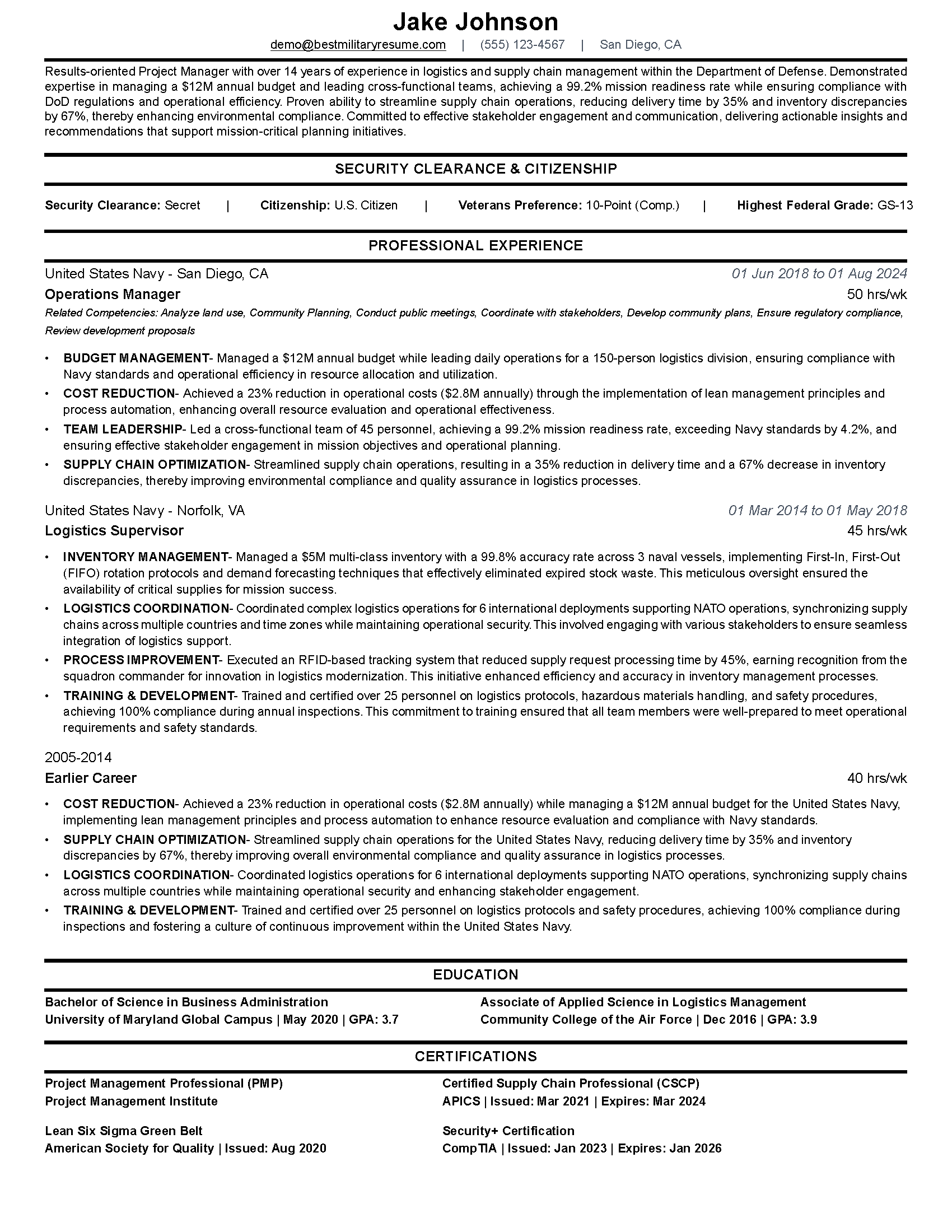
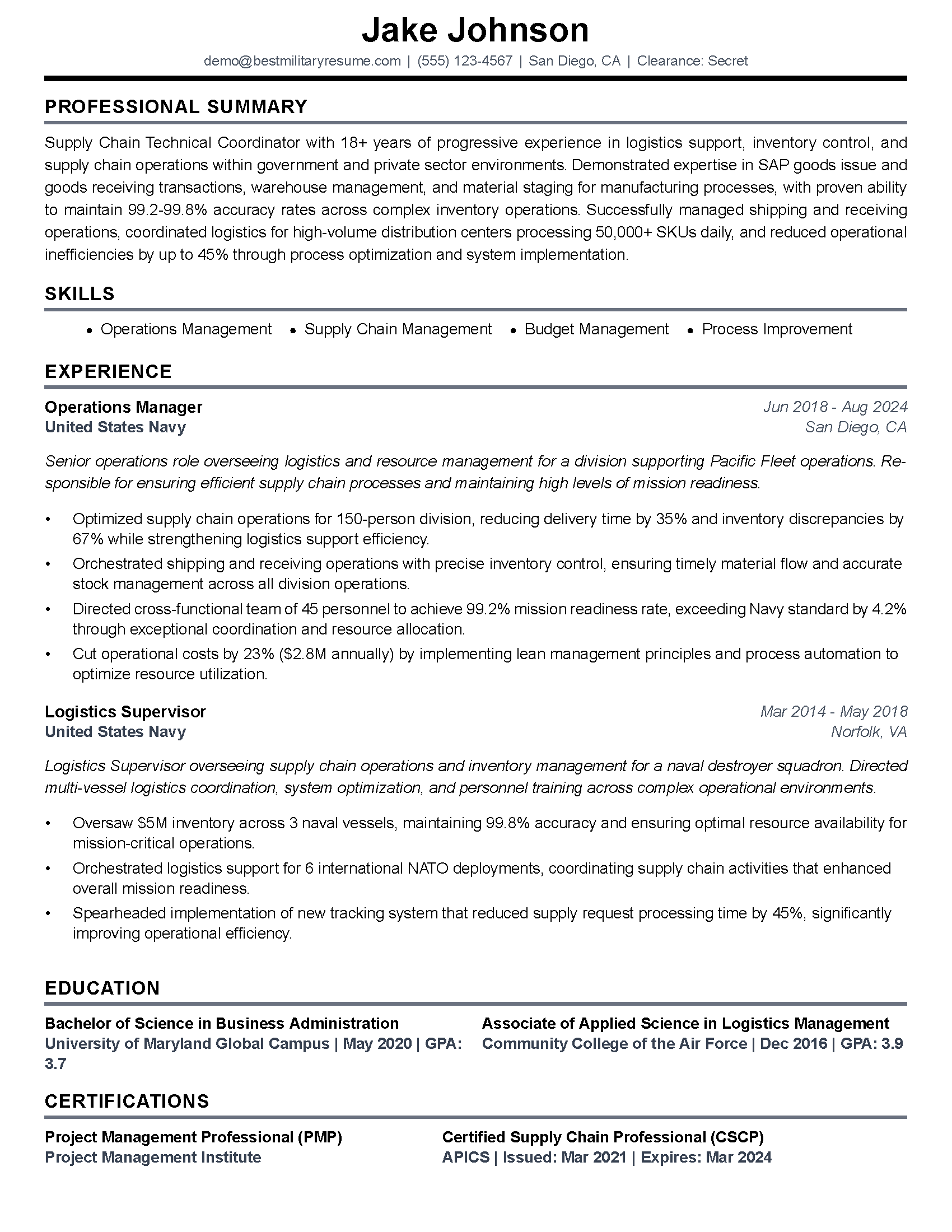
The military resume builder lets you sign in and paste in a North Dakota posting. It reads the posting and tailors your resume to it.
Frequently Asked Questions
Can a private employer in North Dakota prefer veterans?
Who runs a North Dakota veterans preference hearing?
Who pays for the hearing officer?
Can I appeal the hearing officer's order?
About the author
Brad Tachi is the CEO and founder of Best Military Resume and a 2025 Military Friendly Vetrepreneur of the Year award recipient for overseas excellence. A former U.S. Navy Diver with over 20 years of combined military, private sector, and federal government experience, Brad brings unparalleled expertise to help veterans and military service members successfully transition to rewarding civilian careers. Having personally navigated the military-to-civilian transition, Brad deeply understands the challenges veterans face and specializes in translating military experience into compelling resumes that capture the attention of civilian employers. Through Best Military Resume, Brad has helped thousands of service members land their dream jobs by providing expert resume writing, career coaching, and job search strategies tailored specifically for the veteran community.
