Fleet Manager Resume for Veterans: Motor Pool to Bullets
Desiree landed a $135K hybrid senior financial consultant role.
Desiree, E-5, Army National Guard, the interviewer loved the resume from the top down
Your motor pool work can go on a fleet manager resume under the civilian job's own title. O*NET's "Transportation, Storage, and Distribution Managers" page lists "Fleet Manager" in its "Sample of reported job titles".
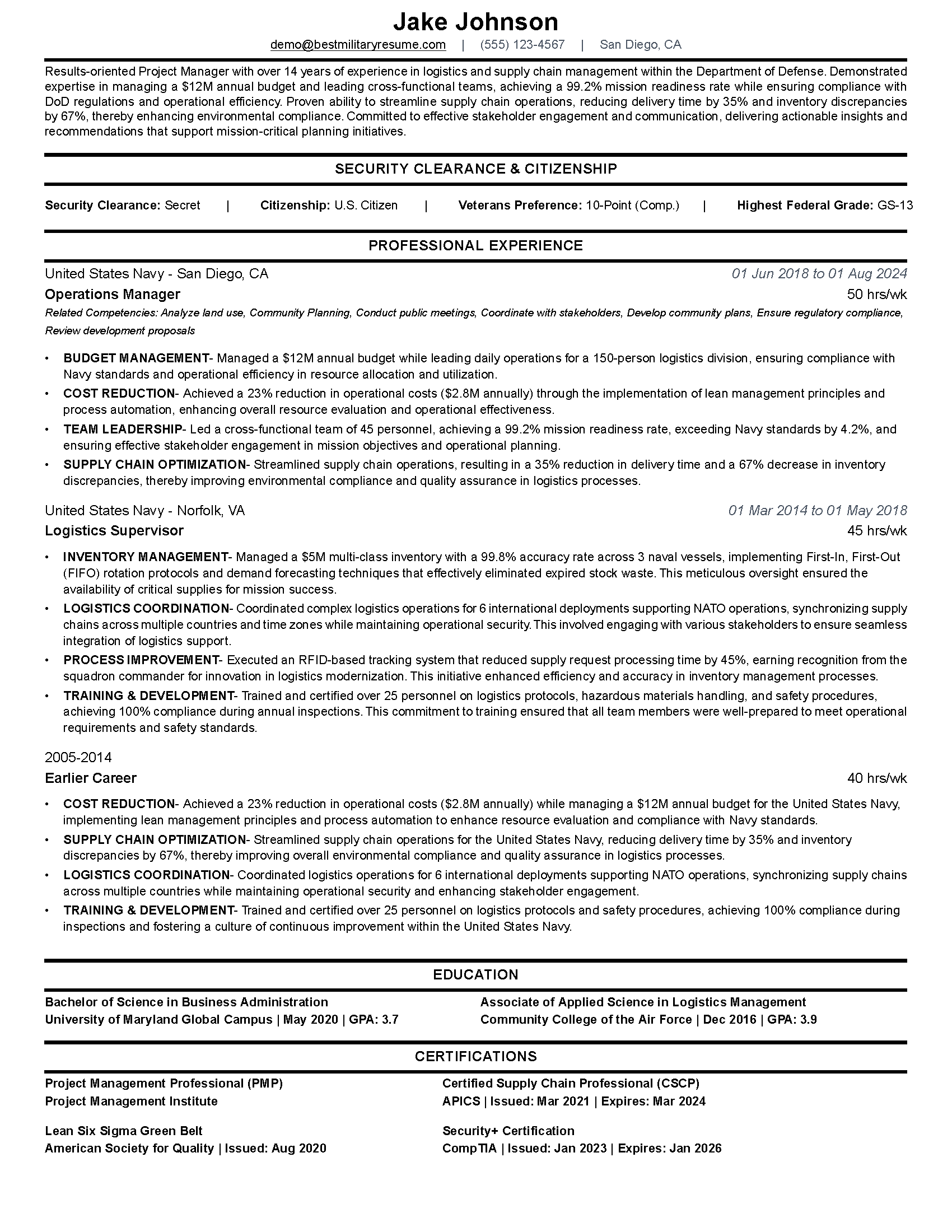
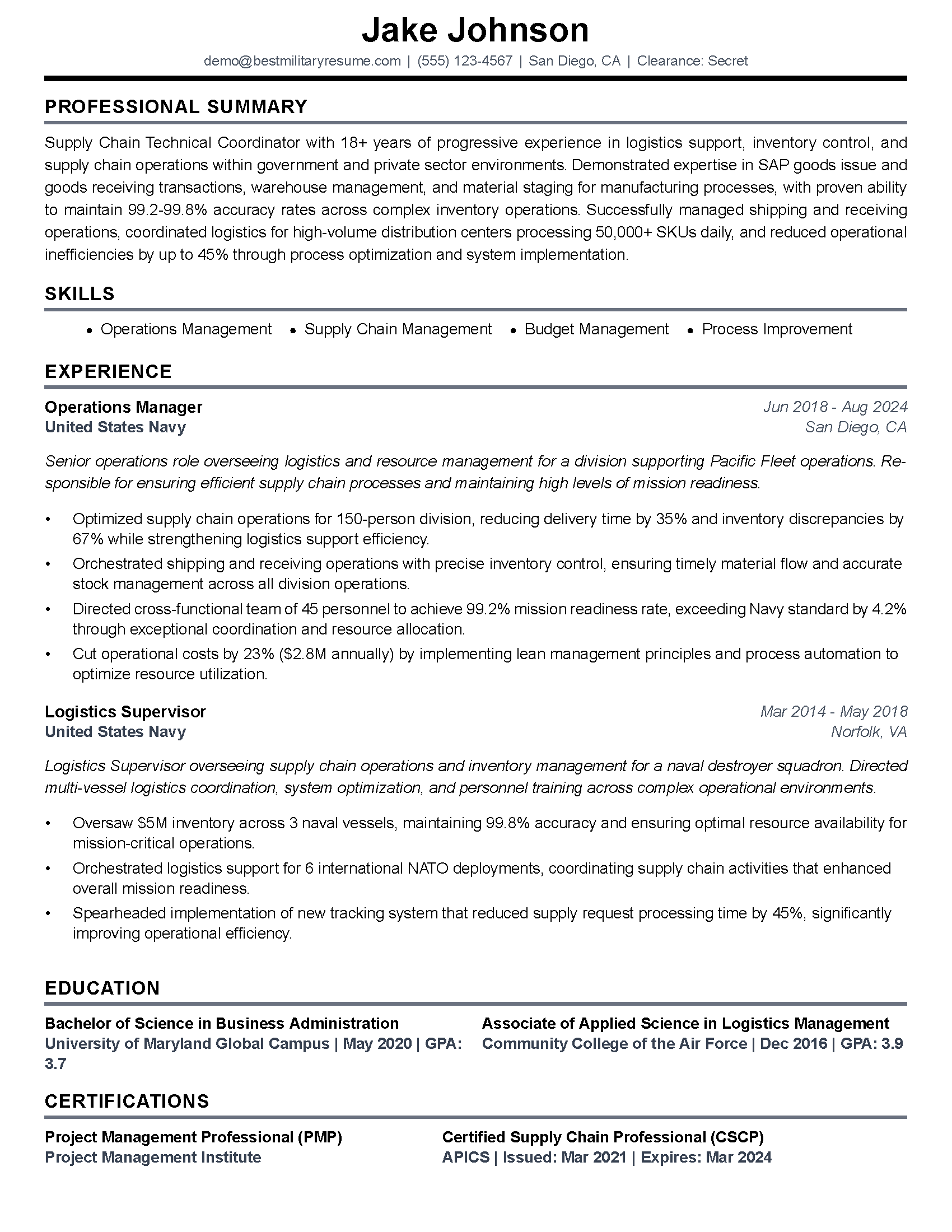
So name the job that way, then prove each task with what you did in the motor pool. The bullets below use the method of BMR's veteran resume builder, which is up to 79,689 resumes built.
Pick the fleet tasks out of a 31-task list
That O*NET page covers more than fleets. It lists 31 tasks, and many are about warehouses and logistics. So pick the tasks that match your work and leave the rest.
One task on that O*NET page: "Inspect physical conditions of warehouses, vehicle fleets, or equipment and order testing, maintenance, repairs, or replacements." That is the task closest to fleet work.
Money is part of the job too. O*NET also lists "Prepare and manage departmental budgets." O*NET lists "Recommend or authorize capital expenditures for acquisition of new equipment or property to increase efficiency and services."
So are rules and records. O*NET says this manager will "Monitor operations to ensure that staff members comply with administrative policies and procedures, safety rules, union contracts, environmental policies, or government regulations." O*NET lists "Maintain metrics, reports, process documentation, customer service logs, or training or safety records."
Fuel and routes are on the list. O*NET lists "Plan or implement energy saving changes to transportation services, such as reducing routes, optimizing capacities, employing alternate modes of transportation, or minimizing idling." If you planned convoy routes or cut idle time, that task is yours.
Motor pool codes on the veteran list, by branch
A veteran job tool maps military jobs to this civilian one. My Next Move for Veterans says "Transportation, Storage, & Distribution Managers perform work familiar to some military personnel." Its Army list includes "Automotive Maintenance Warrant Officer (Warrant Officer only)" and "Motor Transport Operator (Enlisted)".
The same My Next Move for Veterans list includes Marine Corps "Motor Transport Operations Chief (Enlisted)", "Ordnance Vehicle Maintenance Chief (Enlisted)" and "Motor Transport Officer (Commissioned Officer only)".
The Army titles carry the codes 915A and 88M. The Marine titles carry 3537, 2149 and 3502. The list calls this similar work. It does not say the job qualifies you.
Wheeled vehicle mechanic is not on that list. If that was your job, show the times you led the shop.
Drivers who moved into dispatch can start with the 88M Motor Transport Operator career guide. If you still drive and want a CDL job first, see the 88M CDL resume guide.
What the Army's maintenance rule says motor pools do
The Army puts its materiel maintenance policy in a regulation. Army Regulation 750-1 says "The fundamental element of field maintenance is the requirement for PMCS." PMCS means "preventive maintenance checks and services".
AR 750-1 says "The primary functions of maintenance management include forecasting, distribution, scheduling, and" "production control of maintenance workloads". Those are planning words a civilian manager uses too.
AR 750-1 says "All organizations in the Army will implement a system of metrics" so leaders "will assess the success of maintenance operations for which they are responsible." It adds "Fleet utilization tracking is required for all Army tactical equipment tracking miles/hours/kilometers." If you kept those numbers, you did fleet reporting.
Use the table's middle column on your resume. Keep the proof column in your notes for the interview.
| Motor pool work | Civilian words to use | Proof you may have |
|---|---|---|
| Running PMCS and fault checks | Fleet inspection and preventive maintenance | Service schedules and fault records |
| Dispatch and usage tracking | Fleet utilization and maintenance metrics | Mileage and hours reports |
| Parts and repair spending | Budget management | Parts orders and spend reports |
| Driver and shop standards | Safety and regulatory compliance | Inspection results and training lists |
| Requests to replace vehicles | Equipment replacement requests | The request and its repair history |
Tie each bullet to a fleet problem
BMR writes work bullets with one method. It never claims a duty you did not do. It never makes up a number. Each bullet follows Challenge, Action, Result.
- Challenge: Name the fleet problem. Vehicles down, a parts backlog or a service schedule that kept slipping.
- Action: Say what you did about it. Start with a strong verb like led, tracked, scheduled or enforced.
- Result: Say what changed for the fleet. More vehicles ready, faults caught early or a request approved.
Put the result ahead of the duty. A duty says you were in charge of the motor pool. A result says what your work kept rolling.
Add a number only if your records hold it. If they do not, leave it out. A true line beats one you cannot defend in an interview.
Use a posting's words only where they match work you did. Your old evaluations are a good place to find results. The NCOER, OER and FITREP bullet guide shows how to mine them.
Motor pool work, rewritten for a fleet job
These show the method. They are not copy. Swap in your own fleet, your own records and any number you can prove.
- Example bullet: Led the preventive maintenance program for a unit's vehicles, setting the service schedule so faults were found early and fixed before missions.
- Example bullet: Tracked the miles and hours each vehicle ran and showed leaders which ones were due for service next.
- Example bullet: Ran the parts and repair budget for a maintenance shop, ordering what each job needed so trucks got back on the road sooner.
- Example bullet: Held drivers and mechanics to the safety rules, so vehicles left the lot checked and cleared to drive.
- Example bullet: Asked to replace worn gear that kept breaking, and gave leaders the repair history they needed to say yes.
Each one starts with a verb and ends on what the work made possible. None of them names an Army form or system a civilian reader would have to look up.
The lines a fleet recruiter reads first
Your summary is two or three lines. It should show a result, not list duties. See more summary examples by branch.
- Example summary: Army maintenance leader who kept a unit's trucks ready to roll. Caught faults through set service checks and tracked use so repairs came before breakdowns.
- Example skills line: Fleet maintenance, preventive maintenance scheduling, fleet utilization tracking, budget management, safety compliance, parts ordering.
Software comes next. O*NET's software list for the role names "Eaton Fleet Advisor", "ALK Technologies FleetSuite" and "Transportation management system TMS software". List a tool only if you used it. If you only used Army systems, say what you did in them in plain words.
Then the degree question. O*NET puts the role in Job Zone Four: "Most of these occupations require a four-year bachelor's degree, but some do not." So read each posting before you rule a job out.
If your work was mostly buildings, the facilities manager resume guide fits better. If it was supply and freight, try the military logistics to supply chain resume guide. If you ran the whole unit, see the operations manager resume guide.
Hold the builder's bullets up to the table
Give the BMR Resume Builder your PMCS, dispatch and parts work. Read each bullet it writes against the middle column of the table above. If a line still reads like an Army record, swap in that column's civilian words.
Sources: O*NET OnLine, My Next Move for Veterans and Army Regulation 750-1 (29 April 2026). We checked them in November 2026.
Frequently Asked Questions
Do I need a degree to be a fleet manager?
Should I write PMCS on my fleet manager resume?
What if I never used civilian fleet software?
Can a motor transport operator aim for a fleet manager job?
About the author
Brad Tachi is the CEO and founder of Best Military Resume and a 2025 Military Friendly Vetrepreneur of the Year award recipient for overseas excellence. A former U.S. Navy Diver with over 20 years of combined military, private sector, and federal government experience, Brad brings unparalleled expertise to help veterans and military service members successfully transition to rewarding civilian careers. Having personally navigated the military-to-civilian transition, Brad deeply understands the challenges veterans face and specializes in translating military experience into compelling resumes that capture the attention of civilian employers. Through Best Military Resume, Brad has helped thousands of service members land their dream jobs by providing expert resume writing, career coaching, and job search strategies tailored specifically for the veteran community.