Risk Manager Resume for Veterans: Army RM Into Bullets
Desiree landed a $135K hybrid senior financial consultant role.
Desiree, E-5, Army National Guard, the interviewer loved the resume from the top down
A veteran's risk manager resume shows the risks you rated and the calls you made. ATP 5-19 lists five steps: “Step 1–Identify the hazards.” “Step 2–Assess the hazards.” “Step 3–Develop controls and make risk decisions.” “Step 4–Implement controls.” “Step 5–Supervise and evaluate.”
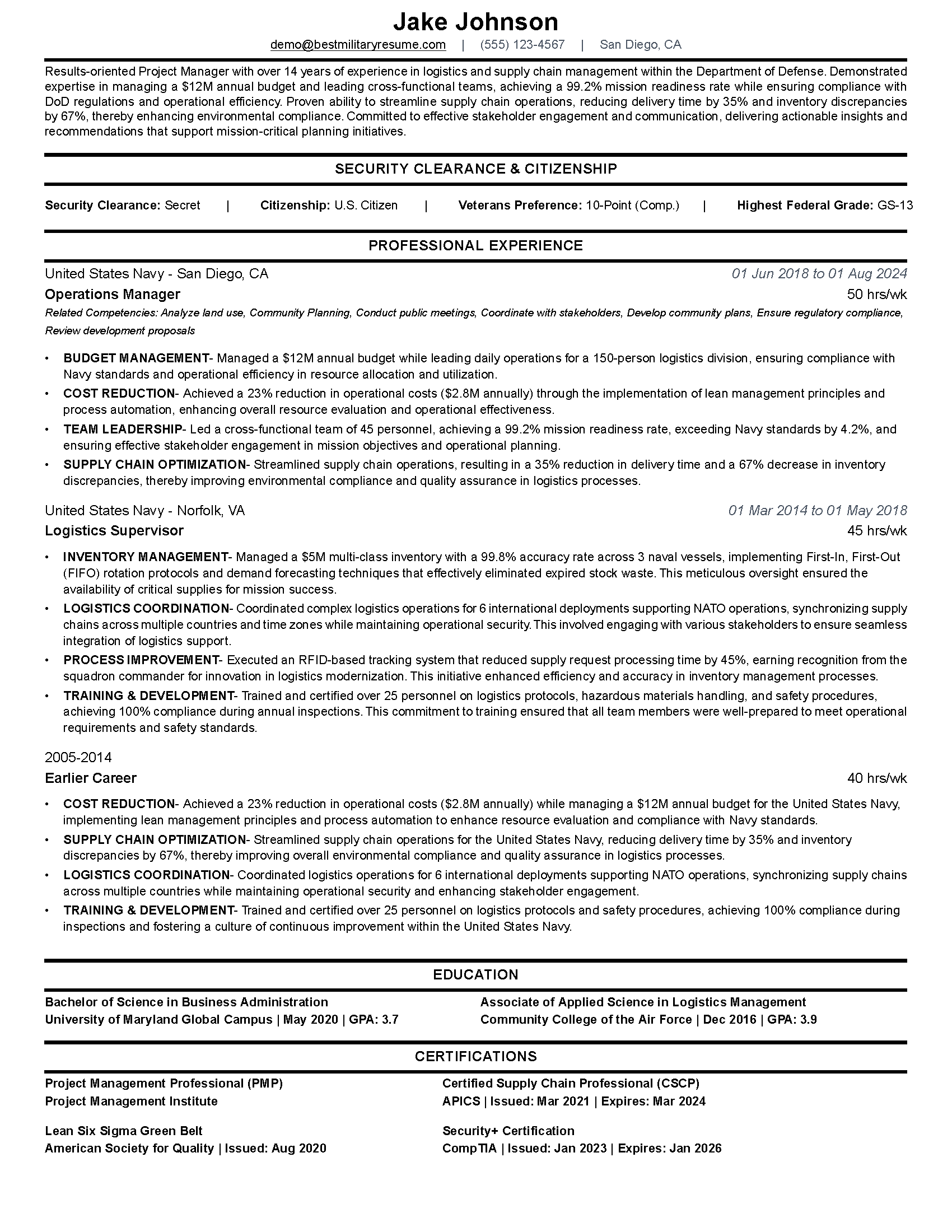
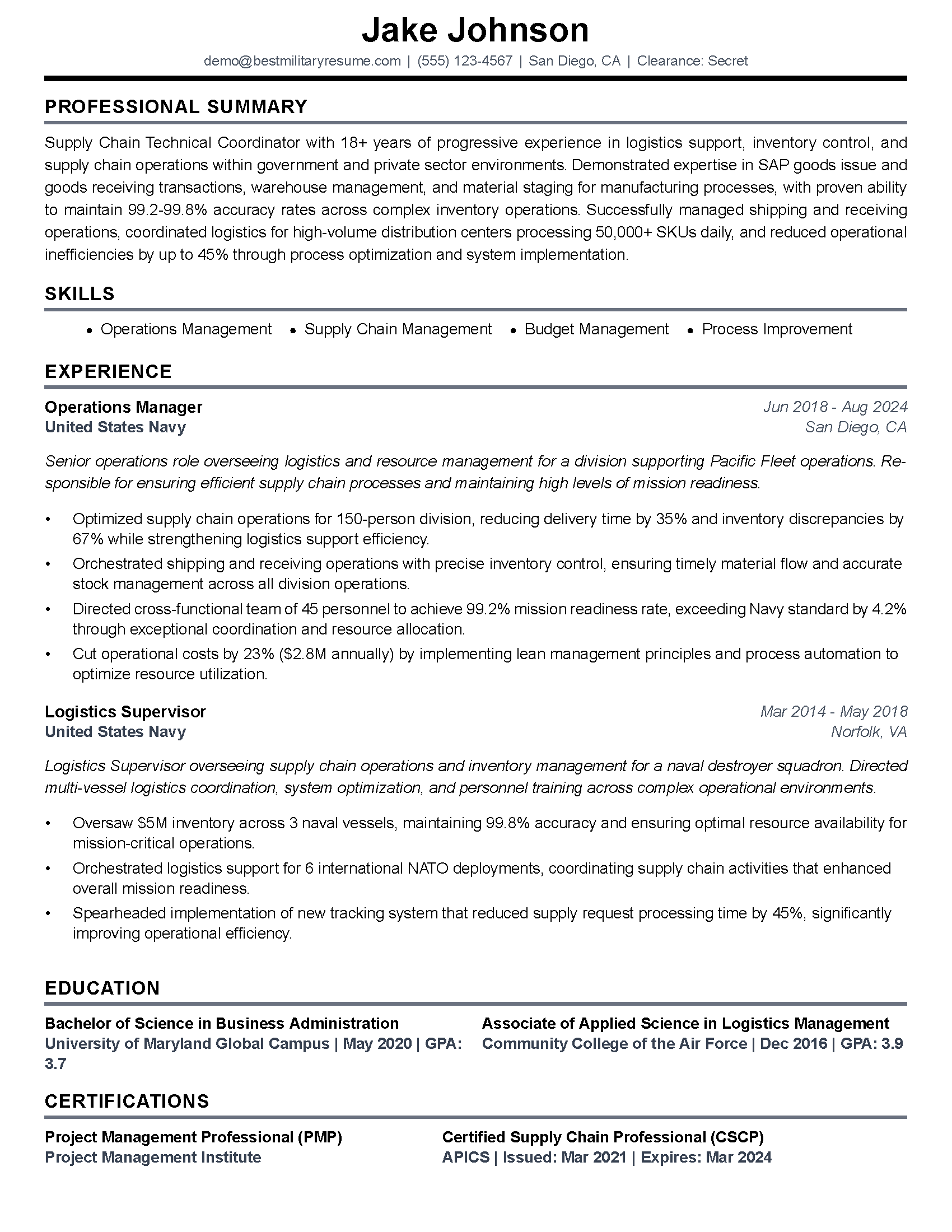
A recruiter may never have seen your worksheets. So your resume has to say what you did on them in plain words. Those worksheets are raw material on BMR, where the resume count reached 79,689 in November 2026.
Where O*NET puts risk manager work
Read the job before you write a line. Two O*NET pages come close to this risk work. Look at both.
O*NET’s Financial Risk Specialists page lists “Risk Manager” as a title for work that “Analyze and measure exposure to credit and market risk”. Tasks include “Recommend ways to control or reduce risk.” That page is the finance side. Aim there only if you want bank or market risk work.
For risk work in operations, see the Business Continuity Planners page. O*NET’s Business Continuity Planners tasks include “Recommend or implement methods to monitor, evaluate, or enable resolution of safety, operations, or compliance interruptions.”
Notice the key words from both pages: reduce risk, monitor, evaluate. Those are the words your bullets should use.
Do you need a degree? See the Financial Risk Specialists page. It says “Most of these occupations require a four-year bachelor's degree, but some do not.” So check each posting before you decide it is out of reach.
Where your Army risk work shows up
Army ATP 5-19 (“NOVEMBER 2021”) defines it this way: “Risk management is the process to identify, assess, and control risks and make decisions that balance” “risk cost with mission benefits (JP 3-0).”
ATP 5-19 says “RM applies to operations” “and to nonoperational activities.” So a range day counts. So does a convoy, a motor pool task or a unit event.
ATP 5-19 says the steps are recorded “on the prescribed form, DD Form 2977 (Deliberate Risk” “Assessment Worksheet)”. If you filled one out, signed one or briefed one, that is resume proof.
You may know the older name. ATP 5-19 says the process, “then renamed composite risk management, was broadened to encompass all operations and activities, on and” “off duty.” Current doctrine says risk management (RM). Write risk management on your resume so it matches the posting.
The rules you worked under count too. ATP 5-19 names four principles, including “Accept no unnecessary risk.” and “Apply RM cyclically and continuously.” You lived that rule each time you cut a risk the mission did not need.
The job word behind each Army step
Each step has a plain job word behind it. Use the word a posting would use, then show the step as proof.
| Army step | What you can point to | Words to use on the resume |
|---|---|---|
| Step 1 | The hazards you listed for an event | Hazard and risk identification |
| Step 2 | How you rated each hazard | Risk assessments |
| Step 3 | The controls you picked and who signed off | Ways to reduce risk, risk decisions |
| Step 4 | How the controls reached the people doing the work | Control rollout, training |
| Step 5 | Your checks during and after the event | Monitor and evaluate, lessons learned |
Step 2 is the rating step. In step 2, ATP 5-19 has planners “Estimate the probability of a harmful event or occurrence from a hazard.” and “Estimate the expected severity of an event or occurrence.” Then “Planners determine the level of risk by using the risk assessment matrix”. Say on your resume that you rated likelihood and severity on a matrix.
Step 3 shows judgment. ATP 5-19 says if controls fall short, “that person must elevate the risk decision to” “the next level in the chain of command.” If you sent a decision up the chain, say so. It shows you knew the limits of your authority.
Step 5 shows follow-through. ATP 5-19 says “step 5 involves ensuring that controls are implemented and performed to standard.” and “RM practitioners capture lessons learned”. So show that your controls held.
One bullet method for every risk call
BMR writes bullets with one method. It never claims a duty you did not do. It never invents a number. Every bullet follows Challenge, Action, Result.
- Challenge: Name the risk the unit faced. Say what event, task or place it was.
- Action: Name the step you ran. Start with a strong verb like led, rated, built or checked.
- Result: Say what changed. The event ran, a control held or a decision went to the right level.
Put the result over the duty. A duty says you were responsible for risk. A result says what your work made possible.
Use a number only if your records show it. If they do not, leave the number out. A true bullet with no number beats a bullet you cannot defend in an interview.
Keep the posting's words where they fit your real work. If a word does not match something you did, leave it out. Your old evaluations can help you find results. Here is how to pull bullets from an NCOER, OER or FITREP.
How the finished risk lines read
These are examples, not copy. Swap in your own events and facts, and add a number only if your records hold one.
- Example bullet: Led deliberate risk assessments for unit training events, rating each hazard by likelihood and severity so leaders could decide before work began.
- Example bullet: Built control plans for high-risk field tasks and briefed the remaining risk to the approving leader, so each decision sat at the right level.
- Example bullet: Checked that controls were in place and done to standard during live events, then logged lessons learned to improve the next assessment.
- Example bullet: Applied the risk process to off-duty and nonoperational activities, finding hazards early and recommending ways to reduce them before anyone got hurt.
Each one shows a step or the whole process, uses a job word and ends on what changed. None of them names a form or a code a recruiter would have to look up.
What sits above your risk bullets?
Your summary sits at the top in two or three lines. Name the job you want. Then name the risk work you did. See more summary examples by branch.
- Example summary: Army leader who ran risk management for training and field work. Rated hazards, set controls and checked them. Seeking a risk manager role in operations.
- Example skills line: Risk assessment, risk assessment matrix, mitigation planning, risk decisions, monitoring, lessons learned, compliance.
Pick skills that match words in the posting and in your bullets. For more skill words, use this list of military skills with civilian translations.
If your risk work was mostly safety, a safety manager resume may fit you better. If it was running the whole unit, look at the operations manager resume guide. Insurance firms hire risk people too, and the insurance career guide shows those paths. For the wider job, read how to translate military experience on a resume.
Where a signed risk worksheet goes next
If you signed or briefed a DD Form 2977, that worksheet holds your best risk bullet. Open the BMR Resume Builder and add it. Describe the hazards you rated, the call you made and the check that proved the controls held.
Sources: Army ATP 5-19 (November 2021), O*NET Business Continuity Planners and O*NET Financial Risk Specialists. We checked them in November 2026.
Frequently Asked Questions
Should my resume say composite risk management?
Can I name the DD Form 2977 on my resume?
Should my risk bullets have numbers?
Does Army risk work fit a bank risk manager job?
About the author
Brad Tachi is the CEO and founder of Best Military Resume and a 2025 Military Friendly Vetrepreneur of the Year award recipient for overseas excellence. A former U.S. Navy Diver with over 20 years of combined military, private sector, and federal government experience, Brad brings unparalleled expertise to help veterans and military service members successfully transition to rewarding civilian careers. Having personally navigated the military-to-civilian transition, Brad deeply understands the challenges veterans face and specializes in translating military experience into compelling resumes that capture the attention of civilian employers. Through Best Military Resume, Brad has helped thousands of service members land their dream jobs by providing expert resume writing, career coaching, and job search strategies tailored specifically for the veteran community.