Where to Put Military Experience on Your Resume
"With the very first resume I created, I was hired."
Kyle, E-7, Navy — aviation maintenance and logistics career
You separated. You have years of real experience. And now you are staring at a blank resume template wondering where any of it goes.
Should your military service be the first thing a hiring manager reads? Should it go under "Work Experience" or get its own section? What about the skills you picked up that have nothing to do with your MOS or rating?
These are not hypothetical questions. After I separated from the Navy as a Diver, I spent weeks rearranging sections on my resume trying to figure out what order would actually get someone to call me back. I put military experience at the top. Then I buried it at the bottom. I even tried splitting it across two sections. Nothing worked until I figured out the actual logic behind section placement -- and it had everything to do with the specific job I was targeting.
This article gives you the section-by-section order for placing military experience on a civilian resume, a federal resume, and a few edge cases where the standard rules change. No theory. Just the layout that works.
Why Section Order on a Military Resume Actually Matters
Hiring managers spend about six seconds on an initial resume scan. That is not an exaggeration -- I saw it firsthand when I reviewed applications for federal positions. Six seconds means the first third of your resume does almost all the heavy lifting.
If your military experience is the strongest thing you bring to a specific job, it needs to be near the top. If you have ten years of civilian work since separating, your military service probably belongs further down. The deciding factor is always the same: what is most relevant to the job you are applying for right now?
Section order also affects how ATS platforms like Workday, iCIMS, and USA Staffing rank your application. These systems parse your resume top to bottom and weight content that appears earlier. A strong keyword match in your first section carries more weight than the same keyword buried on page two. Your resume will not get auto-rejected for bad section order, but it can rank lower in the stack if the most relevant content is hard to find.
Key Takeaway
Section order is not about what you are most proud of. It is about what the hiring manager for this specific job needs to see first. That changes with every application.
What Is the Standard Resume Section Order for Veterans?
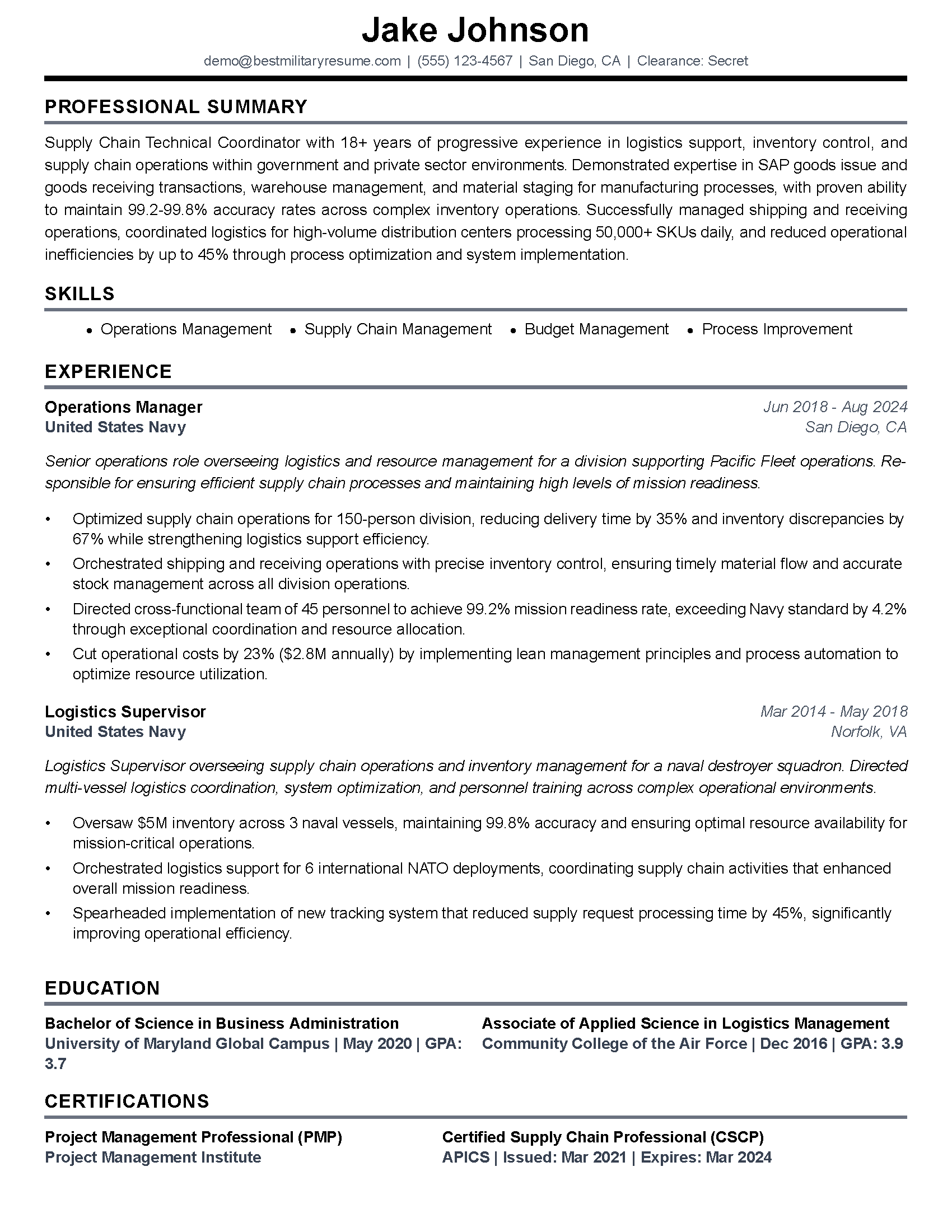
For most veterans transitioning to civilian roles, the section order that consistently performs best looks like this:
Contact Information
Name, phone, email, city/state, LinkedIn URL. No military addresses or APO boxes.
Two to four lines that frame your military background in civilian terms, tailored to the specific role.
Work Experience (Military as Most Recent)
Your military roles listed in reverse chronological order, translated into civilian language with quantified results.
Education and Certifications
Degrees, military schools that translate (e.g., BLC, ALC, SNCO Academy), and industry certifications.
Skills (Optional but Recommended)
Hard skills and technical proficiencies that match the job posting. Skip soft skills -- they belong in your bullet points, not a list.
This order works because reverse chronological is the format that both hiring managers and ATS platforms expect. Your military service goes right under the professional summary because, for recently separated veterans, it IS your most recent and most substantial work experience. There is no need to create a separate "Military Experience" section unless you also have significant civilian work history to showcase alongside it. More on that scenario below.
If you need a deeper dive into what content goes inside each section, the veteran resume walkthrough breaks that down with real examples.

Should Military Experience Get Its Own Section or Go Under Work Experience?
This is the question I see come up the most on BMR, and the answer depends on one thing: how much civilian work history you have since separating.
Scenario 1: You Separated Recently (0-2 Years Ago)
Your military experience IS your work experience. Put it directly under the "Work Experience" or "Professional Experience" heading. Do not create a separate "Military Service" section. Doing so signals to a hiring manager that you see your military time as something different from "real" work -- and that framing works against you.
List your military roles the same way you would list any civilian job: title (translated to a civilian equivalent), organization, location, dates, and bullet points with measurable results. An E-6 who led a maintenance team of 14 in the Army does not need a "Military Background" header. They need a "Work Experience" section that says "Maintenance Supervisor, U.S. Army" with bullets that show what they managed, what they improved, and what it cost.
Scenario 2: You Have 3+ Years of Civilian Experience
Now you have a choice. If the civilian experience is more relevant to the target job, lead with that under "Work Experience" and list your military roles after it in the same section. Reverse chronological order handles this naturally -- your most recent job appears first regardless.
Some veterans in this situation do split into two sections: "Professional Experience" for civilian roles and "Military Experience" below it. This can work if your military background adds credibility (security clearance, leadership scope, technical training) but is not the primary qualification for the job. The risk is that the split pushes your military experience below the fold on a one-page resume, so make sure your military bullet points are tight enough to justify the space.
Scenario 3: Career Changers Targeting a Totally New Field
If you are an 11B (Infantryman) applying for an IT help desk role, leading with infantry experience at the top of the page is going to confuse a hiring manager. In this case, move a skills section or relevant certifications (CompTIA A+, Security+, etc.) above work experience. Your military roles still appear, but the first thing the reader sees is proof that you can do the job they are hiring for.
This is the one situation where breaking from standard reverse chronological order makes sense. You are not hiding your service -- you are leading with what matters to the person reading your resume.
Separate "Military Service" section buried at the bottom of page 2, with untranslated job titles like "E-5, 11B" and no civilian context.
Military roles integrated into "Work Experience" with translated titles, quantified bullets, and positioned based on relevance to the target role.
How Does Section Order Change for Federal Resumes?
Federal resumes follow different conventions than private-sector resumes, and the section order reflects that. If you are applying through USAJOBS, the layout shifts.
A federal resume still targets two pages max, but the content is more detailed. Each position needs hours per week, supervisor contact info, and specific duty descriptions that map to the job announcement. The section order that works for federal applications:
- Contact information -- include citizenship status and veteran preference eligibility
- Professional summary -- 3 to 4 sentences connecting your background to the specific GS series and grade
- Work experience -- military and civilian roles in reverse chronological order, with full detail (hours/week, supervisor name and phone, whether they can be contacted)
- Education -- degrees, credit hours, GPA if above 3.0
- Certifications and training -- relevant military schools and civilian certs
- Additional information -- awards, volunteer work, languages, if space allows
The big difference with federal resumes is that you do NOT split military and civilian experience into separate sections. USA Staffing parses work experience as a single block. Splitting it can confuse the system and make it harder for HR specialists to see your full timeline. Keep everything in one "Work Experience" section, reverse chronological.
For a complete breakdown of federal resume formatting, the federal vs. civilian resume guide covers the structural differences in detail.
Where Do Military Skills Go on a Civilian Resume?
Skills placement trips up a lot of veterans because military training gives you two types of skills: the ones that directly match a job posting (hard skills) and the ones that are valuable but not called out in the posting (leadership, adaptability, problem-solving under pressure).
Hard skills go in a dedicated "Skills" or "Core Competencies" section. Place it either right after your professional summary (if skills are more relevant than job titles for this role) or after your work experience section (if your roles speak for themselves). The decision depends on whether the hiring manager will care more about your skills list or your job history.
For technical roles -- IT, cybersecurity, data analysis, engineering -- a skills section near the top often makes more sense. A hiring manager posting for a Network Administrator wants to see CCNA, TCP/IP, Cisco IOS, and Active Directory before they read about your military unit. For management and operations roles, your work experience typically does the talking, and skills become a supporting section further down.
Soft skills do not get their own section. Period. "Leadership" and "teamwork" as standalone line items on a skills list add nothing. Those belong woven into your work experience bullets where you can show the scale. "Led 22-person logistics team across three distribution points" demonstrates leadership. The word "leadership" sitting on a list does not.
If you are struggling with how to translate your military skills into civilian terms, the military skills translation list has branch-specific examples you can adapt.
Watch Your Security Clearance Placement
If you hold an active or recently expired clearance, it typically goes in either your professional summary or a dedicated line near the top of your resume. Do not bury clearance status at the bottom -- for defense contractors and cleared positions, it can be the first thing a recruiter looks for.
How Should You Order Multiple Military Roles?
If you served for eight, twelve, or twenty years, you probably held multiple roles across different duty stations. The question is how many of those roles belong on your resume and in what order.
Rule of thumb: include the roles that are relevant to the job you are targeting and that fit within two pages. For a veteran with 20 years of service, that might mean three or four roles, not eight. A hiring manager does not need to see every assignment from your career -- they need to see the ones that prove you can do the job they are filling.
Always list military roles in reverse chronological order within the work experience section. Your most recent and most senior role appears first. If you held the same MOS across multiple duty stations, consolidate similar roles when possible. You do not need a separate entry for every PCS if the duties were fundamentally the same.
Here is how consolidation works in practice:
- •Supply Sergeant, Fort Liberty, 2019-2022
- •Supply Specialist, Camp Humphreys, 2016-2019
- •Use when duties and scope were meaningfully different
- •Shows career progression clearly
- •Supply Manager, U.S. Army, 2016-2022
- •Fort Liberty, NC | Camp Humphreys, South Korea
- •Use when duties were essentially the same across stations
- •Saves space for more impactful bullets
The goal is to keep your resume tight. Every line of real estate matters on a two-page document. If you are unsure how far back your military resume should go, the general rule is 10 to 15 years. Roles older than that rarely add value unless they are directly relevant to the target job.
Section Order for Specific Situations
Reservists and Guard Members Still Serving
If you are still drilling, your Reserve or Guard role is active employment. List it under Work Experience alongside your civilian job. The order depends on which role is more relevant to the position you are applying for. If you are an E-7 in the Army Reserve and a project manager at a defense contractor, and you are applying for a GS-12 program management role -- both experiences matter, but the one with more relevant scope and accomplishments should come first.
Include your Reserve/Guard status clearly: "Operations Sergeant (Part-Time), U.S. Army Reserve" so there is no confusion about whether this is a full-time role.
Veterans With Gaps Between Military and Civilian Jobs
If you have a gap between separation and your first civilian role, your resume section order does not need to change. The gap itself is not the problem -- the explanation (or lack of one) is. A brief note in your professional summary or a line item for education/training during that period addresses it without drawing extra attention.
Common gap fillers that belong on a resume: degree completion, certification training, SkillBridge participation, volunteer work with quantifiable outcomes. Do not create a separate section called "Career Break" or "Gap Explanation." Just show what you were doing during that time within the existing sections. For a deeper look at handling gaps on your resume, we have a full playbook.
Retired Military (20+ Years)
With two decades of service, you have more experience than will ever fit on two pages. The section order stays the same, but the selection of what to include gets aggressive. Pick your last two or three assignments -- the ones at the highest level with the broadest scope -- and write detailed bullets for those. Earlier assignments can be summarized in a single line: "Previous assignments include Platoon Sergeant (3rd BCT, 82nd ABN), Drill Sergeant (Fort Jackson), and Squad Leader (2-502 IN, 101st ABN), 2004-2014."
This approach shows career breadth without burning half a page on duties from 15 years ago that are not relevant to what you are applying for now.
What Should NOT Be on Your Military Resume (and Where People Put It Anyway)
Section order is half the battle. The other half is knowing what sections to skip entirely. Some of these waste space, and others actively hurt your chances.
- Objective statement -- Replace with a professional summary. Objective statements tell the employer what YOU want. Summaries tell them what you BRING. Hiring managers care about the second one.
- Full awards list -- Your NDSM, GWOT-SM, and unit awards do not translate to civilian value. If you have a Bronze Star, MSM, or something that demonstrates specific achievement, mention it. A block of ribbon abbreviations wastes space.
- MOS/rating code with no translation -- "68W" or "BM2" alone tells a civilian nothing. Always pair it with the civilian equivalent: "Combat Medic (EMT-B)" or "Deck Supervisor."
- References section -- "References available upon request" has not been necessary for years. Save that space for another bullet point that shows results. If you need guidance on who to actually list when asked, the veteran resume references guide covers it.
- Personal information -- Marital status, number of dependents, religion, SSN (last four or otherwise) -- none of this belongs on a civilian resume. Some veterans include it because their military bio or eval template had these fields. They do not transfer.
Every unnecessary section pushes your real qualifications further down the page. On a two-page resume, a wasted section is a wasted opportunity for a hiring manager to see something that makes them pick up the phone.
"I used to list every military award I had on my resume. Took up six lines. Replaced it with two more work experience bullets that had actual numbers in them. Got three callbacks that week."
How Recruiters Actually Read a Military Resume (And What They Skip)
The feedback from hiring managers who have contacted BMR users tells a consistent story.
Recruiters and hiring managers read resumes in a predictable pattern. They look at the professional summary first. Then they scan job titles and company names. Then they look at dates to understand the timeline. Bullet points get read only if the first two steps caught their interest.
What this means for section order: your professional summary and the top of your work experience section are doing 80% of the work. If your military job title is not translated -- if it just says "E-6" or "BM2" without context -- the recruiter skips it. They do not look it up. They move to the next resume.
For a more detailed breakdown of this reading pattern, the recruiter scan heatmap article visualizes exactly what gets read and what gets ignored.
This is why the professional summary matters so much. It is the one section where you can directly control what the hiring manager reads first. A summary that says "Logistics Manager with 8 years of supply chain operations, $4.2M in inventory accountability, and a track record of reducing delivery times by 30%" tells a story in ten seconds. A summary that says "Dedicated veteran seeking a challenging position that utilizes my skills" tells the hiring manager nothing.
What to Do Next
If you are building your resume from scratch, start with the standard section order: contact info, professional summary, work experience (with military roles translated), education, and skills. Adjust from there based on your specific situation -- how recently you separated, how much civilian experience you have, and what the target job actually requires.
If you already have a resume and you are not getting callbacks, look at what appears in the top third of page one. That is what hiring managers see in those first six seconds. If the most relevant content for the job you want is buried on page two, rearranging your sections might be the fix you need.
BMR's Resume Builder handles the section ordering and military-to-civilian translation automatically. You paste the job posting, and it structures your military experience in the right order with the right language for that specific role. Two free tailored resumes, no paywall to start.
If you are still deciding whether to include military experience at all, read that guide first. For everyone else -- get the order right, translate the language, and put your strongest qualifications where they will actually get seen.
Want the full picture? Our complete guide to listing military service on a resume covers every branch, with examples for each section of the resume.
Frequently Asked Questions
QWhere does military experience go on a resume?
QShould I create a separate Military Experience section?
QDoes resume section order affect ATS ranking?
QHow many military roles should I list on my resume?
QShould skills go before or after work experience?
QWhere do I put security clearance on my resume?
QWhat sections should I remove from my military resume?
QHow is federal resume section order different from civilian?
About the Author
Brad Tachi is the CEO and founder of Best Military Resume and a 2025 Military Friendly Vetrepreneur of the Year award recipient for overseas excellence. A former U.S. Navy Diver with over 20 years of combined military, private sector, and federal government experience, Brad brings unparalleled expertise to help veterans and military service members successfully transition to rewarding civilian careers. Having personally navigated the military-to-civilian transition, Brad deeply understands the challenges veterans face and specializes in translating military experience into compelling resumes that capture the attention of civilian employers. Through Best Military Resume, Brad has helped thousands of service members land their dream jobs by providing expert resume writing, career coaching, and job search strategies tailored specifically for the veteran community.
Found this helpful? Share it with fellow veterans:
