Loading...
Loading...
The civilian and federal jobs that hire Air Force Manpowers — with real salaries and the resume that gets callbacks.
Every 3F3X1 has more options than a Google search will tell you. Below: career paths, BLS salary data, federal GS series, certifications by target career, and how to translate your experience without losing what made you valuable to the Air Force in the first place.
Free · No credit card · Tailored resume in under 5 minutes
After the Navy I got hired into 6 federal career fields and tech sales, and sat on federal hiring panels along the way. I spent the last 2 years rebuilding everything I learned into BMR, tuned for how AI actually screens resumes today. This is the system I wish I'd had on day one.
The 3F3X1 Manpower specialty is the Air Force's in-house workforce-analytics shop. You sized organizations, not staplers. The work runs through four core competencies: organization structure, requirements determination, program allocation and control, and performance management. In plain terms, you decided how many people a unit actually needs, how those positions should be graded, and how the force is structured to do the mission with the fewest wasted billets.
Day to day, that meant running management engineering studies and manpower determinant development to defend a unit's authorizations, building and maintaining Air Force organization structures and manpower standards, and working the manpower data systems that track every funded position across a wing. You ran process reengineering and Continuous Process Improvement (CPI) events, advised commanders on commercial-services and strategic-sourcing decisions, and translated mission requirements into defendable position counts that survived a programming review. This is a quantitative, study-driven analyst role, not a personnel-actions desk. It sits next to 3F0X1 Personnel and 3F5X1 Administration in the force-support family, but the daily work is workforce modeling and efficiency analysis, closer to industrial engineering than to HR.
The training pipeline runs through the Manpower and Personnel apprentice course, where Airmen learn manpower standards methodology, work measurement, requirements determination, and the manpower data systems used to manage authorizations. As of the 30 Apr 2025 specialty description the AFSC is open to prior-service members only, which means most people entering it already carry workforce-management or analytical experience from another field. Civilian employers value this background because you did the exact thing a workforce-planning or operations-analytics team does: you defended headcount with data, built the staffing model, and made the efficiency case to leadership. If you are mapping where those skills go in the civilian and federal market, the military career crosswalk is a fast way to see adjacent roles. For turning your study work into resume language, the guide to explaining military experience without jargon is a good starting point.
When I left the Navy I spent 18 months applying with no callbacks, and the problem was never the work. It was how the work read on paper. A Manpower analyst gets that doubled. You ran management engineering studies and built staffing models that decided real headcount, but a civilian recruiter sees "manpower" and reads a clerk. The translation is what costs the callbacks, not the experience. Get the analyst story onto the page in plain numbers and this AFSC competes for jobs paying six figures. — Brad Tachi, Navy Diver veteran & BMR founder
The number that matters when you're deciding what's next: how does civilian pay compare to what you make now?
Military comp is approximate (varies by location/dependents). Civilian is BLS median. Federal includes locality pay. Your real number depends on duty station, family status, GS step, and overtime.
The civilian market reads a Manpower analyst as a workforce-planning and operations-analytics professional, and the salary data backs that up. These figures come from the Bureau of Labor Statistics Occupational Employment and Wage Statistics (BLS OEWS, May 2024).
Management analyst is the closest direct match. BLS reports a median wage of $101,190 (SOC 13-1111), with projected 9% growth through 2034. Your management engineering studies, process reengineering, and CPI work are the same deliverables a management consultant or internal-improvement analyst produces. Operations research analyst sits right alongside it at a $91,290 median (BLS, May 2024) with a strong 21% growth outlook, and your requirements-determination math is exactly the modeling that role runs. Logisticians ($80,880 median) and compensation, benefits, and job-analysis specialists ($77,020 median) round out the in-field options, the latter because position grading and manpower-standards work overlaps directly with job analysis.
Be honest about the market. Management and operations-analytics roles concentrate in larger metros and around corporate headquarters, healthcare systems, and government contractors. Workforce-planning teams are growing as companies formalize headcount governance, but titles vary widely, so the same skill set is advertised as "workforce analyst," "staffing analyst," "operations analyst," and "business process analyst." Search on the work you did, not on the word "manpower," which civilian job boards do not use. Defense contractors that run their own manpower and management-engineering studies are the most direct hiring pool because they speak the same language you already do. For the cross-branch view, the Navy's YN Yeoman and Army's 42A Human Resources Specialist pages cover adjacent force-support paths. To see what your analytical background is worth in real numbers, the military-to-civilian salary guide walks through it, and you can build your resume now to start matching to these roles.
| Civilian Job Title | Industry | BLS Median Salary | Outlook | Match |
|---|---|---|---|---|
Management Analyst O*NET: 13-1111.00 | Consulting & Business Services | $101,190 | 9% (Faster than average) | strong |
Operations Research Analyst O*NET: 15-2031.00 | Analytics & Operations | $91,290 | 21% (Much faster than average) | strong |
Workforce Planning Analyst O*NET: 13-1141.00 | Human Capital Analytics | $77,020 | 5% (Faster than average) | strong |
Logistician O*NET: 13-1081.00 | Supply Chain & Logistics | $80,880 | 19% (Much faster than average) | moderate |
Business Operations Specialist O*NET: 13-1199.00 | Corporate Operations | $79,590 | 7% (Faster than average) | moderate |
Budget Analyst O*NET: 13-2031.00 | Finance & Government | $87,930 | 4% (As fast as average) | moderate |
Continuous Improvement Analyst O*NET: 13-1111.00 | Process Improvement | $101,190 | 9% (Faster than average) | moderate |
BMR rewrites your 3F3X1 experience for any of the civilian roles above — keywords, achievements, and language hiring managers actually scan for.
Free · No credit card · 2 tailored resumes included
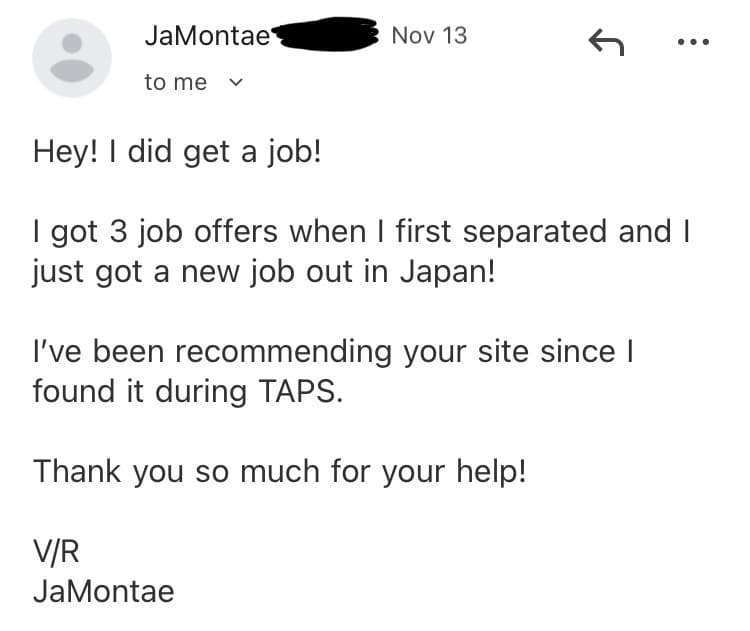
“Hey! I did get a job! I got 3 job offers when I first separated and I just got a new job out in Japan! I’ve been recommending your site since I found it during TAPS. Thank you so much for your help! V/R JaMontae ”
Federal service is where a Manpower background converts the cleanest, because the federal government runs its own version of the work you already did. The marquee target is the GS-0343 Management and Program Analyst series. That series exists to do requirements analysis, organizational studies, process improvement, and program evaluation, which is the civilian-side name for management engineering and manpower-determinant work. Manpower analysts routinely qualify at the GS-9 and GS-11 entry band, and senior NCOs with study portfolios compete at GS-12 and GS-13.
Beyond 0343, your experience supports a wide federal footprint. GS-0340 Program Management fits if you led CPI or reengineering initiatives end to end. GS-0560 Budget Analysis and GS-0501 Financial Administration and Program map to the program-allocation-and-control side of the job, where you tied position authorizations to funded dollars. GS-0201 Human Resources Management covers the workforce-structure and position-classification overlap. GS-0301 Miscellaneous Administration and Program and GS-1101 General Business and Industry are broad series that hire manpower-study skill sets, and GS-0346 Logistics Management works if your studies touched logistics functions. Manpower offices exist across every major command, plus DoD agencies, so the internal hiring market for this exact skill set is unusually deep.
Veterans' Preference applies on USAJOBS, and your time-in-grade context plus a real study portfolio makes the GS-0343 qualification case straightforward when the resume is written to federal standard. Federal resumes are their own format, longer and more detailed than a private-sector resume, so it pays to learn the structure before you apply. Start with the 2026 federal resume format guide and the OPM qualification standards breakdown, then learn to read a posting with the USAJOBS announcement decoder. When you are ready to draft it, the federal resume builder formats it to OPM spec. The Army 36B Financial Management Technician page shares the budget and program-control GS targets if you want a parallel view.
| GS Series | Federal Job Title | Typical Grades | Match | Explore |
|---|---|---|---|---|
| GS-0343 | Management and Program Analyst | GS-9, GS-11, GS-12 | View Details → | |
| GS-0340 | Program Management | GS-11, GS-12, GS-13 | View Details → | |
| GS-0560 | Budget Analysis | GS-9, GS-11, GS-12 | View Details → | |
| GS-0201 | Human Resources Management | GS-9, GS-11, GS-12 | View Details → | |
| GS-1101 | General Business and Industry | GS-9, GS-11 | View Details → | |
| GS-0301 | Miscellaneous Administration and Program | GS-9, GS-11, GS-12 | View Details → | |
| GS-0346 | Logistics Management | GS-9, GS-11, GS-12 | View Details → | |
| GS-0501 | Financial Administration and Program | GS-9, GS-11 | View Details → |
Federal hiring uses keyword-matching and structured experience. BMR builds federal-format resumes (USAJobs-ready) with the right keywords, hours/week, and supervisor info — for any GS series above.
Free · No credit card · Federal + civilian resume formats included
Not everyone wants to stay in a related field. These career paths leverage your transferable skills — leadership, risk management, logistics, project planning — in completely different industries.
Hospital systems run the same staffing-model and position-design problem you solved for a wing, just with nurses and clinical roles instead of Airmen. Your requirements-determination methodology transfers directly.
Industrial engineering is civilian management engineering. The work-measurement and efficiency-study methods you used to set manpower standards are the same tools an IE uses to design production lines.
Estimating labor and resource requirements for a construction bid is the same defensible-quantification skill you used to justify position counts to a programming review.
The demand-forecasting and data-analysis muscle you built doing requirements determination maps to sizing markets and forecasting consumer demand instead of headcount.
The program-allocation-and-control side of manpower work, tying authorizations to funded dollars, is the same financial-modeling discipline a corporate financial analyst applies to business units.
Your performance-management and process-standardization work translates to designing the training that closes a civilian workforce capability gap.
Leading a management-engineering study or CPI initiative end to end is project management. You already coordinated stakeholders, controlled scope, and delivered against a plan.
The skills that made you a good Marine, Sailor, Airman, or Soldier transfer further than you think. BMR rewrites your bullets for any of the pivot careers above — without making you sound like you've never done the work.
Free · No credit card · Try unlimited career angles
If you are staying in workforce planning, operations analysis, or management consulting, your terminology already translates and the hiring teams know the work. This section is for the Airmen targeting careers OUTSIDE the manpower and force-support world, where "management engineering study" and "manpower determinant" mean nothing to a civilian recruiter. The fix is to name the business outcome, not the Air Force process.
The pattern that wins is leading with the analytical result and the dollar or headcount impact. A line like "performed manpower requirements determination" tells a civilian nothing. "Built a staffing model that right-sized a 400-person organization and identified position reductions" tells them you do workforce analytics. Translate the system names too, because the data tools matter to an analytics hiring manager even when the acronym does not. The 50 military terms translated to civilian language glossary and the EPR/OPR to civilian resume guide are built for exactly this, and the resume builder turns the translated bullets into a finished page. The table below shows the mappings that matter most for a Manpower analyst moving into a non-military analytics or operations role.
BMR turns your 3F3X1 duties and accomplishments into civilian bullets that match the job you're applying for — no manual translation, no rewriting.
Free · No credit card · Tailored to each job posting
Which certifications you need depends on where you're headed. Find your target career path below.
The wrong placement can sink an otherwise strong application. BMR knows where each cert ranks, what to call it, and how to frame it for ATS keyword matching and hiring manager attention.
Free · No credit card · Built around your real certs and clearance
If you are targeting management analyst, operations research, or workforce-planning roles, lean on the methodology you already practiced. A Lean Six Sigma credential formalizes the CPI and process-improvement work you ran, and a workforce-analytics or HR-analytics certificate signals you can model staffing for a civilian employer. Professional associations worth joining: the Association for Talent Development and the Institute for Operations Research and the Management Sciences (INFORMS) for the analytics side, and SHRM if you lean toward the workforce-structure and position-design angle. For defense-adjacent work, contractors that run manpower and management-engineering studies hire this background directly, often through SkillBridge.
If you are leaving the force-support world, the Six Sigma for veterans guide and the military-to-data-analyst path map the cleanest crossovers, since your requirements-determination math is a short step from civilian data analysis. American Corporate Partners (ACP) is a strong veteran mentorship network if you want a person inside the industry you are targeting. Use the career crosswalk to explore adjacent fields, and SFL-TAP transition resources for the broader checklist.
Whether you go private-sector or federal, the resume is the gate. The military resume builder handles the civilian version and the federal resume builder formats to OPM standard. When you are ready to start, build your resume now.
Most veterans do this backwards — they wait until terminal leave to start, then panic. Here's the actual sequence that works.
Print this. Tape it to your monitor. Veterans who treat the transition like a 90-day op get hired faster than the ones who treat it like an emergency.
Stop rewriting from scratch every time you apply. BMR turns your military experience into civilian and federal resumes — tailored to each job.