Virginia Veterans Preference: 5%, 10% and Extra Preferred Qualifications
"Still getting interviews left and right. Now I have to say no."
Taranjeet, E-5, Army, optimized her LinkedIn and resume with BMR
Virginia gives veterans 5% on a passing state exam score, or 10% with a VA service-connected disability rating. Most state jobs use no scored test, so the state counts you as holding extra preferred qualifications instead.
That's one extra for a veteran. It's two with a VA rating. Virginia veterans preference sits in Code of Virginia § 2.2-2903. The screening credit comes from the DHRM preference policy guide updated October 31, 2024.
You'll see each veteran question, what a yes adds, and how to write the application around it.
Rules checked against § 2.2-2903 on the Virginia LIS site and the DHRM guides in November 2026.
The five veteran questions on a Virginia state application
The state application asks yes or no questions tied to § 2.2-2903. DHRM's treatment and verification table lists each one. It says what a yes gets you and what paper proves it.
- Veteran: You got an honorable discharge. You also served more than 180 days in a row of full-time active duty. Reserve and Guard active duty count. A yes counts as one extra preferred qualification. Proof is a DD214 or DD256.
- Veteran with a service-connected disability: You got an honorable discharge. You also hold a VA service-connected rating. A yes counts as two extra preferred qualifications. Proof is an official VA letter on letterhead.
- Vietnam Conflict: This one shows up only if you said yes to question 1 or 2. The table lists no credit or proof for it.
- Surviving spouse or child: Your spouse or parent was a veteran killed in the line of duty. A yes counts as one extra preferred qualification. Proof is a DD1300.
- National Guard: You serve in the Virginia National Guard now. You also finished your required initial active-duty service. A yes counts as one extra preferred qualification. HR checks it with the Department of Military Affairs.
Read questions 1 and 2 together. The statute needs the honorable discharge plus one of two things. Either you served the 180-plus days, or you hold a VA service-connected rating. Question 1 asks only about the 180 days. So a short enlistment with a VA rating answers yes to question 2.
Answer only what's true for you, because each yes can be checked against the paper listed above.
What an extra preferred qualification does for you
A Virginia posting lists two kinds of skills. The minimum ones are the floor. The preferred ones are the extras the agency would like to see. The DHRM guide says you must meet the minimum first. Then, during screening, your veteran status counts "as an additional consideration" (DHRM guide).
The table puts that in plain terms. A veteran gets "credit for having one additional preferred qualification" (DHRM table). That's one more than your application shows. With a VA service-connected rating, it's two more.
Here's a made-up example to show the math. A posting lists four preferred qualifications. Your application shows three of them, and you said yes to the veteran question. You get credit for having four. With a VA rating, you get credit for five.
The guide adds one more line worth knowing. It says the credit "remains with the applicant throughout the hiring process, and ultimately becomes a part of the hiring manager's final decision" (DHRM guide). So it doesn't vanish after the first cut.
Percent, not points.
Federal preference adds 5 or 10 points. Virginia's exam credit is a percent of your grade. And most state jobs skip the exam. See our federal 5 and 10 point guide for that system.
Some states work another way. Missouri uses preference as a tie-breaker when other factors are equal. Virginia adds the credit before there's a tie. The guide doesn't say how much each extra weighs at a given agency. To find out, ask the contact named on the posting.
The credit only counts if you meet every minimum
The statute sets a bar for no-exam jobs. Preference goes to a veteran who "meets all of the knowledge, skill, and ability requirements for the available position" (subsection B). Miss one minimum and the extra credit has nothing to sit on.
DHRM Policy 2.10 says agencies screen applications against the minimum qualifications set for the job. It also says "All criteria in any screening must be applied consistently to all applicants" (Policy 2.10).
So the posting's list is the bar. If your resume doesn't show a minimum, the veteran box can't fill the gap. That's why the next step matters more than the yes answer.
Answer each posting line before the credit adds on
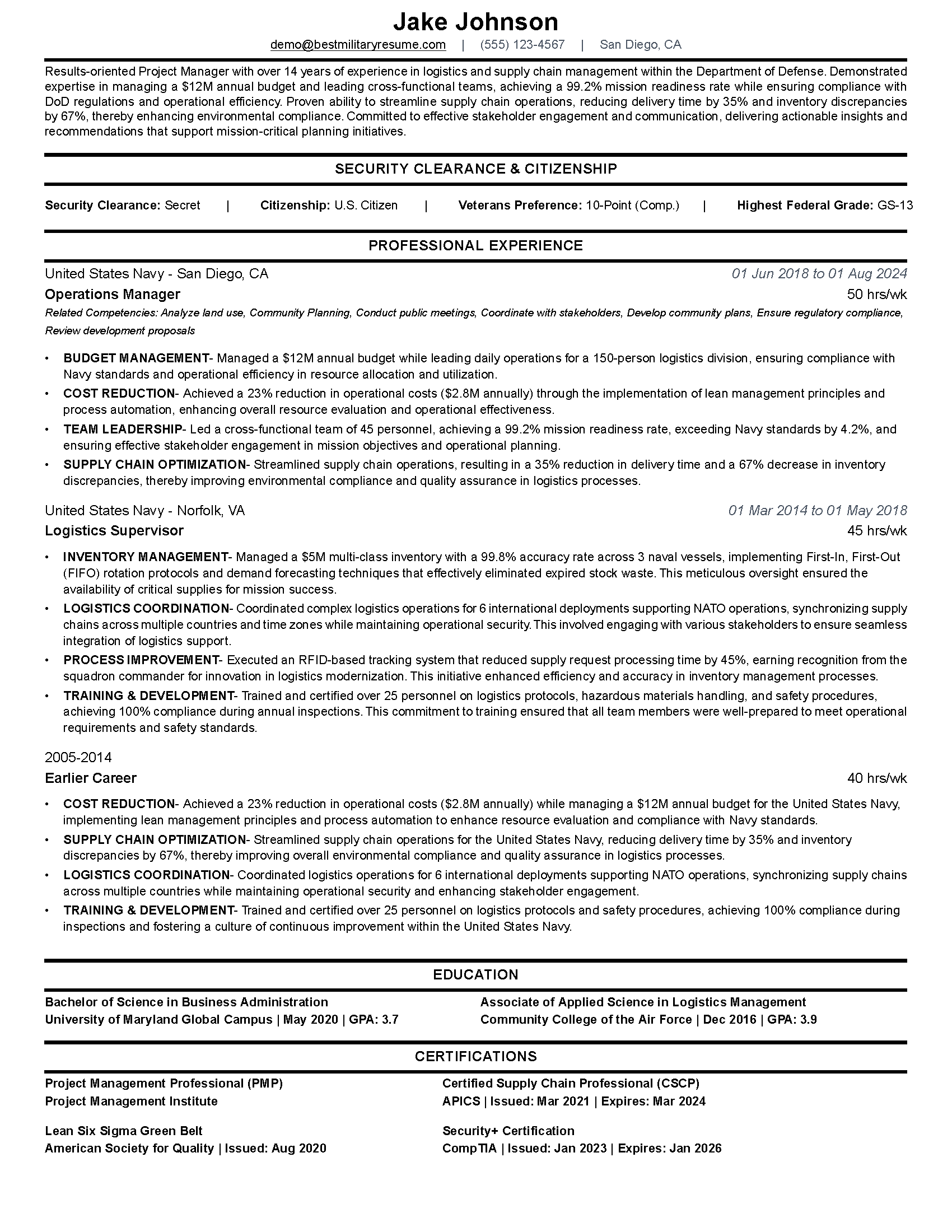
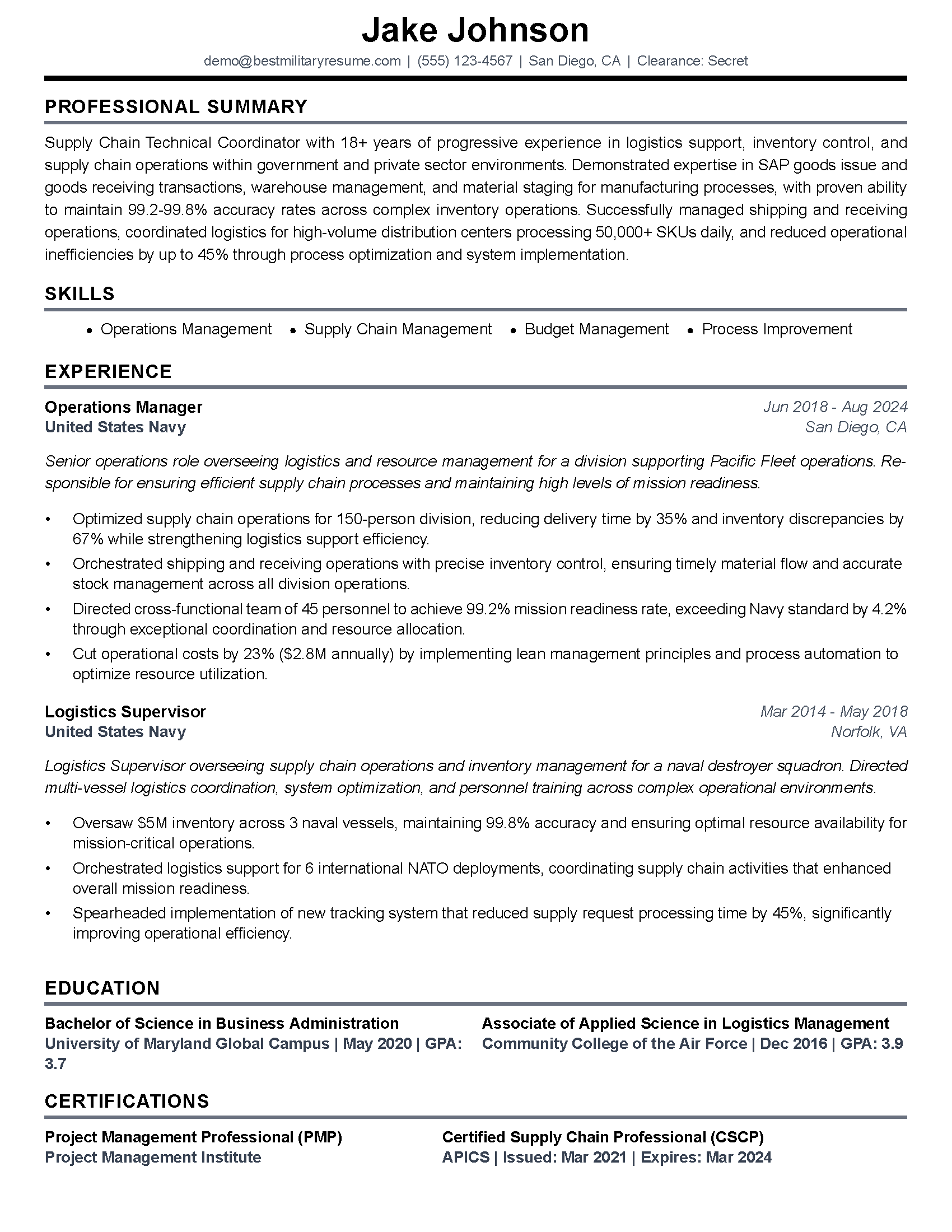
Your job is to make each skill on the list easy to find. Use the posting's own words, then back them with what you did. The veteran credit then stacks on a full count. Here's a made-up set of posting lines for a state supply job. Each has a made-up resume line that answers it.
- Minimum: The posting asks for experience keeping inventory records and doing physical counts. Resume line: Kept inventory records for [number] line items worth [dollar value]. Ran monthly physical counts with [accuracy rate].
- Minimum: The posting asks for skill with an automated inventory system. Resume line: Used an automated inventory system daily to receive, issue and track parts for a [size]-person unit.
- Preferred: The posting asks for experience training staff on supply steps. Resume line: Trained 8 new supply clerks on receiving and issue steps. Each one passed the first inspection.
- Preferred: The posting asks for experience with state or federal buying rules. Resume line: Prepared purchase requests under federal rules for parts and services worth [dollar value] a year.
Put your own numbers where the brackets are. Notice what each line does. It uses the posting's key words, like inventory records and physical counts. Then it adds a number. Every line on the list now has a line on your resume that answers it.
Write it in civilian words, too. Swap a rating code like "LS2" for the work itself, like "managed inventory records." Our guide to tailoring a military resume to a job posting walks through this line by line.
One more tip. Don't wait for the posting to mention veterans. DHRM advises that postings "not state these statuses as additional considerations unless required by law or funding conditions" (DHRM guide). So the posting may not mention veterans at all. The credit still counts when you answer the question.
Guard members: when the Guard credit drops off
The Guard credit is its own preference under § 2.2-2903(C), and it's narrower. You need to be serving in the Virginia National Guard now and have finished your initial active-duty service.
The statute names two cases where it doesn't apply. It "shall not be applied for a position that is limited to state employees" (subsection C). And it "shall not be applied if any other applicant for the position or job classification is (i) a veteran or (ii) a former prisoner of war" (subsection C).
The DHRM table adds the posting labels to watch. It says the Guard credit "Does not apply to positions posted as 'agency only' or 'state employees only'" (DHRM table).
The table adds one more rule. A Guard member who says yes as a veteran gets no Guard credit on top. So if you qualify as a veteran, the veteran question is the one that pays.
The catch is the pool. You can't see who else applied, and one veteran in it turns off the Guard credit. So write the application as if you'll get no credit. Our National Guard resume guide helps with that part.
Surviving spouses and children: two conditions
This covers the spouse or child of a veteran "killed in the line of duty" (subsection E). A child must be under 27. Both come from the definitions in § 2.2-2903(E).
A yes on the application counts as one extra preferred qualification. The proof is a DD1300. On a written exam, Policy 2.10 says the grade goes up 5%.
The statute names only the surviving spouse of a veteran killed in the line of duty. So it gives no preference to the spouse of a living veteran, even one with a VA rating.
If you don't get the job, you can ask why
Subsection D of § 2.2-2903 covers a veteran, surviving spouse, child or Guard member turned down for a state job. You can "request and inspect information regarding the reasons for such denial" (subsection D). The statute limits that "to the extent permitted by law" in the same line.
Use it to fix the next application, not to argue the last one. Ask which skill on the list your application did not show. Then add it, in the posting's words, before you apply again.
State universities may word it their own way
Some state universities run their own hiring pages. VCU's hiring veterans page is one example. It says an applicant with preference "must be offered the job" in one case. That's when their skills are "substantially equal" to the best qualified applicant without preference. VCU also says you don't need military documents to apply.
That's VCU's wording, not the state agency rule above. Before you apply at a university, read its HR page. The state's veterans hiring resources page links all the guides in one place.
City and county jobs run under a different section, § 15.2-1509. So do private employers, under § 40.1-27.2, which our guide to state preference laws for private employers covers. This page covers state jobs only.
Next: answer your Virginia posting line by line
Pull up the Virginia posting you want. Copy every minimum and preferred line into one list. Then write one resume line for each, in the posting's words, with a number.
Ryan, a Marine Sergeant (E-5), wrote this to BMR: "I've been contracting for many years with different companies, but always had troubles describing and quantifying the work I had done. Using BMR helped me to adjust my resume points to fit job positions that would be a good fit for me."
That's the same job you just did by hand. Sign in to the Military Resume Builder and paste in your Virginia posting. It tailors your resume lines to that posting.
Frequently Asked Questions
Does the 10% for a disabled veteran need a certain VA rating percentage?
When will a Virginia agency ask for my DD214 or VA letter?
Where do I get help with the Virginia state jobs site?
Do Guard members get points on a scored assessment?
Does a general discharge count for Virginia veterans preference?
About the author
Brad Tachi is the CEO and founder of Best Military Resume and a 2025 Military Friendly Vetrepreneur of the Year award recipient for overseas excellence. A former U.S. Navy Diver with over 20 years of combined military, private sector, and federal government experience, Brad brings unparalleled expertise to help veterans and military service members successfully transition to rewarding civilian careers. Having personally navigated the military-to-civilian transition, Brad deeply understands the challenges veterans face and specializes in translating military experience into compelling resumes that capture the attention of civilian employers. Through Best Military Resume, Brad has helped thousands of service members land their dream jobs by providing expert resume writing, career coaching, and job search strategies tailored specifically for the veteran community.
