Business Continuity Manager Resume for Veterans
Desiree landed a $135K hybrid senior financial consultant role.
Desiree, E-5, Army National Guard, the interviewer loved the resume from the top down
A veteran's business continuity manager resume shows the plans you wrote and the drills you ran. O*NET's Business Continuity Planners page says the job is to "Plan, conduct, and debrief regular mock-disaster exercises to test the adequacy of existing plans and strategies".
If you wrote your unit's COOP plan or ran its yearly drill, you've done that work. But a hiring team may never have seen a COOP binder. So your resume has to say it in their words.
BMR, a resume builder for veterans, has 79,689 resumes built on it. Yours can show your COOP work in a continuity team's words. A good line reads like this one.
Example bullet: Rewrote the unit continuity plan after the yearly drill exposed gaps, then tracked each fix to done so the next drill ran clean.
Swap in your own plan, drill and fix, and keep the shape. Each example later on works the same way.
What a business continuity planner does all day
Start with what the job asks for, because your bullets have to answer it. The same O*NET summary lists "risk assessments, business impact analyses, strategy selection" and says the planner will "Act as a coordinator for continuity efforts after a disruption event." O*NET's task list starts with "Develop emergency management plans for recovery decision making and communications" and "continuity of critical departmental processes". Read those lines slowly. If you wrote a COOP plan, you've probably done most of them.
O*NET's Business Continuity Planners tasks include "Test documented disaster recovery strategies and plans." and "Establish, maintain, or test call trees to ensure appropriate communication during disaster." A recall roster you tested is a call tree, even if nobody called it that. Say it the way the job says it.
Employers post this job under several names, so don't search for just one. O*NET's sample titles include these:
- Business Continuity Analyst
- Business Continuity Coordinator
- Business Continuity Specialist
- Disaster Recovery Specialist
- Service Continuity Manager
O*NET puts each one in the same job, so the same tasks fit each title. Your work may lean another way, though. If you mostly rated hazards, the risk manager resume guide may fit better. Worked in a county or state emergency office? Then try the emergency management resume guide. If you ran a unit's daily work, see the operations manager resume guide.
Your COOP binder next to the federal standard
FEMA's August 2024 Federal Continuity Directive sets the federal rules for continuity programs. It applies to federal executive departments and agencies, the Defense Department among them. If you wrote or ran a COOP plan, its steps will look familiar. It defines a business impact analysis as "A method of identifying threats and hazards" to essential functions. You do that when you list what could stop your key tasks in a crisis.
The directive requires a yearly exercise of command and control. It says "Document exercise findings in an After-Action Report (AAR)." It also requires a program that "tracks the implementation of corrective actions identified in post-exercise improvement plans". That's the drill, the review and the fix list you already know. Put each one on your resume. Together they show you saw the whole job through.
The directive says alternate sites must be ready "not later than 12 hours after activation". They must support essential functions "for a minimum of 30 days or until normal operations are resumed". Those time marks are rules for federal agencies. Each agency decides how they reach its units. So cite them only if your own plan set the same marks.
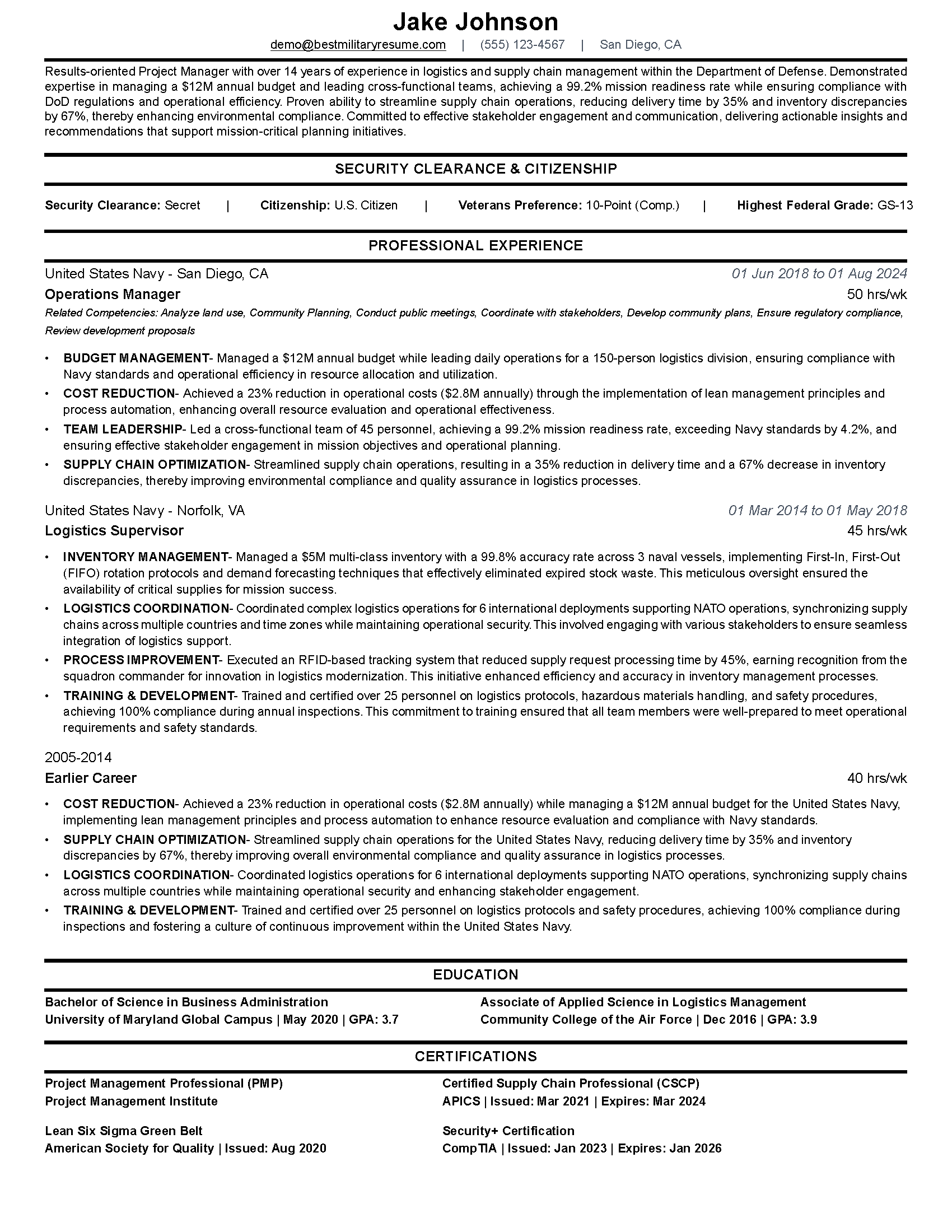
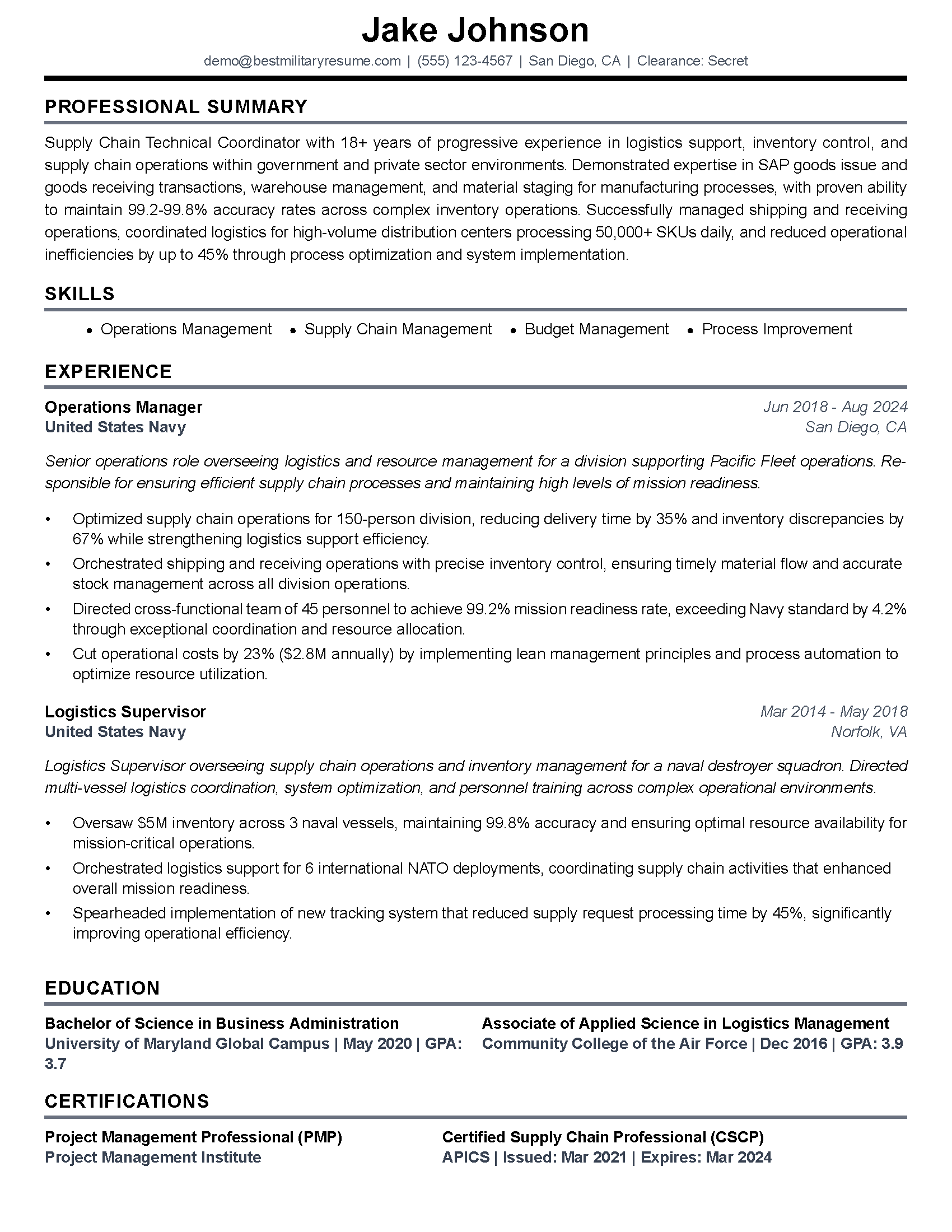
Which continuity task each part of your work proves
Now line up your own work with O*NET's tasks. Go in the order you did it: the plan, then the drill, then the report. O*NET lists this task: "Analyze impact on, and risk to, essential business functions or information systems to identify acceptable recovery time periods and resource requirements." That's the job of sorting what must keep running and what each part needs.
O*NET also lists "Write reports to summarize testing activities, including descriptions of goals, planning, scheduling, execution, results, analysis, conclusions, and recommendations." An after action review you wrote fits that task almost line for line. O*NET's tasks include "Create scenarios to reestablish operations from various types of business disruptions." and "Create or administer training and awareness presentations or materials." Drill scenarios and the classes you taught on the plan go here.
Three more O*NET tasks often match COOP work:
| If you did this | O*NET task it matches |
|---|---|
| Checked an old COOP plan before an inspection | Review existing disaster recovery, crisis management, or business continuity plans. |
| Tied your plan into the higher headquarters plan | Conduct or oversee contingency plan integration and operation. |
| Planned how to keep a server room or comms site running | Develop disaster recovery plans for physical locations with critical assets, such as data centers. |
Did you do this work on Guard or Reserve drill weekends? It still counts. List it under the unit where you did it, the same as any other job.
Write the bullet the way BMR builds it
BMR's bullet method starts from what you actually did. It doesn't claim a duty you didn't do, and it doesn't make up a number.
- Pick one real piece of work: one plan, one drill or one recovery you took part in.
- Name the challenge: say what was at risk or broken before you stepped in.
- Lead with a strong verb: Led, Wrote, Tested or Rebuilt. Then say the action plainly.
- End on the result: say what changed because of you. The win counts for more than the duty.
- Use the job's words where they fit: say business impact analysis only if your work was one.
- Keep only real numbers: if you counted sites, people or hours, use them. If not, leave numbers out.
That's the Challenge, Action, Result pattern. It keeps each bullet about your work, not the title you want.
Take one raw line: "Responsible for unit COOP plan." It names a duty and stops. Run it through the steps and it reads like this:
Example bullet: Wrote the unit's first continuity plan after a power loss stalled operations, then tested it in a drill so leaders knew who moved where.
Is your best proof in an evaluation? The guide to turning evaluations into resume bullets shows how to pull it out.
Six continuity lines to make your own
Each one is an illustration. Swap in your own plan, drill and result, and add only numbers you can back up.
- Example bullet: Led a business impact analysis of the unit's critical functions, so leaders knew which tasks had to restart first after an outage.
- Example bullet: Planned, ran and debriefed a yearly drill that moved key staff to a backup site to test the plan.
- Example bullet: Built and tested the unit's call tree, so leaders could reach each key person fast when the power or network went down.
- Example bullet: Wrote the after action report for the drill and tracked each fix until it was done before the next one.
- Example bullet: Taught short classes on the plan, so each section knew its job before the drill started.
- Example bullet: Ran the recovery after a building lost power, moving key work to a backup site until things were back to normal.
Your COOP summary and the degree question
Your summary sits at the top, and it's the first thing a reader sees. Make it show a result, not a list of duties. Keep it to the work you can prove.
Example summary: Continuity planner who closed each fix a COOP drill review found, so the plan held next time.
For skills, borrow O*NET's terms where your work matches them:
- Business impact analysis
- Risk assessment
- Business continuity and disaster recovery planning
- Mock-disaster exercises and debriefs
- Call tree testing
- Training and awareness materials
Not sure where the military job goes? Read how to list military experience on a resume.
Next, check the degree line. O*NET puts the role in "Job Zone Four: Considerable Preparation Needed" and says "Most of these occupations require a four-year bachelor's degree, but some do not." O*NET's education survey shows "48%" of respondents said "Bachelor’s degree required" for a new hire. That's one survey answer, not a hiring rule. If you have no degree, list your training and let the work carry the page.
Under certification bodies, O*NET names "Disaster Recovery Institute International" and the "Business Continuity Institute". O*NET lists two more bodies too, and it names no credential. It does not say you need one. So check each posting you want.
Aim the page at a real continuity posting
Look up each continuity title from the list above on a job board. Find one posting you would really take. Then open BMR's Resume Builder and tailor your COOP bullets to that posting's words. It won't add work you never did.
Sources: O*NET OnLine's Business Continuity Planners page (updated 2026) and FEMA's Federal Continuity Directive (August 2024). We checked them in November 2026.
Frequently Asked Questions
What job titles should I search besides business continuity manager?
Do I need a certification to get hired?
Does COOP work from Guard or Reserve drills count?
Can I put the federal directive's 12-hour and 30-day marks in my bullets?
About the author
Brad Tachi is the CEO and founder of Best Military Resume and a 2025 Military Friendly Vetrepreneur of the Year award recipient for overseas excellence. A former U.S. Navy Diver with over 20 years of combined military, private sector, and federal government experience, Brad brings unparalleled expertise to help veterans and military service members successfully transition to rewarding civilian careers. Having personally navigated the military-to-civilian transition, Brad deeply understands the challenges veterans face and specializes in translating military experience into compelling resumes that capture the attention of civilian employers. Through Best Military Resume, Brad has helped thousands of service members land their dream jobs by providing expert resume writing, career coaching, and job search strategies tailored specifically for the veteran community.