ERB to Resume: Mine Your Army Record Brief for Bullets
Desiree landed a $135K hybrid senior financial consultant role.
Desiree, E-5, Army National Guard, the interviewer loved the resume from the top down
You sit down to write your resume and the page stays blank. Ten years in the Army, and you can't remember the name of your second unit. Or the year you went to ALC. Or which award came from which deployment.
The good news is the Army already wrote most of it down for you. Your record brief lists where you served, what schools you finished, and what awards you earned. Some soldiers still call it the ERB or ORB. In IPPS-A it's the Soldier Talent Profile. Either way, it's the closest thing you have to a full inventory of your career.
I'm a Navy guy, so I never had an ERB. But the problem is the same in every branch. People write their resume from memory, and memory drops things. This guide shows you how to pull the facts off your record brief and onto one inventory sheet. That sheet is how you go from ERB to resume. It feeds every resume you build after it.
One note on scope. Your record brief tells you WHAT you did and WHERE. Your evaluations tell you HOW WELL. Turning those into resume bullets is its own job. We cover it in how to convert your NCOER, OER, or FITREP into resume bullets. This post is the step before that. Get the inventory first.
What is your Army record brief called now?
It depends on when you served and which system your unit used. For years, enlisted soldiers had the Enlisted Record Brief (ERB) and officers had the Officer Record Brief (ORB). A Guard article on verifying your ERB calls it a snapshot of a soldier's career. It lists military and civilian education, awards, PT scores, and weapons qualifications.
Today the Army runs personnel and pay through IPPS-A, the Integrated Personnel and Pay System-Army. It covers all three components: Regular Army, Guard, and Reserve. Along the way, the Army folded both briefs into one Soldier Record Brief (SRB). Inside IPPS-A, the Soldier Talent Profile, or STP, replaced the SRB.
The IPPS-A talent management page says the STP holds "hundreds of data elements" on each soldier. Those cover knowledge, skills, behaviors, experiences, and readiness. The page also says IPPS-A manages a soldier's career "from Accession through Transition." That last word matters. Your record covers your whole career, right up to the day you get out. So pull it before you go.
You may hear any of these names, and some Army job postings still use more than one. For resume work, it doesn't matter which one you have. They hold the same kind of facts, and you'll use them the same way.
The brief is a list, not a story.
Your record brief gives you names, dates, codes, and places. It won't tell you what you did on a Tuesday. You add that part from your own memory and your evaluations.
How do you get a copy of your record brief?
The path depends on one thing. Are you still in, or already out?
If you're still serving, including Guard and Reserve
Log in to IPPS-A and open the My Soldier Talent Profile tile. The IPPS-A self-service guide calls the STP "a snapshot of Member data" for each soldier. It also says accuracy "is the Member's responsibility." So if something is wrong, fix it now through your S1 or unit HR.
A wrong date on your brief can turn into a wrong date on your resume.
While you're logged in, pull your supporting documents from iPERMS too. That's where documents like award orders, course certificates, and evaluations usually live. The IPPS-A record review job aid says to check iPERMS too. That's how you confirm the documents behind each entry exist. Those documents give you the details the brief leaves out.
Do this before you turn in your CAC. After you separate, you may lose easy access to Army systems. Save PDFs to a personal drive, not a work one.
If you've already separated
You have four solid options, and all of them run through official channels.
- milConnect: VA says Army veterans discharged after October 1, 2002, can request records through milConnect. You need an account to sign in.
- eVetRecs: The National Archives runs an online request tool for your military service records. You verify your identity through ID.me to use it.
- Standard Form 180: This is the paper route. You mail or fax it to the address listed on the form for your branch and dates.
- Unit HR: Still in the Guard or Reserve? Your unit HR can often help.
The VA's page on getting your military records walks through each path. Basic records are generally free for veterans. The National Archives says that holds when discharge was under 62 years ago.
What you get back may not look like the brief you remember. You'll likely get the source documents instead. The National Archives says military personnel records can hold duty stations and assignments, training, qualifications, performance, and awards. That's everything you need for the inventory, just spread across more pages.
Should you attach your ERB or STP to a job application?
No. Your record brief is an internal Army document. It was built for promotion boards, assignments, and your chain of command. A civilian hiring team doesn't need it, and it carries details you shouldn't be handing out.
Look at the IPPS-A profile behind your STP. It shows your date of birth, your DoD ID number, and where you were born. Your brief may also show other personal details. The Guard article above ran a photo of an ERB. Parts were "blurred and cropped to protect Personally Identifiable Information" in that photo. If the Army blurs it for a news story, you shouldn't email it to a recruiter.
Keep the brief on your desk, not in your application.
Use your record brief as a source for your resume. Don't upload it as an attachment unless the posting asks for it. Some AGR and Guard technician postings do. If a posting wants proof of service, read it closely. It will usually name the document it wants.
There's one exception worth knowing. Some Army and Guard job postings, like AGR or technician jobs, may ask for your ERB or STP. That's an Army hiring process asking for an Army document. Follow the posting. For private-sector jobs and most federal jobs, the resume is what they read.
How do you turn your record brief into a resume inventory?
Open a blank document or a spreadsheet. Call it your inventory sheet. You won't send this to anyone. It's your private list of every fact you might ever need.
Now go through your brief one section at a time. Copy each fact into one of these buckets.
1 Assignments and duty titles.
2 MOS and skill identifiers.
3 Schools and courses.
4 Awards and deployments.
5 Civilian education and languages.
6 Clearance and special status.
Don't judge anything yet. Don't ask whether a fact "belongs" on a resume. That call comes later, once you have a real job posting in front of you. Right now you're just getting the facts out of the Army's system and into yours.
It often goes faster than you'd think, because the brief already sorts most of it for you.
What do you pull from your assignments and skill identifiers?
Your assignment history is the spine of your resume. Each line on the brief usually gives you a unit, a location, a duty title, and dates. Each one can turn into a job entry on your resume.
On your inventory sheet, give every assignment its own block. Under it, leave space for three things your brief won't give you. How many people did you lead or support? How much equipment or money were you responsible for? What changed because you were there?
Here's what one block might look like for a sample soldier, Jane Sample. She's a 92Y, and the numbers in brackets are placeholders for her to fill in.
Example: 92Y, Unit Supply Specialist. HHC, Fort Example. 2019 to 2022.
Example: Supply Specialist, U.S. Army. Fort Example. June 2019 to May 2022. Supported [X] soldiers. Tracked [X] items worth $[X]. Ran [X] inventories with [X] losses.
See the difference? The first block is what the Army needed to know. The second is what an employer needs to know. The brief gave Jane the frame. She fills in the scope from her own memory, her hand receipts, and her evaluations.
If you want to see how MOS work maps to civilian jobs, start with your own code. BMR has career pages for many Army jobs. Try 92Y Unit Supply Specialist or 68W Combat Medic Specialist. There's also 25B Information Technology Specialist. Each page shows civilian job titles that match the work.
Don't skip your ASIs and SQIs
Additional skill identifiers and special qualification identifiers are the codes stacked on top of your MOS. They often mark a course or a skill you earned beyond your basic job. On a resume, the code itself means little to a civilian reader. What the code proves is the useful part.
So on your sheet, write the code, then the plain-English skill next to it. Can't remember what an identifier covers? Ask your S1 or check the course paperwork. Don't guess. A wrong claim on a resume is worse than a missing one.
Also check your brief for duty titles you held on top of your main job. Unit armorer, safety rep, or training NCO may not show up as a clean line. If you held those roles, list them anyway. Our guide to putting collateral duties on your resume shows how to write them up.
How do you handle schools, awards, and deployments?
These three sections of your brief are where people often list too much or too little. The inventory sheet fixes both problems. You copy everything now, and you choose later.
Schools and courses
Your brief may list leader courses like BLC, ALC, and SLC, plus any functional schools you finished. Write each one out in full. "ALC" means nothing on a page with no context. "Advanced Leader Course, [X] weeks, leadership and training management" gives the reader something to work with.
Then cross-check two other documents. Your Joint Services Transcript shows college credit recommendations for many courses. Our JST resume guide covers how to read it. Your VMET, the DD Form 2586, adds training and experience details too. See our VMET to resume guide for that one. For where courses go on the page, read how to list military education on a civilian resume.
Awards
Your brief lists your awards, but it often won't say why you got them. That's the part employers care about. Pull the award orders or citations from your records. Each citation often names a specific result, and that result can turn into a resume bullet.
On your sheet, write each award, the date, the unit, and one line about what earned it. Next, read our guide on listing military awards on a civilian resume before you pick which to use.
Deployments
Your brief may show where you went and when. It won't show what you did there. The National Archives makes the same point about service records. They hold administrative facts, not the story of your work.
So on your sheet, write the country, the months, and your role on that deployment. Then add what you ran or supported. Keep it at a level you'd say in public. Our guide on how to list deployments on a resume shows formats that work.
Your record brief tells them where you were. Your resume has to tell them what you did there.
Brad Tachi, Navy Veteran and BMR Founder.
What about civilian education, languages, and your clearance?
These are short sections on most briefs, but they can carry a lot of weight on a resume. They're also easy to get wrong if you copy them blind.
- Civilian education: Your brief may show a degree level or credit hours. Check it against your actual transcripts. The brief is only as current as the last update someone made.
- Languages: Does your brief show a language or test scores? Write the language and your level in plain terms. Some jobs ask for it outright.
- Security clearance: If a clearance shows on your brief, don't just copy it. Confirm the level and status first, then phrase it carefully. Our guide to security clearance phrasing on a resume covers what you can say.
- Civilian jobs and skills: IPPS-A lets you add civilian jobs and self-reported skills to your profile. If you entered any, pull them too.
From the hiring side of the desk, a line that doesn't match the record costs you trust fast. Check these few lines twice.
What goes on the resume and what stays on the sheet?
Now you have a full inventory. Most of it won't go on any one resume. That's fine, and it's the point.
Think of it in two layers. The first layer is a master resume. It holds every fact from your sheet, written out in civilian words, and you never trim it. Old assignments stay. Off-target jobs stay. Something from twelve years ago might be exactly what a posting asks for next year.
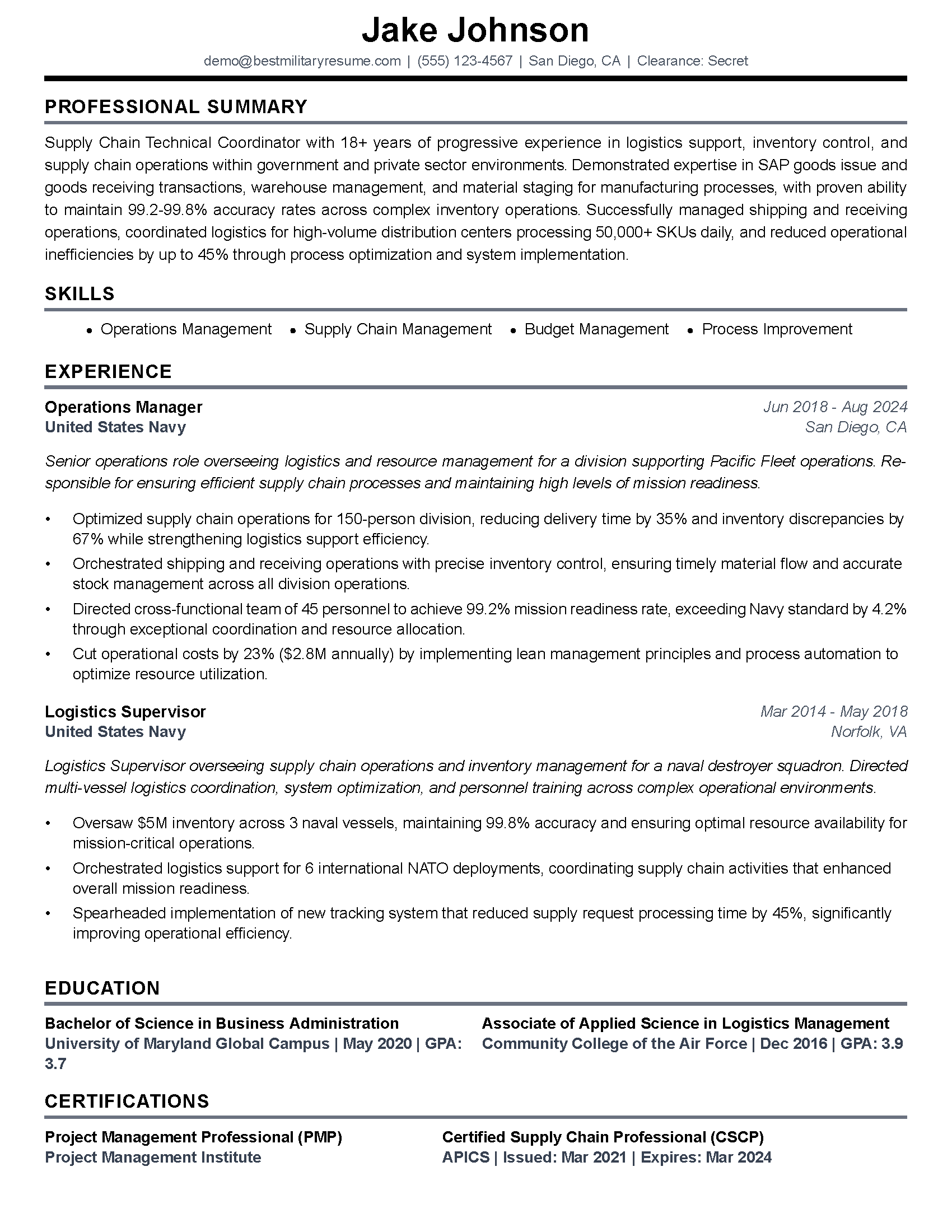
The second layer is the version you send. You cut that one from the master for each job posting. It uses the posting's own words for work you actually did, and it brings the scope with it. How many people, how much gear, how much money. The rank comes off, and the size of what you ran tells them your level.
Say Jane applies for a warehouse supervisor job. Here's how a few lines from her sheet might show up. These are sample bullets, and the brackets are her numbers to fill in.
- Example: Managed supply operations for a [X]-person organization, tracking [X] items worth $[X].
- Example: Led [X] full inventories with [X] unresolved losses, and trained [X] new hand receipt holders.
- Example: Completed a [X]-week Army leadership course in team training and risk planning.
Every line traces back to the sheet. The assignment came from the brief. The course came from the brief. The numbers came from Jane's own records. If you want more full examples by job, see our Army resume examples by MOS.
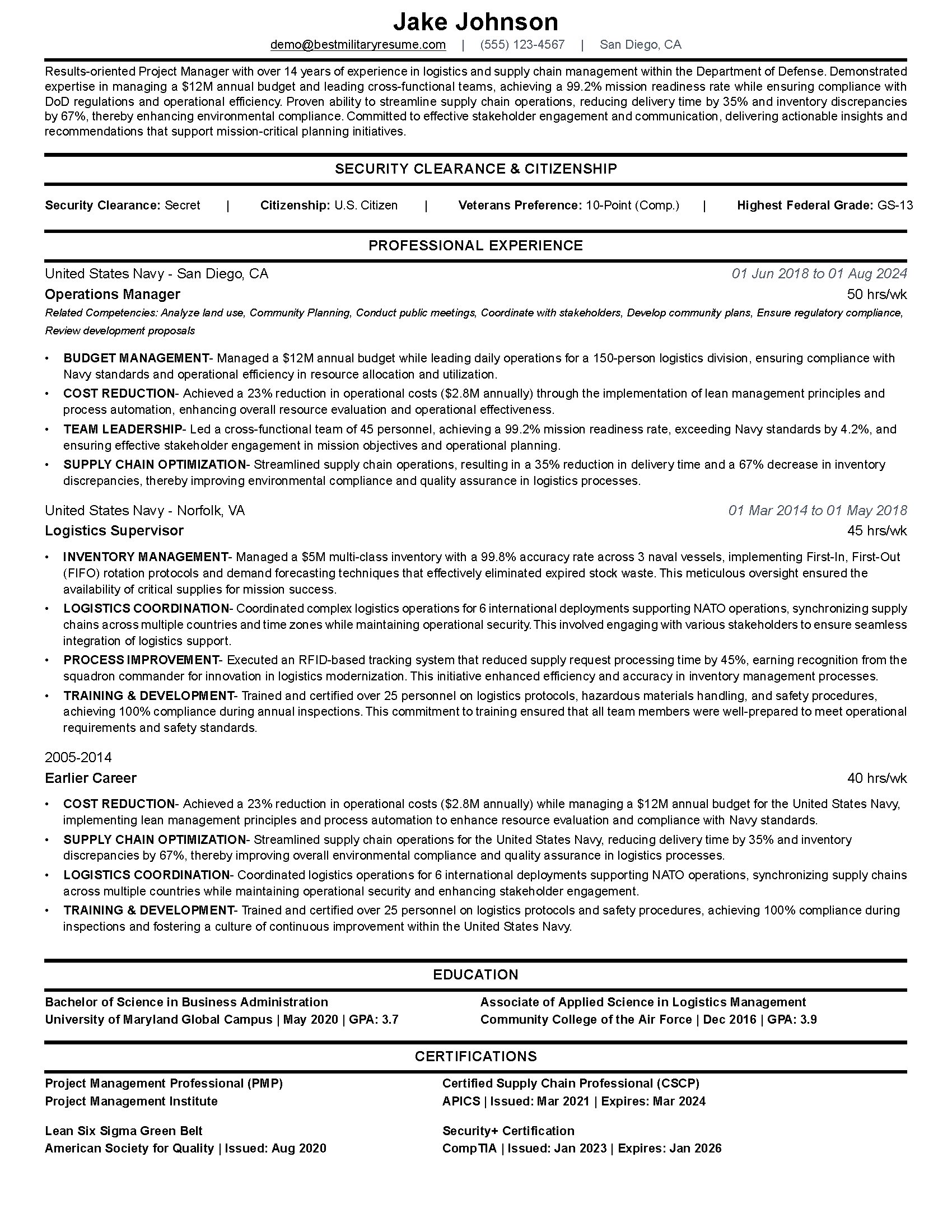
For federal jobs, the same inventory works, but the rules for the page change. Federal resumes need month and year on every job, plus hours per week. For most federal jobs, the resume is two pages. Always check the announcement, because some of them are exceptions. For the full service section layout, read our guide to listing military service on a resume.
What to Do Next
Here's your next hour, step by step.
- Pull your record brief from IPPS-A if you're still in. If you're out, request your records through eVetRecs. Or use milConnect if you left the Army after October 1, 2002.
- Download your award orders, course certificates, and evaluations while you have access.
- Build your inventory sheet with the six buckets above. Copy every fact, and judge nothing yet.
- Fill in the scope for each assignment from your own records and memory.
- Use the NCOER guide linked at the top to add the "how well" part from your evaluations.
Then move the whole sheet into a master resume. That's the step Best Military Resume's resume builder is built for. You put your full history in one base resume, written in civilian terms. When you find a job you want, paste in the posting. BMR copies your base and rewrites your summary, work bullets, and skills in the posting's own words. It doesn't add work you never did, and your base stays untouched.
The free account gives you one federal and one private tailored resume, so you can test both lanes. Your record brief already did the hard part of remembering. Now put it to work.
Frequently Asked Questions
What is the difference between an ERB and an STP?
How do I get my ERB or STP after I leave the Army?
Should I attach my ERB to a job application?
Is my ERB the same as my DD-214?
What parts of my record brief go on a resume?
Can my record brief replace my evaluations for resume bullets?
How do Guard and Reserve soldiers get their STP?
About the Author
Brad Tachi is the CEO and founder of Best Military Resume and a 2025 Military Friendly Vetrepreneur of the Year award recipient for overseas excellence. A former U.S. Navy Diver with over 20 years of combined military, private sector, and federal government experience, Brad brings unparalleled expertise to help veterans and military service members successfully transition to rewarding civilian careers. Having personally navigated the military-to-civilian transition, Brad deeply understands the challenges veterans face and specializes in translating military experience into compelling resumes that capture the attention of civilian employers. Through Best Military Resume, Brad has helped thousands of service members land their dream jobs by providing expert resume writing, career coaching, and job search strategies tailored specifically for the veteran community.
