North Carolina Veterans Preference: What Changed October 1, 2026
"Still getting interviews left and right. Now I have to say no."
Taranjeet, E-5, Army, optimized her LinkedIn and resume with BMR
North Carolina's veterans preference for state jobs changed October 1, 2026, and now covers active-duty spouses. Veterans and Guard members can get 10 points on scored exams, service credit, and a final-pick edge. Spouses get the 10 points.
The new rules come from Session Law 2026-40. It repealed the old Chapter 126 and wrote Chapter 126A. Many pages that rank for this today still quote the old law. Here you get the old and new rules side by side, a credit example and an application checklist.
What changed on October 1, 2026?
The General Assembly ratified Senate Bill 1041 on July 2, 2026, and the governor signed it. It took effect October 1. The session law numbered the veterans section G.S. 126A-57.3. The General Statutes now number it G.S. 126A-5-14. You may see both numbers. They point to the same preference.
| Point. | Old law, through Sept. 30, 2026. | New law, from Oct. 1, 2026. |
|---|---|---|
| Where it lives. | G.S. 126-80 to 126-83. | G.S. 126A-5-14, numbered 126A-57.3 in the session law. |
| Active-duty spouse. | Not listed. | Listed as an eligible person. |
| Veteran test. | "A veteran who served during a period of war," or one with a peacetime service-connected disability. | "A veteran." No period-of-war list in the section. |
| Guard survivors. | Only if the member died on state duty or for service reasons. | Any surviving spouse or dependent of an NC Guard member. |
| Points and credit. | 10 points and the four-year cap in rule 25 NCAC 01H .1104. Credit required by old G.S. 126-82(b). | Left to the state HR policy dated Oct. 1, 2026. |
You can read the old wording on the G.S. 126-81 page. One point is not settled for us. The new section drops the war-period list, and so does the policy. If you served only in peacetime and were turned down before, ask the agency's HR office.
Are you an eligible person under the new law?
The new section names five groups. This is the list, word for word from G.S. 126A-5-14(b)(2):
- a: "A veteran."
- b: "The spouse of a disabled veteran."
- c: "The surviving spouse or dependent of a deceased veteran."
- d: "An eligible member of the National Guard."
- e: "The spouse of a service member who is serving in the Armed Forces of the United States on active duty."
A veteran is someone who served on active duty "for reasons other than training." The discharge must be "under other than dishonorable conditions." So time spent only in training doesn't make you a veteran under this law.
The Guard rule is narrow. You must be a North Carolina resident in the NC Army or Air National Guard, in good standing. A former member needs an honorable discharge and at least six years of creditable service. Guard members from other states aren't named. Reserve members aren't named either, so a Reservist with no active duty should ask HR before claiming it.
The preference covers state jobs under the State Human Resources Act. Certain jobs exempt from that act fall under a different law, G.S. 128-15. The current text of G.S. 128-15 still uses the war-period test. It now names NC Guard members too. For a county or city job, check that employer's own posting and HR office.
Where do the 10 points go?
The points only go on a numerically scored exam. The state's Veteran's and National Guard Preference Policy says the agency "must give 10 preference points to the eligible person." It adds that spouses and dependents get the 10 points too.
If the posting has no scored test, the points never come into play. When a test is only one part of the score, the points go on that part alone.
The policy gives its own example. Say a scored exam counts for 25%, an in-basket exercise 25%, and a structured interview 50%. The 10 points apply "only to the portion of the applicant's score that was based on a numerically scored examination, not to the final ranking." Don't count on 10 points lifting your whole score.
How much service credit do you get with no scored exam?
This credit matters on any job without a scored test. Say the agency judges you by interview or another unscored method. You can then get up to four years of credit for unrelated military service. Spouses and dependents don't get this credit. It's for the veteran or Guard member only.
The math has two steps. First, the agency counts your related service beyond the minimum. Then it gives unrelated service credit to fill the gap up to four years. If your extra related service is four years or more, you get no unrelated credit.
Here is a real state job with a made-up veteran. The Warehouse Supervisor class spec (06/2018) asks for a high school diploma or GED. It also asks for "three years of supervisory experience in warehouse or storage operations."
Say our made-up Army veteran spent five years as a supply sergeant running a warehouse. Before that, she spent three years as an Army truck driver. Her supervisory warehouse time is related. Her driving time is unrelated.
- Meet the minimum: Three of her five warehouse years cover the minimum.
- Count related time beyond it: That leaves two extra years.
- Find the gap: Four years minus two leaves room for two years of credit.
- Add unrelated credit: She gets two of her three driving years as credit.
Then the agency compares her to other applicants on total experience, credit included. If she'd had only one year of driving, she'd get one year. The credit can't go past the service you actually have.
What does "substantially equal" mean at the final pick?
This is the rule that can decide the hire. The policy compares an eligible veteran or Guard member to the most qualified pool. That person "must be hired when overall qualifications are substantially equal." Then it defines the term:
"Substantially equal qualifications occur when the employing agency cannot make a reasonable determination that the qualifications held by one or more applicants are significantly better suited for the position than the qualifications held by another applicant."
Read it plainly. You don't have to beat everyone. If the agency can't show another finalist is clearly better suited, you get the job. That bar is wider than a dead-even tie. Missouri, for one, gives preference only when all other job factors are equal. Florida must interview preference-eligible applicants who meet the minimum qualifications on jobs with no scored exam. Texas has its own interview rule.
Three limits apply. First, this final rule is only for applicants from outside state government. A current state employee gets the credit but "no further preferences" at the pick. Second, some state employees outrank you when they're equal to you. The policy lists four:
- Promotion: A qualified career-status employee going for a promotion.
- Exempt jobs: An employee who left an exempt policy-making or managerial job for reasons other than just cause.
- Layoffs: A career-status employee notified of or separated by a reduction in force.
- Injury leave: An employee coming back from workers' compensation leave.
Third, the final-pick section names veterans and Guard members. It doesn't name spouses. The policy gives spouses the 10 points, but it's not clear they get the final-pick rule. A spouse should ask HR how the agency applies it.
Which papers do you send, and when?
Send proof during the application process. The policy says the agency "must receive and review the appropriate documentation prior to extending an offer." Waiting for an offer to send it is too late.
- Veterans: Your DD Form 214, Certificate of Release or Discharge from Active Duty.
- Current NC Guard members: A copy of your NGB 23A (RPAS).
- Former NC Guard members: Your DD 256 or NGB 22, showing honorable discharge and six years.
- Spouses and dependents: The policy says "all eligible persons must submit a DD Form 214." An active-duty member has no DD-214 yet, so ask HR what it takes as proof.
State job openings start from the state's Work NC job page. If the agency skipped your preference, the policy points you to its formal internal grievance process. The new law sends that appeal through G.S. 126A-8-4 and 126A-8-5.
Checked against Session Law 2026-40 and the state HR office's October 1, 2026 policy in November 2026.
How do you make your application read as at least equal?
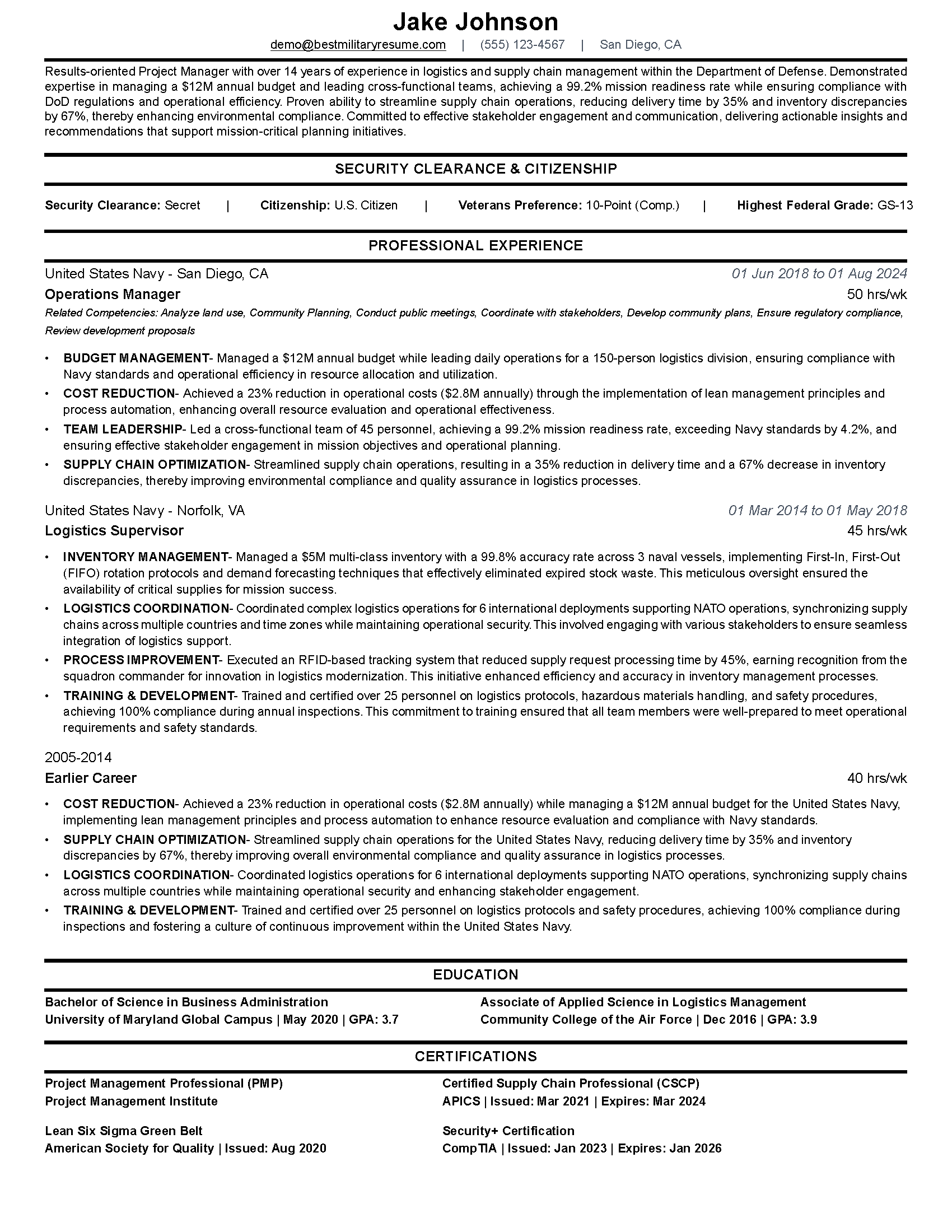
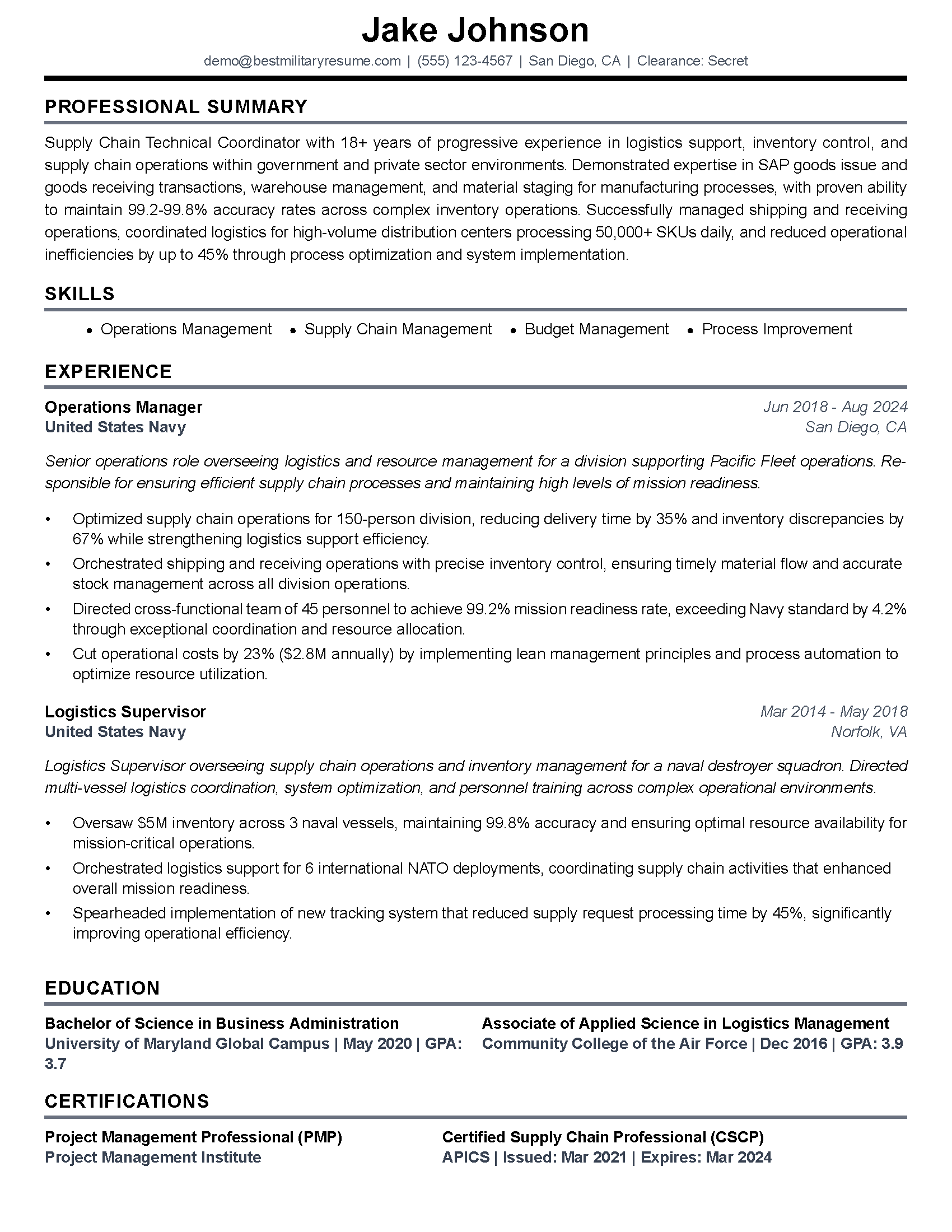
Every piece above starts after you meet the minimum. The credit and the final rule can't help an application that hides your experience. Your job is to put each qualification on the page so nobody has to guess.
- Use the posting's words: If it says "warehouse or storage operations," write "warehouse operations." Don't write "supply room" when the posting says warehouse.
- Answer every line: Cover each required and preferred qualification, in the order the posting lists them.
- Give dates by month: The policy credits military training and experience "year-for-year and month-for-month." Show start and end months for each job.
- List your training: Put military schools with their hours. They count toward the minimum when they relate to the job.
- Bring the scope: Write how many people you led, how much gear you tracked, and its dollar value.
- Split related from unrelated: Give each job its own entry. Don't merge your warehouse years and your driving years into one block.
Take the Warehouse Supervisor spec again. It asks for the "ability to maintain accurate inventory control records and reports." A strong line answers it in the same words. For example: "Kept inventory control records for [number] line items worth $[value], with [result] on [number] audits." Fill the brackets with your own real numbers. Do this for each line in the spec, not just the first one.
Federal preference runs on a different system of 5 or 10 points. If you apply to both, read how federal veterans preference points work. Spouses moving with the service also have a separate federal program, Military Spouse Preference.
What to Do Next
Pick one North Carolina posting you'd take. Copy every required and preferred qualification into a list. That list is your build sheet.
Robert, an Army Specialist, wrote in after using BMR.
"The tool was helping me get in the door, I was consistently getting invites to interview and all that starts with the resume so thank you so much!"
Sign in to the military resume builder and paste your Work NC posting. Give your related and unrelated service their own entries, with start and end months, so the agency can count your credit.
Frequently Asked Questions
Does North Carolina veterans preference help in a layoff?
Is there a deadline after discharge to use NC veterans preference?
Can a spouse use NC veterans preference if the veteran already used it?
Do I have to send my DD-214 with every NC state application?
About the author
Brad Tachi is the CEO and founder of Best Military Resume and a 2025 Military Friendly Vetrepreneur of the Year award recipient for overseas excellence. A former U.S. Navy Diver with over 20 years of combined military, private sector, and federal government experience, Brad brings unparalleled expertise to help veterans and military service members successfully transition to rewarding civilian careers. Having personally navigated the military-to-civilian transition, Brad deeply understands the challenges veterans face and specializes in translating military experience into compelling resumes that capture the attention of civilian employers. Through Best Military Resume, Brad has helped thousands of service members land their dream jobs by providing expert resume writing, career coaching, and job search strategies tailored specifically for the veteran community.
