Home / Military to civilian jobs / Coast Guard / ET

Coast GuardRating ET

Electronics Technician

That is Coast Guard Rating ET. Civilian jobs, federal paths, and how the work reads on a resume.

What is in this guide

Salary range
$48K to $145K
Career paths
14
Federal GS series
10
Companies hiring
12
Resume examples
8
Certification paths
7
Questions answered
10

What the translation looks like

How it reads in service

Maintained all C5ISR systems aboard WMSL-750 including SPS-73 radar, HF/VHF/UHF communications, DGPS, AIS, and satellite communications supporting a crew of 170

How a hiring manager reads it

Managed enterprise communications and sensor infrastructure for a 170-person organization, maintaining network uptime across 12 integrated systems including radar, satellite links, voice/data networks, and GPS navigation with 99.2% system availability


Roles this background maps to

  • Electrical/Electronics Repairer (Commercial/Industrial)$66,820
  • Telecommunications Equipment Installer/Repairer$61,070
  • Network and Computer Systems Administrator$96,800

Median pay, BLS OEWS May 2024

Build a resume for a real job

You pick the job. We write it from your ET experience. Free to start.

Brad TachiNavy Diver · BMR founder

After the Navy he was hired into six federal career fields and tech sales, and sat on federal hiring panels along the way. The last two years went into rebuilding all of it into BMR, tuned for how resumes get screened today. 71,892 resumes built so far.

Get a free ET Electronics Technician sample resume

One page, built in our template, with the military experience translated into the civilian terms hiring managers and screening software read. Use it as a reference for your own. Leave an email and the download link comes to you.

Free. Occasional job-search tips come with it. Unsubscribe anytime.

What the job actually is

Coast Guard Electronics Technicians (ET) install, maintain, troubleshoot, and repair the electronic systems that keep the Coast Guard operational — C5ISR (Command, Control, Communications, Computers, Cyber, Intelligence, Surveillance, and Reconnaissance), radar, navigation systems, radio communications, and satellite equipment. ETs work on everything from HF/VHF/UHF radio systems to SPS-73 surface search radar to GPS and AIS navigation suites aboard cutters, at shore-based communication stations, and at LORAN/DGPS transmitting facilities.

The ET rating requires a strong foundation in electronics theory, digital and analog circuits, microwave systems, fiber optics, and computer networking. ETs attend 'A' School at Training Center Petaluma, CA, followed by specialized equipment courses (C-schools) for specific systems. Many ETs earn qualifications in TEMPEST (emissions security), cybersecurity, and classified communications systems. Some ETs specialize in aids to navigation (ATON) electronics, maintaining the electronic systems on buoys, lighthouses, and range markers across the nation's waterways.

What makes CG ETs particularly marketable is the breadth of their experience. Unlike military ETs who may specialize in a single system for an entire tour, Coast Guard ETs on small cutters maintain everything — radar, communications, navigation, and IT networks — because there is no one else to call. That independent troubleshooting capability across multiple systems is exactly what employers in telecommunications, defense contracting, and critical infrastructure value.

CG ETs sit at one of the more underrated tech crossover points in the Coast Guard — the depth of electronics troubleshooting plus shipboard systems experience translates to federal electronics technician, FAA technical roles, and DoD contractor positions consistently. From the federal hiring side, the cleared-electronics combination is in steady demand. — Brad Tachi, Navy Diver veteran & BMR founder

Security clearance
Secret (minimum); TS/SCI for some billets
ASVAB requirement
MK+GS+2EI=222 (minimum)
Training
ET 'A' School at Training Center Petaluma, CA (~26 weeks). Covers electronics theory, digital/analog circuits, communications systems, radar, and computer networking. Follow-on C-schools for specific equipment (SPS-73 radar, HF/UHF systems, satellite communications). Advanced ETs may attend TEMPEST or cybersecurity courses.
Certs earned in service
CompTIA Security+ (some billets), TEMPEST certification (some billets), FCC licenses (some billets), First Aid/CPR/AED, HAZMAT awareness

Pay reality check

The number that decides most of this: how does civilian pay compare to what the paycheck looks like now?

Coast Guard mid-career

$58K to $82K

E-5 to E-7 total comp: base plus BAH, BAS and the tax advantage.

Civilian Electronics Technician

$56K to $125K

BLS median across the direct-match civilian roles on this page.

Federal, GS-9 to GS-13

$58K to $120K

10 matching GS series, plus locality pay and step increases.

About 9% higher on average

Civilian roles for Electronics Technicians pay about $6K more than mid-career enlisted total comp.

Military comp is approximate and moves with location and dependents. Civilian is the BLS median. Federal includes locality pay. The real number depends on duty station, family status, GS step and overtime.

Private sector career paths

The private sector demand for electronics technicians remains strong, driven by expanding telecommunications infrastructure, cybersecurity concerns, and the growing complexity of electronic systems across industries. According to the Bureau of Labor Statistics (May 2024), electrical and electronics repairers (commercial and industrial equipment) earn a median annual wage of $66,820 (O*NET 49-2094.00), while telecommunications equipment installers and repairers earn a median of $61,070 (O*NET 49-2022.00).

For ETs who pivot toward network administration or cybersecurity, the salary trajectory improves significantly. BLS reports network and computer systems administrators at a median of $96,800 (O*NET 15-1244.00) and information security analysts at a median of $124,910 (O*NET 15-1212.00). The cybersecurity path is particularly strong for ETs with TEMPEST, COMSEC, or classified network experience — and the field is growing at 33% according to BLS, far faster than average.

Defense contractors represent the most straightforward path for many CG ETs. Companies like L3Harris, Raytheon, and Northrop Grumman maintain the exact same systems ETs worked on in the Coast Guard, and an active security clearance is a hiring multiplier. ETs with C5ISR or radar maintenance experience are in particular demand.

Civilian job title translations

Civilian job titleIndustryBLS median salaryOutlookMatch
Electrical/Electronics Repairer (Commercial/Industrial)O*NET 49-2094.00Manufacturing / Utilities / Defense$66,820About as fast as average (2%)strong
Telecommunications Equipment Installer/RepairerO*NET 49-2022.00Telecommunications$61,070Little or no change (-1%)strong
Network and Computer Systems AdministratorO*NET 15-1244.00IT / Multiple Industries$96,800About as fast as average (3%)strong
Information Security AnalystO*NET 15-1212.00IT / Defense / Government$124,910Much faster than average (33%)strong
ElectricianO*NET 47-2111.00Construction / Maintenance$62,350About as fast as average (6%)moderate
Avionics TechnicianO*NET 49-2091.00Aviation / Aerospace$74,210Much faster than average (11%)moderate
Field Service EngineerO*NET 49-2094.00Defense / Technology$66,820About as fast as averagestrong
Broadcast and Sound Engineering TechnicianO*NET 27-4011.00Media / Broadcasting$55,650About as fast as average (2%)moderate

Companies that hire this background

L3Harris TechnologiesMilitary Fellowship Program

Major defense contractor producing communications, radar, and electronic warfare systems used by the Coast Guard. Direct hiring path for ETs who maintained Harris radio systems.

Raytheon Technologies (RTX)Military Veteran Careers

Produces radar, sensors, and C4ISR systems. ETs with radar maintenance experience (SPS-73, SPS-67) are strong candidates for field service and engineering support roles.

Northrop GrummanMilitary Hiring

Major defense electronics and cybersecurity contractor. Hires ETs for electronic systems maintenance, cybersecurity, and communications roles. Active SkillBridge participant.

General Dynamics IT (GDIT)

Provides IT and cybersecurity services to government agencies. Strong hiring for cleared technicians with network and COMSEC experience. One of the largest defense IT employers.

LeidosMilitary & Veterans

Defense and IT services contractor supporting DHS, DOD, and intelligence community. Hires ETs for field service, network engineering, and cybersecurity analyst positions.

Motorola Solutions

Builds and maintains public safety radio communications systems. ETs with land mobile radio experience are strong candidates for field service technician roles.

VerizonMilitary Talent Program

Major telecommunications carrier with active military hiring programs. Hires network technicians, field engineers, and cybersecurity professionals. SkillBridge participant.

AT&TMilitary & Veteran Careers

Major telecom carrier with veteran-focused hiring. Network operations, fiber installation, and wireless infrastructure roles. Participates in SkillBridge.

FAA (Federal Aviation Administration)Airway Transportation Systems Specialist

FAA maintains air traffic control radar, navigation aids, and communications systems nationwide. GS-2101 and GS-0856 positions. Radar maintenance experience from CG translates directly.

CISA (Cybersecurity & Infrastructure Security Agency)

DHS component focused on cybersecurity and critical infrastructure protection. Hires for GS-2210 (IT Management) and GS-0855 (Electronics Engineering). Direct Hire Authority for veterans.

Booz Allen HamiltonMilitary Hiring Program

Defense and intelligence consulting firm with major cybersecurity practice. Hires cleared technical professionals for government client support. Values CG ET background.

SAIC (Science Applications International Corp)

Defense IT and engineering services company. Supports Coast Guard, DHS, and DOD contracts. Hires ETs for field maintenance, network operations, and systems engineering roles.

See a salary you want? Build a resume aimed at it.

BMR rewrites your ET experience for any of the roles above, in the language the people reading actually scan for.

Free to start. 2 tailored resumes included.

Build My Resume Free

Already have a resume? Get it graded straight.

Upload it and get a number in about a minute, plus the ET lines a civilian hiring manager will not follow and what to write instead. No account.

Free. Your file is never stored.

Score my resume free

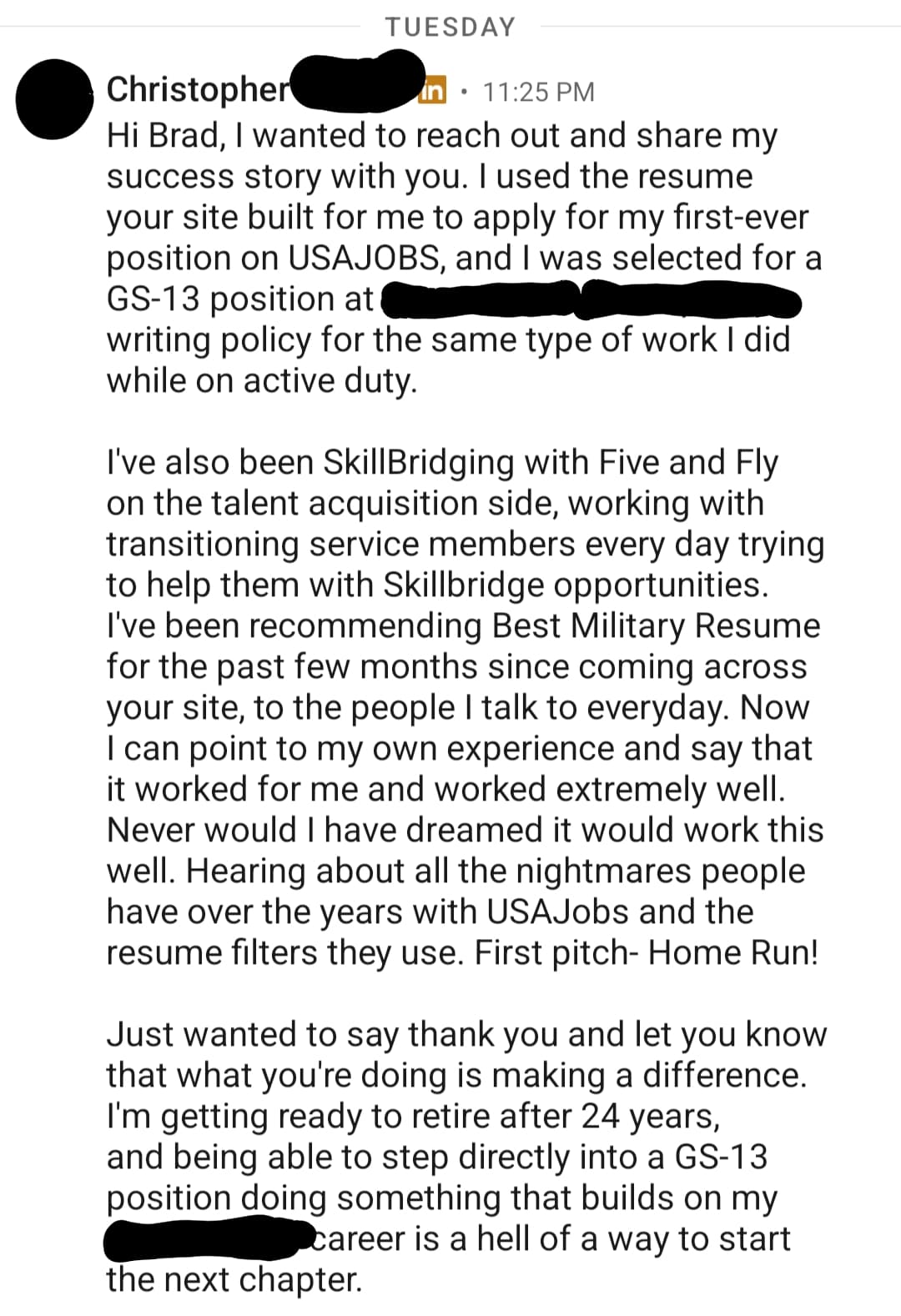
A Coast Guard story from the same road

Christopher, success story
I used the resume your site built for me to apply for my first-ever position on USAJOBS, and I was selected for a GS-13 position writing policy for the same type of work I did while on active duty. First pitch- Home Run!

Christopher · Chief Petty Officer (E-7) · Coast Guard · Federal Policy

Read the full story

Federal career paths

Federal agencies maintain massive electronic and communications infrastructure, and they need technicians who can keep it running. The GS-0856 (Electronics Technician) series is the most direct path — USCG shore installations, FAA, DHS, and DOD all hire GS-0856s. ETs with radar experience should look at FAA positions maintaining air traffic control radar and navigation aids, where the systems overlap significantly with Coast Guard equipment.

For ETs targeting IT careers, the GS-2210 (Information Technology Management) series is the broadest federal IT classification. This covers everything from help desk to network engineering to cybersecurity. ETs with network experience or cybersecurity qualifications (Security+ or higher) can enter at GS-9 or GS-11. DHS, NSA, and the intelligence community hire extensively into 2210 positions and value the clearance ETs already hold.

The GS-0855 (Electronics Engineering) series is available for ETs who pursue an engineering degree — some agencies accept extensive technical experience with appropriate education. GS-0391/0392 (Telecommunications) positions at agencies operating their own communications infrastructure (DOD, DHS, FAA, FEMA) are also strong matches. For the analytically minded ET, GS-1550 (Computer Science) and GS-1560 (Data Science) are growth fields where technical troubleshooting skills translate to data analysis and software roles.

Federal series and position matches

SeriesFederal job titleTypical gradesMatchExplore
GS-0856Electronics TechnicianGS-7, GS-9, GS-11, GS-125 of 5View details
GS-2210Information Technology ManagementGS-7, GS-9, GS-11, GS-125 of 5View details
GS-0855Electronics EngineeringGS-9, GS-11, GS-124 of 5View details
GS-0391TelecommunicationsGS-7, GS-9, GS-114 of 5View details
GS-0301Miscellaneous Administration and ProgramGS-7, GS-9, GS-113 of 5View details
GS-1550Computer ScienceGS-9, GS-11, GS-123 of 5View details
GS-0850Electrical EngineeringGS-9, GS-11, GS-123 of 5View details
GS-0340Program ManagementGS-11, GS-12, GS-133 of 5View details
GS-0392General TelecommunicationsGS-7, GS-9, GS-113 of 5View details
GS-0802Engineering TechnicianGS-7, GS-9, GS-113 of 5View details

Federal resumes follow different rules. We know them.

Federal raters match your record against the announcement's specialized experience statement. BMR writes the federal format for any GS series above, with the hours per week and supervisor detail a rater looks for.

Free to start. Federal and private sector formats included.

Build My Federal Resume Free

Want to change careers entirely?

Not everyone stays in a related field. These paths run on the transferable half of the job: leadership, risk, logistics, planning.

MRI Technologist$88,180 median · Healthcare · O*NET 29-2035.00

MRI machines run on RF coils and magnetic fields, the exact RF and signal theory a Coast Guard ET lives in. Operating one rewards comfort with electromagnetic systems and the discipline to run a complex machine to spec.

Transfers: RF and electromagnetic signal knowledge, Precision equipment operation, Reading waveforms and image artifacts, Methodical safety screening.

How to get there: Complete a radiologic technology associate degree, then an MRI certificate and ARRT credential. The RF and electronics background shortens the technical theory portion.

BLS OEWS May 2024 · 6% (Faster than average)

Diagnostic Medical Sonographer$89,340 median · Healthcare · O*NET 29-2032.00

Sonography is signal transmission and echo interpretation, conceptually the same as the sonar and radar return reading ETs already do. The instinct for reading a clean signal from noise transfers straight across.

Transfers: Transducer and signal-path understanding, Interpreting waveforms and returns, Precise equipment handling, Quality control on captured data.

How to get there: Earn an accredited sonography associate degree or a certificate if you already hold a health credential, then pass the ARDMS exam.

BLS OEWS May 2024 · 11% (Much faster than average)

Cardiovascular Technologist$67,260 median · Healthcare · O*NET 29-2031.00

EKG and cath-lab work is electronic signal capture and interpretation, the same waveform-reading discipline ETs apply to comms and radar gear. The leap is the clinical context, not the underlying electronics.

Transfers: Biomedical signal acquisition, Reading and interpreting waveforms, Operating sensitive diagnostic electronics, Troubleshooting noisy signal sources.

How to get there: Complete a cardiovascular technology associate degree or a certificate program, then earn credentials through CCI or ARDMS.

BLS OEWS May 2024 · 6% (Faster than average)

Air Traffic Controller$144,580 median · Aviation and Transportation · O*NET 53-2021.00

ETs already work radar and radio systems and stay sharp under pressure. Controllers read the same kind of scope and run the same disciplined comms, only directing aircraft instead of maintaining the gear.

Transfers: Radar scope and RF comms fluency, Precision communication under pressure, Sustained situational awareness, Calm high-consequence decisions.

How to get there: Apply through the FAA Academy or a CTI-partner college and complete FAA training. Veterans get preference and radar or comms experience is directly relevant.

BLS OEWS May 2024 · 3% (As fast as average)

Geological Technician$48,390 median · Energy and Geoscience · O*NET 19-4043.00

Seismic and geophysical surveys are sensor arrays and signal processing, the same instrumentation work ETs do. The electronics behind the data acquisition is familiar territory in a completely different industry.

Transfers: Sensor and instrumentation operation, Signal and data interpretation, Calibrating and maintaining field electronics, Methodical measurement under field conditions.

How to get there: Enter with a geoscience associate degree or relevant technical training. Some firms hire strong electronics technicians and train the geoscience side on the job.

BLS OEWS May 2024 · 5% (Faster than average)

Sales Engineer$121,520 median · Technical Sales · O*NET 41-9031.00

ETs understand RF, comms, and test equipment at a level most salespeople cannot fake. That credibility sells radios, radar, test gear, and secure-comms systems to technical buyers who respect someone who actually knows the hardware.

Transfers: Deep RF and electronics knowledge, Explaining complex systems plainly, Diagnosing customer technical problems, Credibility with engineering buyers.

How to get there: Move from a hands-on electronics role into technical sales for a manufacturer. Product training plus existing systems knowledge carries the transition; no new degree required.

BLS OEWS May 2024 · 6% (Faster than average)

Pivoting industries does not mean starting from scratch.

The skills behind the specialty carry further than the specialty. BMR rewrites your bullets for any of the paths above without making it sound like you have never done the work.

Free to start. Try as many angles as you want.

Tailor My Resume to a New Career

Skills translation guide

If you are heading to a defense contractor to maintain the same C5ISR systems you worked on in the Coast Guard, your terminology translates directly. They know what SPS-73 radar is. They know what COMSEC means.

But if you are targeting careers outside of defense and telecommunications — IT management, cybersecurity, project management, or any corporate role — the hiring manager does not know what "C5ISR" means or why troubleshooting a DGPS transmitter makes you qualified to manage their network infrastructure. Below are translations that reframe your ET experience into language that resonates in non-defense, non-telecom industries.

Resume bullet examples

Before, in service

Maintained all C5ISR systems aboard WMSL-750 including SPS-73 radar, HF/VHF/UHF communications, DGPS, AIS, and satellite communications supporting a crew of 170

After, on the resume

Managed enterprise communications and sensor infrastructure for a 170-person organization, maintaining network uptime across 12 integrated systems including radar, satellite links, voice/data networks, and GPS navigation with 99.2% system availability

Before, in service

Served as COMSEC custodian for three crypto accounts, managing 150+ controlled items including KYK-13, KG-175, and CCI equipment per EKMS procedures

After, on the resume

Served as information security compliance officer managing three classified data accounts with 150+ controlled items, conducting quarterly audits, maintaining chain-of-custody documentation, and achieving zero discrepancies across four external inspections

Before, in service

Troubleshot SPS-73 radar system failures to component level using oscilloscopes, spectrum analyzers, and TDRs, reducing system downtime from 72 hours to 8 hours on three critical failures

After, on the resume

Performed systematic root cause analysis on critical production systems, using advanced diagnostic equipment to isolate failures to component level, reducing mean-time-to-repair by 89% and restoring operations within hours instead of days

Before, in service

Managed ESD Miami electronics shop: 8 technicians, $2.4M test equipment inventory, maintenance support for 12 cutters and 4 shore facilities across District 7

After, on the resume

Directed a regional technical services department of 8 technicians, managing $2.4M in diagnostic equipment, providing maintenance support across 16 client locations, and maintaining service level agreements for critical infrastructure

Before, in service

Executed PMS requirements on 40+ electronic systems monthly, maintaining MRIs above 95%, documenting all maintenance in SAMS/SAP, and scheduling depot-level repairs

After, on the resume

Managed preventive maintenance program across 40+ enterprise systems, maintaining 95%+ service level compliance, documenting all activities in asset management system, and coordinating third-party vendor repairs when required

Before, in service

Led installation of new GMDSS communications suite on WMEC-270: coordinated with contractors, ran cable, configured frequencies, conducted acceptance testing, and trained operators

After, on the resume

Led technology deployment project installing new enterprise communications system: coordinated with vendors, managed infrastructure preparation, configured system parameters, conducted acceptance testing, and delivered end-user training to 30+ personnel

Before, in service

Maintained TEMPEST compliance for classified spaces aboard cutter, conducting annual inspections, documenting RED/BLACK separation, and coordinating remediation for identified vulnerabilities

After, on the resume

Ensured electromagnetic emissions security compliance for sensitive facilities, conducting annual vulnerability assessments, maintaining physical separation standards for classified and unclassified systems, and managing remediation projects for identified risks

Before, in service

Trained and qualified 5 junior ETs on radar maintenance, communications troubleshooting, and COMSEC procedures through PQS program, conducting oral boards and practical assessments

After, on the resume

Developed and delivered technical competency training for 5 new technicians across radar systems, communications infrastructure, and information security protocols, designing assessment criteria and conducting skills evaluations with 100% qualification rate

Get bullets like these written from your own record.

BMR turns your ET duties and accomplishments into civilian bullets aimed at the job you are applying for. No manual translation.

Free to start. Tailored to each posting.

Generate My Resume Bullets

Certifications by career path

Which ones you need depends on where you are headed.

Cloud Computing

AWS Cloud Practitioner / Solutions ArchitectAmazon Web Services

RecommendedCost $100 - $300 per examTime 1-3 months prepGI Bill eligibleCloud certifications are increasingly valued for IT careers. ETs with network infrastructure experience have a foundation. AWS offers free training resources and military discounts. Cloud roles offer strong remote work opportunities.

Communications & Marketing

FCC General Radiotelephone Operator License (GROL)Federal Communications Commission

RecommendedCost $100 - $200 (testing fee)Time 1-2 months prepRequired for some broadcast and telecommunications positions. ETs with RF and transmitter experience have a strong foundation. Validates knowledge of radio operating procedures and electronic fundamentals.

Cybersecurity

CompTIA Security+CompTIA

RecommendedCost $350 - $400 (military discount available)Time 1-3 months prepGI Bill eligibleBaseline cybersecurity certification. Many ETs can pass with existing COMSEC and network security knowledge. Required for DOD 8570 IAT Level II compliance. CompTIA offers military discounts on vouchers.

CISSP (Certified Information Systems Security Professional)ISC2

RecommendedCost $749 exam feeTime 3-6 months prepGI Bill eligibleGold standard for senior cybersecurity roles. Requires 5 years of experience — military service counts. ISC2 offers free associate membership for those building experience hours. Highest ROI cert for ETs targeting cybersecurity management.

General Career Transition

First Aid / CPR / AEDAmerican Red Cross / American Heart Association

RequiredCost $50 - $100Time 1 daySome ETs earned this during service. Required for many field service and safety positions. Keep current through separation.

IT & Networking

CompTIA Network+CompTIA

RecommendedCost $350 - $400 (military discount available)Time 1-3 months prepGI Bill eligibleValidates networking fundamentals. Good stepping stone for ETs transitioning from hardware to IT networking roles. Many ETs have the knowledge already from maintaining shipboard networks.

Cisco CCNACisco Systems

RecommendedCost $330 exam feeTime 3-6 months prepGI Bill eligibleIndustry standard for network engineering. Validates routing, switching, and network security skills. Particularly valuable for ETs targeting network administrator or engineer positions. GI Bill covers many CCNA prep programs.

CompTIA A+CompTIA

RecommendedCost $250 - $350 per exam (2 exams)Time 1-2 months prepGI Bill eligibleEntry-level IT certification covering hardware and software troubleshooting. Many ETs find this too basic given their experience — consider going directly to Network+ or Security+ unless targeting help desk roles.

Project Management

PMP (Project Management Professional)Project Management Institute (PMI)

RecommendedCost ~$555 (PMI member)Time 3-6 months prepGI Bill eligibleValuable for ETs moving into technical project management. System installation, equipment modernization, and maintenance program management hours count toward PMP eligibility. Strong for defense contractor program offices.

Safety & EHS

OSHA 30-Hour General IndustryOSHA (via authorized providers)

RecommendedCost $150 - $300Time 4-5 daysGI Bill eligibleEntry credential for safety careers. Relevant for ETs targeting electrical safety or industrial safety roles. Can be completed online. Good foundation for CSP pursuit.

Got a cert? Do not bury it.

Placement decides whether a screener ever sees it. BMR knows where each one ranks, what to call it, and how to frame it.

Free to start. Built around your real certs and clearance.

Build My Resume the Right Way

Transition resources

For Staying in Electronics / Telecommunications

SkillBridge Programs: Defense contractors like L3Harris, Raytheon, and Northrop Grumman participate in DOD SkillBridge. This lets you work civilian positions during your last 180 days while still receiving military pay. Search the SkillBridge database for current openings in electronics and telecommunications.

CompTIA Certifications: CompTIA offers stackable IT certifications that are widely recognized. A+ (hardware/troubleshooting), Network+ (networking), and Security+ (cybersecurity) are the entry-level trio. Many ETs can pass Security+ with minimal additional study. CompTIA offers military discounts.

Manufacturer Certifications: If you maintained specific systems (Cisco, Motorola, Harris radios), manufacturer certifications validate your expertise. Cisco CCNA is particularly valuable for network-focused ETs.

IEEE and AFCEA: The IEEE is the world's largest technical professional organization. AFCEA (Armed Forces Communications & Electronics Association) specifically serves the defense/intelligence C4ISR community — excellent for networking into defense contractor positions.

For Careers Outside of Electronics

Cybersecurity Careers: ETs with COMSEC, TEMPEST, or classified network experience are well-positioned for cybersecurity roles. Start with CompTIA Security+, then target CISSP for advancement. BLS reports infosec analysts at $124,910 median with 33% growth — one of the fastest-growing fields in the economy.

Project Management: The PMP certification (PMI) is valued for ETs transitioning into technical project management. Your experience managing system installations, coordinating maintenance schedules, and leading technical teams counts toward PMP eligibility.

Federal Employment (USAJobs): Create your USAJobs profile immediately. Key agencies for ETs: DHS, FAA, NSA, DOD, and the intelligence community. Federal resumes are 2 pages max. Build yours here.

Veteran Networking: American Corporate Partners (ACP) provides free mentorship from corporate executives. ACP is legitimate and completely free for veterans.

Clearance Leverage: Your active Secret (or higher) clearance is extremely valuable in the defense and intelligence sectors. ClearanceJobs.com lists positions requiring active clearances. ETs with TS/SCI access are in particularly high demand. Do not let your clearance lapse during transition.

GI Bill Strategy: Consider using your GI Bill for certifications and short programs rather than a 4-year degree — CISSP, CCNA, and PMP prep courses offer faster ROI for ETs who already have hands-on technical experience. Use the GI Bill Comparison Tool to verify program approval.

BMR Career Resources

Coast Guard Resume Guide | Complete Military Resume Guide | Top Companies Hiring Veterans | Build Your Resume Free
Your 30, 60, 90-day transition plan

Most people do this backwards: wait for terminal leave, then panic. This is the sequence that works. Already out? Same plan, day one is today.

Days 0 to 30

Set the foundation

  • Pull your DD-214 (request it from milConnect if you are already separated)
  • List your top three civilian roles and your top three GS series
  • Build your tailored ET resume, free
  • Write one strong LinkedIn headline, not "veteran seeking opportunities"
  • Gather your evals and performance reports for the accomplishments
Build my resume free

Days 30 to 60

Apply with intent

  • Apply to five to ten jobs a week, quality over volume
  • Tailor every resume to the announcement (BMR does this part for you)
  • Connect with five people a week on LinkedIn, not a spray
  • Set up a USAJOBS profile and a saved search for your GS series
  • Say your bullets out loud to a civilian friend and fix what they do not follow
Tailor my next resume

Days 60 to 90

Close the offer

  • Track every application: date, status, contact, notes
  • Follow up seven to ten days after each one
  • Prep behavioral interviews with the STAR method
  • Negotiate. The BLS median is your floor, not the offer
  • Keep applying after the first offer. Options are the leverage
Track my applications

Questions about ET

What is the median salary for electronics technicians in the civilian sector?

According to BLS May 2024 data, electrical and electronics repairers in commercial/industrial settings earn a median of $66,820 (O*NET 49-2094.00). Telecommunications equipment installers and repairers earn a median of $61,070 (O*NET 49-2022.00). ETs who pivot to network administration earn a median of $96,800, and those targeting cybersecurity can reach $124,910 (information security analysts). The path you choose matters significantly for earning potential.

Which certifications should I get before separating?

Depends on your target career. For IT/cybersecurity: CompTIA Security+ is the minimum — many ETs can pass it with existing knowledge. For network roles: CompTIA Network+ or Cisco CCNA. For project management: start PMP prep. For continued electronics work: manufacturer-specific certifications (Cisco, Motorola, Harris) validate your systems experience. Universal: keep your Security+ and any active clearance credentials current through separation.

Is my security clearance valuable outside the Coast Guard?

Extremely. An active Secret clearance saves employers $5,000-15,000+ and months of processing time. ETs with TS/SCI access are in even higher demand. Defense contractors, intelligence agencies, and DHS components actively recruit cleared technicians. ClearanceJobs.com lists positions specifically. Your clearance remains active for up to 24 months after separation — start your job search before it lapses.

What if I want to leave electronics entirely?

Many ETs pivot successfully into project management (BLS median $100,750), operations management ($102,950), management analysis ($101,190), or training development ($65,850). Your transferable skills — systematic troubleshooting, technical documentation, team coordination, independent problem-solving — are valued across industries. See the Career Change Paths section for specific paths and entry requirements.

Do I need a degree to work in cybersecurity?

Not necessarily. Many cybersecurity employers — especially defense contractors and federal agencies — accept military technical experience combined with certifications in lieu of a degree. CompTIA Security+ is the baseline. CISSP (for senior roles) typically requires 5 years of experience, which military service can satisfy. BLS reports 33% growth for information security analysts, so demand outpaces the supply of credentialed professionals.

How do defense contractors view Coast Guard ET experience?

Very favorably. Companies like L3Harris, Raytheon, Northrop Grumman, and General Dynamics maintain the exact same C5ISR, radar, and communications systems that CG ETs work on. Your hands-on maintenance experience, combined with an active clearance, makes you a direct hire for field service engineer and systems technician positions. Many defense contractors participate in SkillBridge programs specifically to recruit separating ETs.

How does Veterans Preference work for federal IT positions?

Veterans' Preference gives you 5 or 10 extra points on federal hiring assessments. Many federal IT positions (GS-2210) also use Direct Hire Authority, which can expedite the process. DHS Cybersecurity and CISA are frequent users of DHA for IT roles. For GS-0856 (Electronics Technician) positions, your military experience directly satisfies the specialized experience requirement at the GS-7 through GS-11 level.

Should I use my GI Bill for a degree or certifications?

For ETs with hands-on experience, certifications typically offer faster ROI than a 4-year degree. CompTIA, Cisco, and ISC2 certifications are GI Bill-eligible at many training providers. However, if you are targeting electronics engineering (GS-0855) or computer science (GS-1550) federal positions, a bachelor's degree may be required. Evaluate your target career path before committing. Use the VA GI Bill Comparison Tool to verify program approval.

Where are the best job markets for former CG ETs?

For defense contractors: DC Metro (Northern Virginia/Maryland), San Diego, Colorado Springs, Huntsville (AL), and any major military installation area. For telecommunications: major metro areas with 5G buildout. For cybersecurity: DC Metro leads, followed by New York, San Francisco, and Dallas. For federal GS-0856 positions: anywhere with CG, FAA, or DOD shore installations. Remote work is increasingly available for cybersecurity and IT roles.

Can I start job searching while still on active duty?

Yes — start 12 months before your EAS. At 180 days out, you may qualify for DOD SkillBridge at a defense contractor. At minimum: earn Security+ or Network+ 6-9 months out, have your resume ready 6 months out, apply to federal positions 6 months out (federal hiring is slow), and network through AFCEA events. Use terminal leave as your transition runway. Many defense contractors will begin the interview process while you are still active.

Turn your ET Electronics Technician experience into a resume that gets callbacks

Stop rewriting from scratch every time you apply. BMR turns your military experience into civilian and federal resumes, tailored to each job.

2

Tailored resumes

Rewritten for each job posting

2

Cover letters

Matched to the role

LinkedIn optimization

Profile rewrite for civilian recruiters

Elevator pitch generator

For interviews and networking

2

Company research reports

Know who you are applying to

Job tracker

Every application in one place

Start My Free ResumeFree for every veteran. Built by a Navy Diver veteran, 71,892 resumes built for the military community.